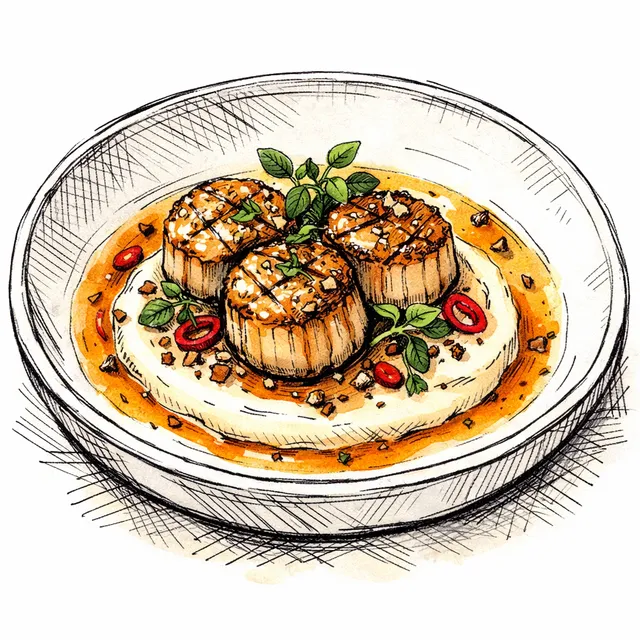
Pan-Seared Hokkaido Scallops with Aji Limo-Pisco Pan Reduction and Brown Butter Cauliflower Silk
When I was cooking my way through Lima, I fell hard for Nikkei cuisine—that brilliant, historic collision of Japanese precision and Peruvian soul. This dish is a love letter to those flavors. I remember sitting at a tiny cevichería counter watching a chef slice raw fish with katana-like focus while splashing bright, fiery aji limo juice across the board. It clicked instantly in my head: the clean umami of a Hokkaido scallop craves that exact electric heat and citrus tang. Here, we sear the scallops hard, then build a pan reduction using floral pisco and tart yuzu right in the caramelized fond. Why this works: pisco brings a grape-forward aroma that cuts through the rich, nutty brown butter and white miso cauliflower silk underneath, bridging the gap between Japanese umami and Peruvian acid. My tip? Don't rush the cauliflower silk; blend it while it is piping hot to get that silk-road smoothness. Jump in, break the rules, and make it your own.
Featured Recipe
Pan-Seared Hokkaido Scallops with Aji Limo-Pisco Pan Reduction and Brown Butter Cauliflower Silk
Plump, caramelized dayboat scallops meet the vibrant, electric heat of Peruvian Nikkei cuisine. A glossy pan reduction of floral pisco, tart yuzu, and minced aji limo is mounted directly into the seared scallop fond, served over a velvety canvas of nutty brown butter and white miso cauliflower silk.
Save a copy to your collection for editing
Timeline
Ingredients
- 16 large sea scallops(about 1.25 lbs / 570g, dry-packed, side muscle removed)
- 1 tsp fine sea salt(divided: 1/2 tsp for cauliflower, 1/2 tsp for scallops)
- 1/4 tsp freshly ground white pepper
- 5 cups cauliflower florets(from 1 medium head, about 500g)
- 1 garlic clove(smashed)
- 5 tbsp unsalted butter(divided: 2 tbsp for cauliflower, 3 tbsp cold cubed for sauce)
- 1.5 tbsp shiro miso(sweet white koji miso)
- 1/4 cup whole milk(warm; can substitute dashi or unsweetened almond milk)
- 2 tbsp neutral cooking oil(avocado oil or grapeseed oil)
- 2 tbsp shallot(finely minced (about 1 small shallot))
- 1 tbsp aji limo or Fresno chile(finely minced, seeds removed for gentle heat)
- 1/4 cup Peruvian Pisco(or dry junmai sake)
- 1/3 cup dashi stock(kombu-bonito dashi or rich vegetable stock)
- 2 tbsp yuzu juice(fresh or 100% bottled unsweetened)
- 1 tbsp shiro shoyu(white soy sauce, or substitute light usukuchi soy sauce)
- 2 tbsp micro cilantro(or finely chiffonaded shiso leaves, for garnish)
- 1/2 tsp fine sea salt(mentioned in step 1 but not explicitly listed in ingredients)
- 3 tbsp unsalted butter(mentioned in step 6 as cold butter for emulsifying the sauce)
Instructions
- 1
Set up a steamer basket over a pot of boiling water. Add 5 cups cauliflower florets, 1 smashed garlic clove, and 1/2 tsp fine sea salt. Cover and steam until the florets are completely tender and pierce effortlessly with a knife.
12 min
Tip: Steam rather than boil so the cauliflower doesn't absorb excess water, ensuring a purée that is intensely rich rather than watery.
- 2
While the cauliflower steams, thoroughly pat 16 large sea scallops dry on all sides using paper towels. Place them on a wire rack and season the top and bottom evenly with the remaining 1/2 tsp fine sea salt and 1/4 tsp freshly ground white pepper. Let them sit uncovered at room temperature to dry out the surface.
5 min
Tip: Surface moisture is the mortal enemy of a crisp crust. A short rest on a wire rack allows surface water to wick away completely before searing.
- 3
Melt 2 tbsp unsalted butter in a small saucepan over medium heat until the milk solids turn hazelnut-brown and smell nutty, about 3 minutes. Drain the steamed cauliflower and transfer to a high-speed blender along with the browned butter, 1.5 tbsp shiro miso, and 1/4 cup whole milk. Blend on high until completely silky and lustrous. Taste, adjust seasoning if needed, and keep warm.
5 min
Tip: The shiro miso adds natural glutamates and a subtle sweetness that mirrors the natural sugars in the scallops.
- 4
Heat 2 tbsp neutral cooking oil in a large 12-inch heavy stainless steel or cast-iron skillet over medium-high heat until faintly smoking. Gently place 16 large sea scallops into the pan flat-side down, leaving ample space between each. Sear undisturbed for 2 minutes until a deep, golden-brown crust forms. Flip and sear the second side for just 1 minute. Immediately transfer scallops to a warm resting plate.
5 min
Tip: Do not move the scallops during the first two minutes; this lets the Maillard reaction build undisturbed while keeping the core translucent.
- 5
Carefully tip the pan and spoon out excess oil, keeping the browned fond stuck to the bottom. Lower the heat to medium. Add 2 tbsp shallot and 1 tbsp aji limo or Fresno chile, sautéing for 1 minute until fragrant. Pour in 1/4 cup Peruvian Pisco to deglaze, vigorously scraping the caramelized fond from the pan with a wooden spoon. Simmer until the pisco reduces by half.
3 min
Tip: Pisco's floral grape esters latch onto the savory fond proteins, dissolving flavor compounds that water alone cannot release.
- 6
Add 1/3 cup dashi stock, 2 tbsp yuzu juice, and 1 tbsp shiro shoyu to the skillet. Bring to a rapid simmer for about 2 minutes until the liquid reduces to a syrupy glaze that coats the back of a spoon. Pull the pan completely off the heat and aggressively whisk in cold 3 tbsp unsalted butter, one cube at a time, until the sauce transforms into a glossy, emulsified nappe reduction.
3 min
Tip: Taking the pan off the heat is crucial before adding butter; excessive heat will break the delicate fat-in-water emulsion.
- 7
Spoon warm brown butter-miso cauliflower silk onto four shallow dinner bowls or plates, smoothing the center with the back of a warm spoon. Arrange four seared scallops atop each mound. Spoon the glossy aji limo-pisco pan reduction over and around the scallops, then crown with 2 tbsp micro cilantro.
3 min
Tip: Serve immediately while the scallop crust remains crisp and the pan reduction is warm and glossy.
Chef's Notes
Why this works: Scallops are loaded with glycine, an amino acid that provides their signature sweetness and caramelizes rapidly when heated properly. However, if they contain excess moisture, they steam rather than sear, leaving you with rubbery texture and zero crust. Always seek out 'dry' scallops—chemical-free and untreated with sodium tripolyphosphate. In this dish, we bridge classic French saucier technique with Lima's Nikkei traditions: searing hard to build fond, deglazing with aromatic Peruvian Pisco (whose alcohol evaporates while capturing volatile aromatics), and reducing it down with kombu dashi and tart yuzu. Mounting cold butter off the heat (monter au beurre) creates a velvety emulsion that wraps around the tongue, balancing the bright heat of the aji limo against the deep umami of the miso cauliflower silk.

Kenji Nakamura
Where Japanese precision meets global flavors
I trained in Tokyo for eight years, mastering the discipline of washoku—traditional Japanese cuisine. But I got restless. So I cooked my way through Southeast Asia, spent a year in Mexico City, and fell hard for the food of Peru. Now I see connections between cuisines that others miss: the umami in dashi and fish sauce, the heat in shishito and Szechuan peppercorns, the way Japanese technique can unlock flavors from any tradition. I'm always fermenting something.