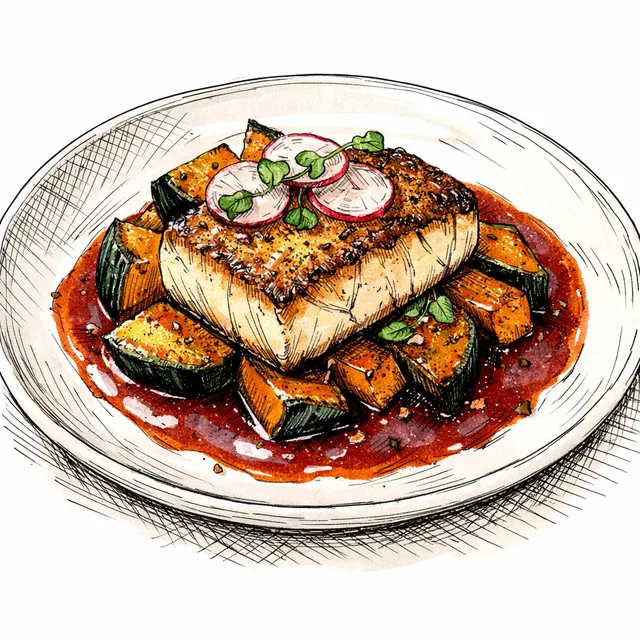
Pan-Seared Pacific Halibut with Caramelized Kabocha & Guajillo-Miso Reduction
When I was living in Mexico City, I became obsessed with the deep, fruity heat of guajillo chiles. One rainy afternoon, staring at a wedge of kabocha squash and a tub of shiro miso I had brought from Tokyo, it hit me. The natural sweetness of the squash needed the earthy punch of the chile, and miso was the ultimate bridge to tie them together. That fusion birthed this dish. This pan-seared Pacific halibut with caramelized kabocha and a guajillo-miso reduction is special to me because it proves that borders in the kitchen are entirely fictional. Why this works: the gentle umami of the white miso softens the sharper edges of the guajillo, while mounting the pan sauce with ice-cold butter at the very end creates an emulsion that clings to the fish like velvet. My tip for making it your own? Don't stress if you can't find halibut—any firm, thick white fish will happily take on this flavor bath. Now, get that skillet hot and go break some rules.
Featured Recipe
Pan-Seared Pacific Halibut with Caramelized Kabocha & Guajillo-Miso Reduction
Crisp, golden-crusted Pacific halibut paired with tender, deeply caramelized kabocha squash crescents. An elegant weeknight dinner brought together by a rapid pan reduction of smoky guajillo chile, sweet shiro miso, and dry sake mounted with cold butter.
Save a copy to your collection for editing
Timeline
Ingredients
- 4 fillets Pacific halibut fillets(skinless, about 6 oz each, patted bone-dry)
- 1/2 small squash Kabocha squash(about 1 lb, seeded and cut into 1/2-inch crescents with peel left on)
- 1.5 tsp Kosher salt(divided)
- 0.5 tsp Ground white pepper(freshly ground preferred)
- 2 tbsp Avocado oil(or any high-smoke-point neutral oil, divided)
- 1 Dried guajillo chile(stemmed, seeded, and finely minced)
- 2 tbsp Shiro miso(sweet white fermented soybean paste)
- 0.25 cup Dry sake(such as junmai)
- 0.5 cup Kombu dashi(or low-sodium dashi stock)
- 1 tbsp Mirin(hon-mirin preferred)
- 3 tbsp Unsalted butter(chilled and cut into small cubes)
- 1 tsp Yuzu juice(or fresh Meyer lemon juice)
- 2 Scallions(thinly sliced on a steep bias)
- 4 Fresh shiso leaves(rolled and sliced into fine ribbons)
Instructions
- 1
Prep your hero squash and fish. Halve, seed, and slice 1/2 small squash Kabocha squash into 1/2-inch crescents (keep that gorgeous green skin on!). Season the squash with 0.5 tsp Kosher salt. Pat 4 fillets Pacific halibut fillets thoroughly dry with paper towels, then season both sides evenly with 1 tsp Kosher salt and 0.5 tsp Ground white pepper. Let the fish sit at room temperature for 10 minutes to temper so it cooks evenly.
5 min
Tip: Keeping the peel on the kabocha isn't just a time-saver—it holds the squash's structural integrity during searing and packs an earthy, mineral contrast to its sweet flesh.
- 2
While the fish tempers, combine 0.5 cup Kombu dashi, 0.25 cup Dry sake, 2 tbsp Shiro miso, 1 tbsp Mirin, and 1 Dried guajillo chile in a small bowl. Whisk vigorously until the miso is completely dissolved and no clumps remain. Set the mixture right next to your stovetop.
4 min
Tip: Whisking the miso into the liquids beforehand prevents scorched paste when you deglaze, ensuring an effortlessly silky emulsion later.
- 3
Heat 1 tbsp Avocado oil in a large 12-inch stainless steel or cast-iron skillet over medium-high heat until shimmering. Lay the kabocha crescents flat in a single layer. Sear undisturbed for 3 to 4 minutes until deeply browned on the bottom, flip, reduce heat to medium, cover with a lid or foil, and cook another 3 minutes until tender when pierced with a cake tester. Transfer the kabocha to a warm serving platter.
8 min
Tip: Covering the pan creates steam trapped with searing heat, cooking the interior of the dense squash through without drying out the edges.
- 4
Wipe out any charred bits, leaving the fond, and return skillet to medium-high heat with the remaining 1 tbsp Avocado oil. When oil just starts to whisper with smoke, lay the 4 fillets Pacific halibut fillets into the pan away from you. Sear undisturbed for 4 minutes until a crisp, pale-golden crust releases naturally from the surface. Gently flip and sear the second side for 2 minutes until just cooked through to 130°F (54°C). Transfer the fish alongside the kabocha to rest.
7 min
Tip: Resist the urge to nudge the fish early. The Maillard reaction will naturally release the proteins from the metal once a crisp crust has set.
- 5
Carefully tilt the skillet and spoon out any excess pooling oil, keeping all the golden browned fond stuck to the bottom. Pour the prepared guajillo-miso-sake mixture into the hot pan. Bring immediately to a hard boil over medium-high heat, scraping the bottom with a wooden spoon to melt that savory crust into the liquid. Simmer briskly for 3 minutes until reduced by half into a glossy, bubbling reduction.
4 min
Tip: Reducing the sake drives off harsh ethanol while concentrating the glutamates and natural sugars of the rice into a sticky glaze base.
- 6
Take the skillet completely off the heat. Immediately add 3 tbsp Unsalted butter one cube at a time, swirling and whisking constantly until the cold fat melts and emulsifies into a velvety, creamy glaze. Whisk in 1 tsp Yuzu juice. Spoon the warm reduction over the seared halibut and caramelized kabocha, then finish with 2 Scallions and 4 leaves Fresh shiso leaves.
3 min
Tip: Keep the pan off the burner while mounting the butter; excessive heat will break the emulsion into separated oil instead of a silky sheen.
Chef's Notes
Why this works: Kabocha squash is exceptionally dense in starch and natural sugars compared to watery butternut or acorn squashes. When seared in high-heat oil, its cut faces caramelize rapidly via pyrolysis and Maillard reactions, producing nutty, roasted undertones that mimic roasted chestnuts. Pacific halibut is lean and delicate, which means it thrives when paired with big glutamate richness. Enter the reduction: toasted Mexican guajillo chile brings dried-apricot sweetness and mild tannins, cutting through the rich butter mount, while Japanese shiro miso brings fermented savory funk. Mounting cold butter off-heat into the reduced sake and dashi creates a classic French pan emulsion (beurre blanc style), capturing every bit of fond left behind by both squash and fish.

Kenji Nakamura
Where Japanese precision meets global flavors
I trained in Tokyo for eight years, mastering the discipline of washoku—traditional Japanese cuisine. But I got restless. So I cooked my way through Southeast Asia, spent a year in Mexico City, and fell hard for the food of Peru. Now I see connections between cuisines that others miss: the umami in dashi and fish sauce, the heat in shishito and Szechuan peppercorns, the way Japanese technique can unlock flavors from any tradition. I'm always fermenting something.