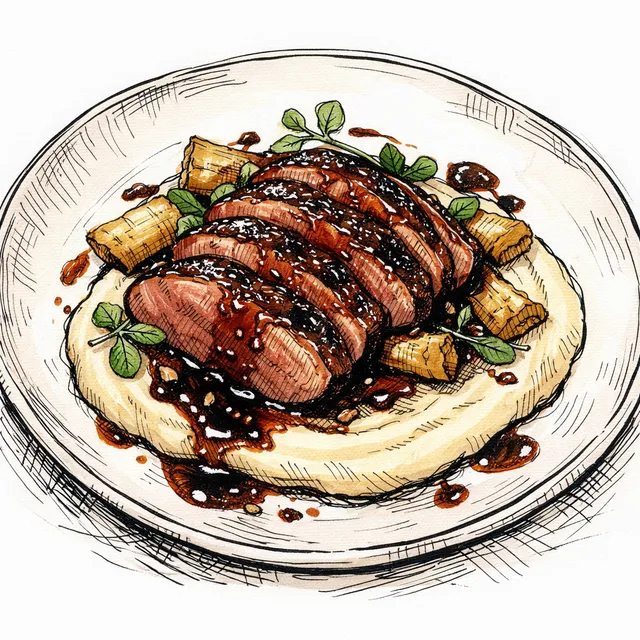
Pasilla & Red Miso-Glazed Duck Breast with Brown Butter Parsnip Silk
When I was staging in Oaxaca, I became obsessed with the fruity, raisin-like smoke of dried pasilla chiles. Sitting in a mezcal bar one night, biting into a charred tlayuda, my brain did what it always does: it bridged continents. I wondered how that brooding Mexican heat would play with the deep, funky umami of the red miso paste sitting in my fridge back in Tokyo. That spark became this dish.
Here is why this works: red miso is packed with glutamates, while pasilla chiles bring natural sugars and complex fruitiness. When you reduce them together into a glaze and brush it over a slow-rendered duck breast, the sugars caramelize into an incredible mahogany crust. Pair that with a parsnip silk enriched with nutty brown butter, and you have magic.
Why is this special to me? It represents my entire culinary philosophy on a single plate—Japanese technical precision meeting the bold soul of global flavors. If you want to make it your own, swap the parsnips for celeriac or toss a splash of mirin into the glaze. Don't be precious with it; cook, taste, and break the rules.
Featured Recipe
Pasilla & Red Miso-Glazed Duck Breast with Brown Butter Parsnip Silk
Crisp-skinned, slow-rendered duck breasts painted with a savory-sweet pasilla chile and red miso lacquer, resting atop velvety brown butter parsnip purée. It's the ultimate dinner party centerpiece where Tokyo precision lacquer meets the brooding, dried-fruit depth of Mexican dried chiles.
Save a copy to your collection for editing
Timeline
Ingredients
- 2 duck breasts(boneless, skin-on, about 8 oz each)
- 1 dried pasilla chile(stemmed, seeded, and torn into pieces)
- 3 tbsp aka miso (red miso)(aged fermented red soybean paste)
- 2 tbsp mirin(Japanese sweet rice wine)
- 2 tbsp sake(dry junmai sake)
- 1 tbsp light brown sugar
- 1 tsp toasted sesame oil
- 1 tsp fresh lime juice(freshly squeezed)
- 1 lb parsnips(peeled and sliced into 1/2-inch coins)
- 1 cup whole milk
- 3 tbsp unsalted butter
- 1.5 tsp kosher salt(divided)
- 6 oz maitake mushrooms(pulled into bite-sized clusters)
- 2 tbsp scallions(thinly sliced on a bias)
- 3 tablespoons boiling water(for steeping the chile)
- 1 tablespoon rendered duck fat(for cooking mushrooms)
Instructions
- 1
Place 1 lb parsnips, 1 cup whole milk, and 0.5 tsp kosher salt into a medium saucepan. Bring to a gentle simmer over medium-low heat, cover partially, and cook until the parsnips are knife-tender, about 15 minutes.
15 min
Tip: Watch the heat carefully so the milk doesn't scorch or boil over. Simmering in dairy tenderizes parsnip pectins while enriching them with natural sweetness.
- 2
While parsnips cook, place 1 dried pasilla chile in a small bowl with 3 tablespoons boiling water; steep for 5 minutes until soft. Transfer the rehydrated chile and its soaking water to a blender cup along with 3 tbsp aka miso (red miso), 2 tbsp mirin, 2 tbsp sake, 1 tbsp light brown sugar, 1 tsp toasted sesame oil, and 1 tsp fresh lime juice. Blend until glossy and completely smooth.
7 min
Tip: Pasilla chiles bring dried raisin and cocoa undertones that amplify the deep, funky amino acids in aged red miso without blowing out your palate with raw heat.
- 3
Pat 2 duck breasts dry with paper towels. Using a sharp knife, score the skin in a tight 1/4-inch diamond crosshatch pattern, cutting just through the fat cap without nicking the flesh underneath. Season both sides with 0.5 tsp kosher salt.
4 min
Tip: Scoring creates micro-channels that allow subcutaneous fat to escape and baste the skin continuously during the cold-pan render.
- 4
Melt 3 tbsp unsalted butter in a small skillet over medium heat until the foaming subsides and milk solids turn golden amber with a hazelnut aroma, about 3 minutes. Drain the tender parsnips (reserving 2 tablespoons warm milk) and transfer to a blender with the browned butter, reserved milk, and 0.25 tsp kosher salt. Purée on high until silky and smooth, then keep warm in the covered pot.
6 min
Tip: Brown butter introduces nutty lactones that bridge the sweet starch of root vegetables with the rich gaminess of duck fat.
- 5
Place scored 2 duck breasts skin-side down into a cold, dry, heavy cast-iron skillet. Set the heat to medium-low and render undisturbed for 10 to 12 minutes, spooning off pooling duck fat every few minutes to a heatproof ramekin, until the skin turns deep mahogany and ultra-crisp.
12 min
Tip: Starting in a cold pan is non-negotiable food science: it renders maximum subcutaneous fat before the muscle proteins contract, preventing rubbery skin.
- 6
Heat a separate skillet over medium-high heat with 1 tablespoon of the rendered duck fat from the duck pan. Add 6 oz maitake mushrooms and remaining 0.25 tsp kosher salt. Sear undisturbed for 3 minutes until crisp and edges are deeply browned, then toss and cook 2 minutes more. Remove from heat.
5 min
Tip: Maitake absorbs duck fat like a sponge, developing crispy frills that give textural contrast against the velvet parsnip silk.
- 7
Flip 2 duck breasts flesh-side down in the cast-iron pan for 1 minute. Brush the crispy skin generously with 2 tablespoons of the prepared pasilla-miso glaze. Flip the duck back skin-side down for 30 to 45 seconds to aggressively lacquer and caramelize the glaze, then remove from the pan immediately to prevent scorching.
3 min
Tip: Miso sugars burn quickly above 330 degrees F, so watch for rapid bubbling and blistering. You want caramelized toffee notes, not acrid carbon.
- 8
Transfer duck to a warm cutting board and spoon 1 more tablespoon of the pasilla-miso glaze over the hot skin. Let rest for 6 minutes so internal juices redistribute throughout the muscle fibers.
6 min
Tip: Resting equalizes the internal pressure gradient, ensuring a perfect rosy medium-rare throughout with zero moisture pooling on your cutting board.
- 9
Carve each duck breast against the grain on a 45-degree bias into 1/3-inch thick slices. Swoosh a generous pool of warm brown butter parsnip purée onto dinner plates, fan the sliced duck over the top, arrange charred maitake clusters alongside, and garnish with 2 tbsp scallions.
4 min
Tip: Cutting on a sharp bias maximizes surface area against your palate, delivering the crisp miso-lacquered crust and tender meat in equal proportion.
Chef's Notes
Why this works: Pasilla chiles are the dried form of chilaca chiles, famous in mole for their dark, raisin-like earthiness. When married to aka miso (red miso), which has undergone long-term microbial fermentation and Maillard browning in cedar vats, you unlock massive glutamic acid synergies. The slow-rendered duck breast provides luscious rendered lipids that mellow out the intensity, while the nutty brown butter parsnips ground the whole plate with velvety comfort.

Kenji Nakamura
Where Japanese precision meets global flavors
I trained in Tokyo for eight years, mastering the discipline of washoku—traditional Japanese cuisine. But I got restless. So I cooked my way through Southeast Asia, spent a year in Mexico City, and fell hard for the food of Peru. Now I see connections between cuisines that others miss: the umami in dashi and fish sauce, the heat in shishito and Szechuan peppercorns, the way Japanese technique can unlock flavors from any tradition. I'm always fermenting something.