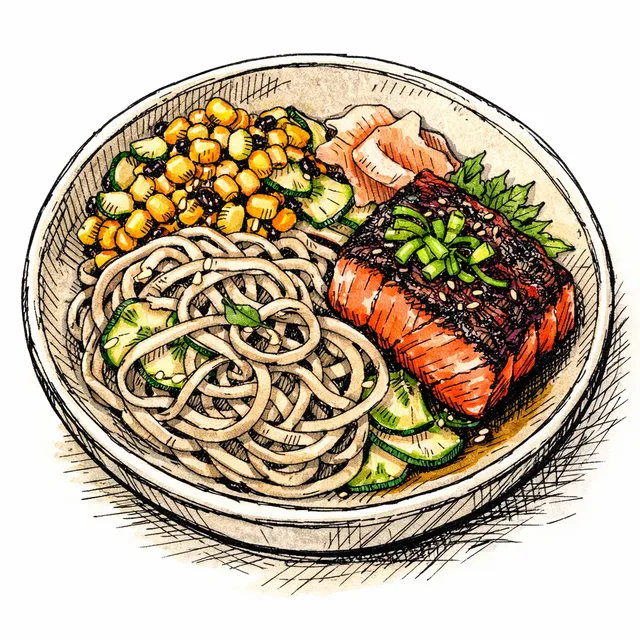
Pasilla and Red Shiso-Cured Seared King Salmon Bowl
Ever stare at a jar of dried pasilla chiles and a bag of salted red shiso leaves and wonder what happens if they collide? That is how this bowl was born. I was sitting in my cramped Tokyo apartment years ago, missing the earthy, dried-fruit smoke of Mexican markets while snacking on my neighbor's homemade shiso pickles. Bam. Lightbulb. Why this works is all about bridging distant culinary DNA: the deep, prune-like smoke of the pasilla acts like a dry-brine, pulling moisture out of the king salmon while infusing it with complex heat, while the shiso provides an anise-like brightness that cuts right through the rich, buttery fat of the fish. Quick-cure it for just fifteen minutes—trust me, any longer and you lose that silky sashimi-grade core when you hard-sear it tataki-style. Slide that gorgeous crusted salmon over chilled soba noodles tossed in citrus ponzu, and add a sweet charred corn sunomono for crunch. Want to make it your own? Swap the corn for grilled peaches if they are in season. Go break some rules in the kitchen today!
Featured Recipe
Pasilla & Red Shiso-Cured Seared King Salmon Bowl with Chilled Soba and Charred Corn Sunomono
A vibrant midday lunch bowl showcasing wild king salmon quick-cured in ground pasilla chile and red shiso, hard-seared tataki-style to retain a buttery, sashmi-grade core. Served over chilled buckwheat soba tossed in a citrus ponzu, alongside sweet charred corn and crunchy edamame sunomono.
Save a copy to your collection for editing
Timeline
Ingredients
- 1 lb skinless wild-caught king salmon fillet(center-cut, pin bones removed)
- 1.5 tbsp ground pasilla chile(finely ground dried pasilla)
- 1 tbsp yukari(Japanese dried red shiso leaf flakes)
- 1 tbsp kosher salt(fine sea salt or Diamond Crystal kosher)
- 1 tbsp turbinado sugar(or raw cane sugar)
- 8 oz buckwheat soba noodles(dried 100% or high-ratio buckwheat noodles)
- 2 tbsp neutral high-heat oil(avocado or grapeseed oil, divided)
- 1 cup fresh sweet corn kernels(shucked from about 1 ear)
- 0.75 cup shelled edamame(thawed if frozen)
- 1 cup Persian cucumber(thinly sliced into half-moons)
- 3 tbsp rice vinegar(unseasoned)
- 2 tbsp white shoyu(or light Japanese soy sauce)
- 2 tbsp fresh lime juice(strained)
- 1.5 tbsp toasted sesame oil(unrefined)
- 1 tsp freshly grated ginger(finely microplaned)
- 1 ripe Hass avocado(pitted and sliced)
- 1 tbsp toasted white and black sesame seeds(for garnish)
- 0.25 cup fresh cilantro leaves(or micro red shiso, for garnish)
- 1 pinch salt(Added in step 3 to the cucumber mixture)
Instructions
- 1
In a small bowl, whisk together 1.5 tbsp ground pasilla chile, 1 tbsp yukari, 1 tbsp kosher salt, and 1 tbsp turbinado sugar. Coat all sides of 1 lb skinless wild-caught king salmon fillet evenly with the cure, pressing lightly so it adheres. Place on a wire rack over a small sheet pan and let rest at room temperature to cure for 15 minutes.
15 min
Tip: The pasilla provides raisin-like smoke and mild earthy warmth, while the yukari delivers tart, floral acidity. This 15-minute window draws out surface moisture and tightens the flesh without drying out the interior.
- 2
Bring a medium pot of unsalted water to a rapid rolling boil. Add 8 oz buckwheat soba noodles and cook according to package instructions, about 4 to 5 minutes, stirring occasionally with chopsticks to prevent sticking.
7 min
Tip: Buckwheat soba requires plenty of boiling water so the starch doesn't turn gummy. Keep it at a steady simmer.
- 3
Heat a heavy skillet over medium-high heat with 1 tsp neutral high-heat oil. Add 1 cup fresh sweet corn kernels and blister undisturbed for 2 minutes until lightly charred. Toss in 0.75 cup shelled edamame and heat through for 1 minute. Remove from heat, transfer to a mixing bowl, and fold in 1 cup Persian cucumber, 2 tbsp rice vinegar, and a pinch of salt. Set aside to quick-pickle.
6 min
Tip: Charring the corn concentrates sugars while the quick soak in rice vinegar cuts right through the rich salmon fat.
- 4
Drain the cooked soba in a colander and immediately plunge into a bowl of ice water. Vigorously swish and rub the noodles with your hands to wash away surface starch. Drain thoroughly and toss with 0.5 tbsp toasted sesame oil to keep the strands separate.
4 min
Tip: Washing soba in ice water is the cardinal rule of Japanese noodle making; it arrests cooking and gives each strand a springy, toothsome al dente bite.
- 5
In a small glass jar or bowl, whisk together 2 tbsp white shoyu, 2 tbsp fresh lime juice, the remaining 1 tbsp rice vinegar, remaining 1 tbsp toasted sesame oil, and 1 tsp freshly grated ginger until emulsified.
3 min
Tip: White shoyu (shiro shoyu) provides pure wheat-fermented umami without discoloring the pale buckwheat noodles.
- 6
Quickly rinse the salmon under a gentle trickle of cold water to remove excess surface salt, then pat completely dry with paper towels. Heat a cast-iron skillet over high heat until wisps of smoke appear, then add remaining 1.5 tbsp neutral high-heat oil. Lay the cured salmon into the pan and hard-sear without moving for 45 to 60 seconds per side, blistering the crust while keeping the center cool and sashimi-rare. Transfer to a cutting board to rest for 2 minutes, then slice into 1/3-inch thick tataki slices.
5 min
Tip: Make sure your skillet is ripping hot. The cure forms a caramelized, savory bark almost instantly, locking in the luscious, buttery fat of the wild king salmon.
- 7
Toss the chilled soba with half of the citrus ponzu dressing and divide between wide shallow bowls. Top each bowl with the charred corn-edamame sunomono, sliced 1 ripe Hass avocado, and the sliced seared salmon tataki. Drizzle the remaining ponzu over the salmon and avocado. Garnish with 1 tbsp toasted white and black sesame seeds and 0.25 cup fresh cilantro leaves.
4 min
Tip: Serve immediately while the seared edges of the salmon are warm and fragrant against the cool, crisp noodles.
Chef's Notes
WHY THIS WORKS: Wild king salmon is dense, incredibly rich in omega-3 fatty acids, and notoriously delicate when heated too long. By employing an osmosis-driven dry cure with dried red shiso (yukari) and ground pasilla chile for precisely 15 minutes, we pull out water from the salmon's cellular surface, denaturing exterior proteins just enough to lock in juices and concentrate flavor. Pasilla brings roasted dried fruit notes and gentle smoke, while yukari's citric and malic acids naturally cut the rich fat. A smoking-hot, 45-second sear triggers aggressive Maillard reactions on the spice crust while keeping the interior pristine, cool, and melt-in-your-mouth rare. Contrast that with chilled, mineral-rich buckwheat soba and a tart sunomono, and you have the ultimate energizing midday bowl.

Kenji Nakamura
Where Japanese precision meets global flavors
I trained in Tokyo for eight years, mastering the discipline of washoku—traditional Japanese cuisine. But I got restless. So I cooked my way through Southeast Asia, spent a year in Mexico City, and fell hard for the food of Peru. Now I see connections between cuisines that others miss: the umami in dashi and fish sauce, the heat in shishito and Szechuan peppercorns, the way Japanese technique can unlock flavors from any tradition. I'm always fermenting something.