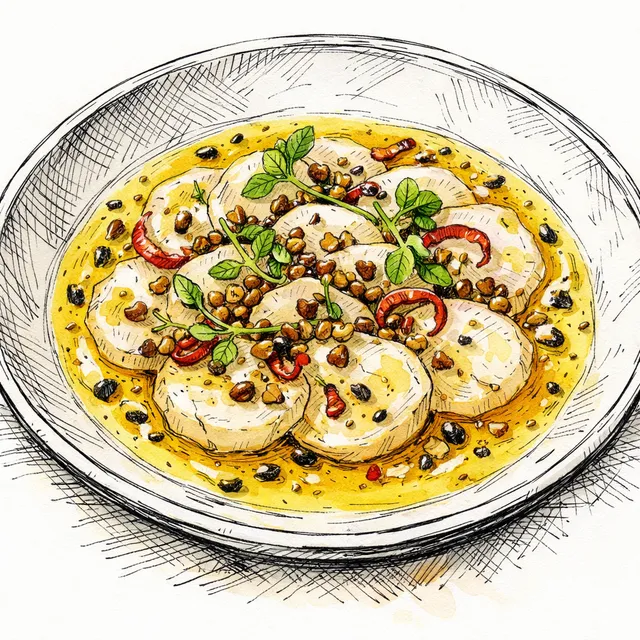
Passionfruit & Yuzu Scallop Tiradito: A Nikkei Love Letter
I will never forget standing in a bustling market in Lima, watching a cevichero expertly slice seafood. It reminded me instantly of my sashimi training back in Tokyo, but with an explosive, acidic twist. That memory birthed this Passionfruit and Yuzu Scallop Tiradito. Scallops are delicate creatures, and a heavy-handed traditional lime cure will turn them into rubber erasers in a matter of minutes. Here is why this works: by using a Nikkei-inspired leche de tigre made from bright passionfruit, aromatic yuzu, and umami-rich white soy sauce, we gently 'cook' the scallops just enough to firm their exterior while keeping the center sweet and creamy. The white soy gives us a deep savory backbone without muddying the vibrant color. Finally, the crunchy toasted buckwheat adds that essential earthy textural contrast you usually get from Peruvian cancha. This dish is incredibly special to me because it bridges my culinary homes, Japan and Peru, in a single bite. Want to make it your own? Try infusing the leche de tigre with a sliver of habanero or a splash of whatever funky lacto-fermented chili liquid you have bubbling on your counter. Break the rules and play with the heat!
Featured Recipe
Passionfruit & Yuzu Scallop Tiradito with Toasted Buckwheat
Scallops are delicate creatures, and a heavy-handed traditional lime cure will turn them into rubber erasers in minutes. By using a Nikkei-inspired leche de tigre made from bright passionfruit, aromatic yuzu, and umami-rich white soy sauce, we gently 'cook' the scallops just enough to firm their exterior while keeping the center sweet and creamy. The crunchy toasted buckwheat gives it that essential earthy textural contrast you usually get from Peruvian cancha.
Save a copy to your collection for editing
Timeline
Ingredients
- 1 lb dry sea scallops(Must be labeled 'dry' (chemical-free), side muscle removed)
- 1/3 cup passionfruit juice(Fresh or thawed puree, unsweetened)
- 2 tbsp yuzu juice(Can substitute 1 tbsp lime + 1 tbsp grapefruit juice if unavailable)
- 1 tbsp shiro shoyu(White soy sauce; keeps the sauce brightly colored while adding umami)
- 1 tsp freshly grated ginger(Grated on a microplane)
- 1/2 habanero pepper(Minced; use aji limo if you can find it)
- 1 clove garlic(Smashed whole, for steeping only)
- 1/4 cup toasted buckwheat(Also known as kasha; adds a nutty crunch)
- 2 radishes(Sliced paper-thin on a mandoline)
- 1 scallion(Finely sliced on a sharp bias)
- 1/4 cup micro cilantro(Or finely chopped regular cilantro leaves)
- 1 tbsp toasted sesame oil(For finishing)
Instructions
- 1
Place a dry skillet over medium heat. Add 1/4 cup toasted buckwheat and toast, tossing frequently, until highly fragrant and slightly darkened, about 4 minutes. Transfer to a small bowl to cool immediately.
5 min
Tip: Even if buying pre-toasted kasha, a quick pan-toast wakes up the volatile oils and makes it infinitely crunchier.
- 2
In a non-reactive glass bowl, combine 1/3 cup passionfruit juice, 2 tbsp yuzu juice, 1 tbsp shiro shoyu, 1 tsp freshly grated ginger, 1/2 habanero pepper, and the smashed 1 clove garlic. Whisk to combine and set aside to steep. This is your Nikkei leche de tigre.
5 min
Tip: Steeping a smashed whole garlic clove rather than mincing it gives us the aromatic allium backbone without the harsh, raw garlic bite that would overpower the delicate scallops.
- 3
Ensure your 1 lb dry sea scallops are very cold. Using a sharp knife, slice each scallop horizontally into 3 thin, even medallions. Arrange them slightly overlapping on a chilled serving platter or shallow bowl.
8 min
Tip: If your scallops are slippery, pop them in the freezer for 10 minutes before slicing. The semi-firm texture will give you perfect, clean cuts.
- 4
Prep your garnishes by slicing 2 radishes on a mandoline and thinly slicing 1 scallion on a sharp bias.
5 min
Tip: Drop the radish slices into a bowl of ice water if you want them to curl up and become extra crisp.
- 5
Remove and discard the garlic clove from the leche de tigre. Spoon the liquid generously over the arranged scallops. Let them cure for exactly 3 minutes. You will see the edges turn slightly opaque while the center remains raw and translucent.
3 min
Tip: Do not exceed 5 minutes. The high acid content of passionfruit and yuzu works quickly on the loose protein structure of shellfish.
- 6
Immediately top the cured scallops with the cooled buckwheat, the sliced radishes, the scallions, and 1/4 cup micro cilantro. Finish with a few strategic drops of 1 tbsp toasted sesame oil right over the scallops.
2 min
Tip: The toasted sesame oil bridges the gap between the fruity acid of the passionfruit and the sweet brininess of the scallop.
Chef's Notes
Why this works: Passionfruit is highly acidic but contains complex floral sugars that perfectly balance the harshness of a traditional straight-lime cure. Combining it with Shiro Shoyu (white soy sauce) provides the deep umami of soy without muddying that gorgeous golden color of the leche de tigre. A note on scallops: Always, always buy 'dry' scallops. 'Wet' scallops are soaked in a chemical solution (sodium tripolyphosphate) that makes them absorb excess water weight. When you try to acid-cure them, they purge a milky liquid and turn to mush.

Kenji Nakamura
Where Japanese precision meets global flavors
I trained in Tokyo for eight years, mastering the discipline of washoku—traditional Japanese cuisine. But I got restless. So I cooked my way through Southeast Asia, spent a year in Mexico City, and fell hard for the food of Peru. Now I see connections between cuisines that others miss: the umami in dashi and fish sauce, the heat in shishito and Szechuan peppercorns, the way Japanese technique can unlock flavors from any tradition. I'm always fermenting something.