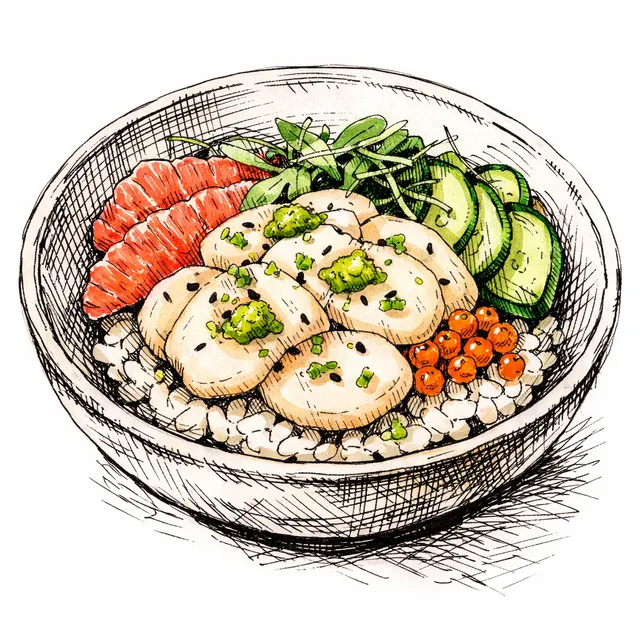
Pink Grapefruit and Green Yuzu Kosho-Cured Hokkaido Scallop Bowl
When I was running a pop-up in Lima, I fell hard for the way Peruvian ceviche and Japanese sashimi spoke the same language. Both respect the fish, both demand precision, and both rely on a heavy hit of acid to wake up the palate. This bowl is a direct love letter to those late nights in Peru. We are quick-curing sweet, velvety Hokkaido scallops in a zesty pink grapefruit and green yuzu kosho leche de tigre. That green yuzu kosho brings a funky, fermented kick that bridges the gap between Andean citrus and Japanese citrus effortlessly. I layer them over nutty, dashi-steamed quinoa, then top everything with quick-pickled fennel sunomono, seared avocado, and toasted sesame. Why this works: the citrus acid lightly denatures the outer protein of the scallop while the interior stays meltingly raw, mirroring the exact texture magic of a great tataki. Want to make it your own? Swap the scallops for firm white fish like flounder, or trade the quinoa for sushi rice if you want to lean fully into the Japanese side of things. Get in there, break the rules, and make it delicious.
Featured Recipe
Pink Grapefruit & Green Yuzu Kosho-Cured Hokkaido Scallop Bowl
Sweet, velvety Hokkaido sea scallops are quick-cured in a zesty pink grapefruit and green yuzu kosho leche de tigre, then layered over nutty dashi-steamed quinoa. Topped with quick-pickled fennel sunomono, seared avocado, and toasted sesame, this bowl is the ultimate bright, umami-loaded Nikkei lunch.
Save a copy to your collection for editing
Timeline
Ingredients
- 1 cup dry white quinoa(rinsed thoroughly)
- 1.75 cups kombu dashi(or cold water steeped with kombu)
- 1.5 tbsp toasted sesame oil(divided)
- 0.75 tsp fine sea salt(divided)
- 1 small fennel bulb(cored and shaved paper-thin on a mandoline)
- 1 Persian cucumber(shaved into paper-thin coins)
- 3 tbsp rice vinegar(unseasoned)
- 1 tbsp mirin
- 0.33 cup fresh pink grapefruit juice(strained of seeds)
- 2 tbsp fresh lime juice
- 1.5 tsp green yuzu kosho(fermented green chili-yuzu paste)
- 1.5 tbsp shiro shoyu(white soy sauce, or standard light soy sauce)
- 0.5 tsp grated fresh ginger(finely microplaned)
- 12 oz sashimi-grade Hokkaido sea scallops(patted dry, side muscles removed)
- 1 firm avocado(pitted, peeled, and sliced into wedges)
- 1 tbsp toasted white and black sesame seeds(for garnish)
- 6 fresh shiso leaves(chiffonade cut, or fresh mint leaves)
Instructions
- 1
In a medium saucepan, combine 1 cup dry white quinoa, 1.75 cups kombu dashi, 0.5 tbsp toasted sesame oil, and 0.25 tsp fine sea salt. Bring to a boil over medium-high heat, cover tightly with a lid, reduce heat to low, and simmer undisturbed for 15 minutes until liquid is absorbed.
18 min
Tip: Cooking quinoa directly in dashi infuses natural glutamic acid straight into the grain, giving you an earthy, umami base instead of bland water-cooked grains.
- 2
Toss 1 small fennel bulb and 1 Persian cucumber with 3 tbsp rice vinegar, 1 tbsp mirin, and 0.25 tsp fine sea salt in a shallow bowl. Massage gently with your fingertips and set aside to quick-pickle.
5 min
Tip: Paper-thin cuts ensure the cell walls break down rapidly in the vinegar solution, creating that crisp sunomono snap in under 10 minutes.
- 3
In a non-reactive ceramic or glass bowl, whisk together 0.33 cup fresh pink grapefruit juice, 2 tbsp fresh lime juice, 1.5 tsp green yuzu kosho, 1.5 tbsp shiro shoyu, and 0.5 tsp grated fresh ginger until the yuzu kosho is thoroughly emulsified.
4 min
Tip: Grapefruit brings softer malic acid and pleasant bitter grapefruit aromatics (nootkatone), mellowing the sharp bite of pure lime juice so the sweet scallop flavor stays front-and-center.
- 4
Slice 12 oz sashimi-grade Hokkaido sea scallops horizontally into 1/3-inch thick discs. Submerge the sliced scallops into the prepared citrus curing liquid, gently folding so every slice is coated. Let cure at cool room temperature for exactly 8 minutes.
8 min
Tip: Watch the clock closely: at 8 minutes, the acid slightly coagulates the outer surface proteins into an opaque, silky bite while preserving a translucent, sweet raw core. Longer than 10 minutes, and the texture turns stringy.
- 5
Heat a heavy cast-iron skillet over medium-high heat with the remaining 1 tbsp toasted sesame oil. Lay 1 firm avocado wedges into the hot pan and sear undisturbed for 90 seconds until a deep golden crust forms. Flip and sear the other side for 60 seconds, then remove from heat and season with remaining 0.25 tsp fine sea salt.
4 min
Tip: Hard-searing avocado creates smoky caramelized notes that anchor the bright acidity of the cured shellfish.
- 6
Remove the lid from the quinoa and fluff vigorously with a fork. Let stand uncovered for 2 minutes to allow trapped steam to escape, preventing the grains from turning soggy.
2 min
Tip: Letting the steam dissipate keeps each grain distinct, ready to drink up the cured scallop juices without clumping.
- 7
Divide the warm dashi quinoa among serving bowls. Arrange the seared avocado wedges and drained fennel-cucumber sunomono around the edges. Lift the citrus-cured scallops from the marinade and fan across the center. Spoon 2 to 3 tablespoons of the residual grapefruit-yuzu marinade over everything, then garnish with 1 tbsp toasted white and black sesame seeds and 6 fresh shiso leaves.
4 min
Tip: The contrast between the warm, nutty grain base and the chilled, acid-snapped scallops is where the magic lives—serve immediately!
Chef's Notes
Why this works: Hokkaido sea scallops (Hotate) boast an exceptionally high concentration of free amino acids—principally glycine, which registers as clean sweetness on our palates. Traditional Peruvian ceviche relies exclusively on harsh lime acid, which can overwhelm the delicate nuance of cold-water scallops. By pairing lime with fresh pink grapefruit, we introduce subtle floral notes and a gentler pH drop, while green yuzu kosho introduces salt, citrus peel oils, and fermented chili capsaicin to denature the scallop's outermost proteins in exactly 8 minutes. Don't skip rinsing your quinoa—it washes away saponins so the kombu dashi can deeply penetrate each grain.

Kenji Nakamura
Where Japanese precision meets global flavors
I trained in Tokyo for eight years, mastering the discipline of washoku—traditional Japanese cuisine. But I got restless. So I cooked my way through Southeast Asia, spent a year in Mexico City, and fell hard for the food of Peru. Now I see connections between cuisines that others miss: the umami in dashi and fish sauce, the heat in shishito and Szechuan peppercorns, the way Japanese technique can unlock flavors from any tradition. I'm always fermenting something.