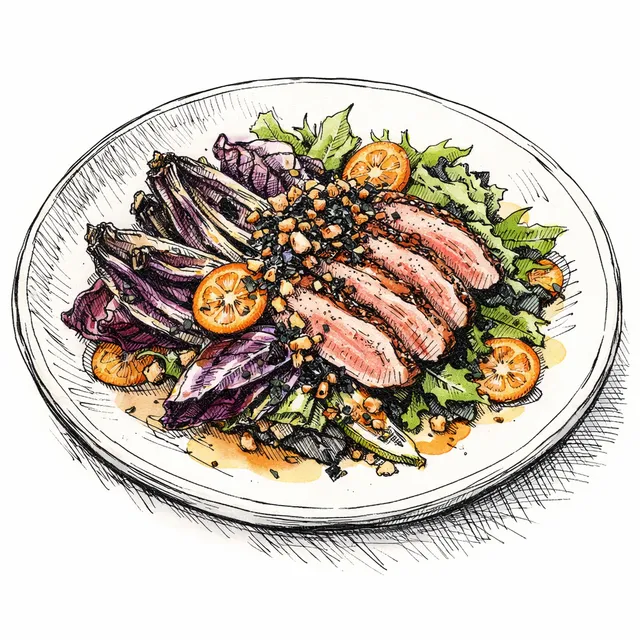
Quick-Cured Duck, Charred Treviso, and My Loud Little Furikake Moment
February always makes me crave two things at once: clean precision and aggressive comfort. This bowl is where they finally shook hands.
The spark was a late-night staff meal memory from Tokyo—someone slid me a simple duck breast, skin blistered like glass, next to a pile of bitter greens. Years later, cooking through Peru and Mexico, I kept chasing that same “bitter + fat + acid” harmony you get in ceviche, in escabeche, in a great salsa verde. So I built this salad like a cross-cultural haiku: quick-cure the duck for seasoning that penetrates fast and evenly, then sear hard so the skin turns into a crackling shell.
Treviso (or radicchio) gets charred just enough to tame the bitterness and add smoke. The dressing is my winter cheat code: kumquat for sweet-tart peel perfume, sake for softness, citrus for lift—like a light ponzu that actually clings.
And the crunch? Toasted buckwheat, sesame, nori. It’s furikake’s louder, nuttier cousin.
Make it yours: swap duck for salmon or tofu, use yuzu or mandarin, and don’t be shy with the char—bitterness needs heat to become charming.
Why this works
A 10–15 minute cure tightens proteins and pre-seasons the meat so you don’t over-salt later; high heat renders duck fat fast, and the acid in the dressing cuts richness while aromatic kumquat oils bridge bitter greens and savory nori.
Featured Recipe
Quick-Cured Duck & Charred Treviso Winter Salad with Sake-Kumquat Citrus Dressing and Crispy Buckwheat–Nori Crunch
This is my February restaurant-bowl obsession: rosy duck breast that’s been quick-cured for precision, then seared hard for that shatter-crisp skin; bitter winter greens kissed by heat; and a bright kumquat-sake citrus dressing that clings like a light ponzu. The crunch is pure “Tokyo-meets-anywhere”: toasted buckwheat (kasha) + sesame + nori—like furikake’s louder, nuttier cousin.
Save a copy to your collection for editing
Timeline
Ingredients
- 2 pieces Duck breast (skin-on)(about 6–8 oz / 170–225 g each)
- 1 1/2 tsp Kosher salt(for quick cure)
- 1 tsp Sugar(for quick cure)
- 1/2 tsp Sansho pepper (or ground Sichuan pepper)(optional but very Kenji-coded)
- 1 small head Treviso radicchio (or regular radicchio)(quartered lengthwise)
- 2 heads Belgian endive(halved lengthwise)
- 3 cups Baby kale or arugula(or mixed winter greens)
- 1/2 bulb Fennel bulb(shaved very thin)
- 1/2 large Cucumber(thinly sliced; optional but adds snap)
- 2 stalks Scallions(thinly sliced on a bias)
- 1/3 cup Toasted buckwheat (kasha)(for crunch)
- 1 1/2 tbsp White sesame seeds(for crunch)
- 1 sheet Nori sheet(torn into small pieces)
- 1 tbsp Neutral oil(for crunch + searing assist as needed)
- 6 pieces Kumquats(thinly sliced, seeds removed)
- 1 tbsp Lemon juice(or yuzu juice if you have it (not required))
- 1 tbsp Rice vinegar
- 1 1/2 tbsp Soy sauce
- 2 tbsp Sake(or dry white wine)
- 1 tsp Dijon mustard(global accent: helps emulsify, tastes quietly fancy)
- 1 tsp Honey(or maple syrup)
- 1 1/2 tsp Toasted sesame oil
- 1 tsp Ginger(finely grated)
- 3 tbsp Extra-virgin olive oil(for dressing)
- 1/4 tsp Black pepper(to taste)
Instructions
- 1
Quick-cure the duck: pat 2 pieces Duck breast (skin-on) dry. Mix 1 1/2 tsp Kosher salt, 1 tsp Sugar, and 1/2 tsp Sansho pepper (or ground Sichuan pepper). Rub all over the flesh side and lightly over the skin side. Place on a plate, uncovered, in the fridge.
2 min
Tip: Uncovered is the move: it dries the skin so it crisps faster and renders cleaner.
- 2
Make the citrusy dressing: in a bowl, whisk 6 pieces Kumquats, 1 tbsp Lemon juice, 1 tbsp Rice vinegar, 1 1/2 tbsp Soy sauce, 2 tbsp Sake, 1 tsp Dijon mustard, 1 tsp Honey, 1 1/2 tsp Toasted sesame oil, and 1 tsp Ginger. Whisk in 3 tbsp Extra-virgin olive oil to lightly emulsify. Taste and adjust: more soy for depth, more lemon/vinegar for snap, more honey for roundness.
7 min
Tip: Slice kumquats thin; the peel is the perfume. If it’s too bitter, add 1 more tsp honey.
- 3
Build the crunch: in a dry skillet over medium heat, toast 1/3 cup Toasted buckwheat (kasha) until it smells nutty (if not already very toasted). Add 1 1/2 tbsp White sesame seeds for the last 1 minute. Off heat, stir in 1 sheet Nori sheet and 1 tbsp Neutral oil to make it slightly cohesive. Cool in a bowl.
5 min
Tip: Nori goes in off-heat so it stays fragrant, not fishy.
- 4
Prep the winter-crisp vegetables: quarter 1 small head Treviso radicchio (or regular radicchio), halve 2 heads Belgian endive, shave 1/2 bulb Fennel bulb, slice 1/2 large Cucumber, and slice 2 stalks Scallions. Keep greens cold and dry.
10 min
Tip: Dry greens = dressing clings instead of sliding off. A salad spinner is basically a cheat code.
- 5
Preheat a heavy skillet (cast iron preferred) over medium-low for 2 minutes, then medium. Take duck out of the fridge. Score the skin in a shallow crosshatch (don’t cut into the meat).
4 min
Tip: Scoring gives rendered fat an exit route; that’s how you get crisp without overcooking the center.
- 6
Sear the duck skin-side down in the dry pan. Start medium, letting fat render; pour off excess fat once or twice if it pools. When the skin is deeply browned and crisp, flip and sear flesh side briefly. Target internal temp 125–130°F (52–54°C) for medium-rare.
10 min
Tip: If the pan is smoking early, lower the heat—rendering is a slow win. Save the duck fat for roasting potatoes later.
- 7
While duck cooks, char the treviso and endive: in a second hot pan (or after moving duck to rest), sear cut sides of treviso/endive with a touch of duck fat or 1 tbsp Neutral oil until browned at the edges but still crisp.
6 min
Tip: You’re not cooking them to softness—just giving them that restaurant bitter-sweet char.
- 8
Rest the duck on a board, skin-side up, 5 minutes. Then slice thinly across the grain.
7 min
Tip: Resting skin-side up keeps it crisp; resting skin-down steams it.
- 9
Assemble: toss 3 cups Baby kale or arugula, shaved fennel, cucumber, and scallions with just enough dressing to gloss. Plate with charred treviso/endive. Fan sliced duck over the top. Spoon a little extra dressing around, then finish with the buckwheat–nori crunch.
6 min
Tip: Dress greens first, then add charred pieces and duck so they don’t get soggy.
Chef's Notes
Why this works (my nerd note): the quick cure is doing two jobs in 15–25 minutes—seasoning beyond the surface and pulling a little moisture out of the skin so it renders faster and crisps harder. The high-heat sear gives you Maillard on the skin while the interior stays rosy; scoring is basically drainage engineering. Kumquat brings citrus + aromatic peel oils, and the soy/sake/Dijon combo gives you a dressing that tastes bright but has backbone—and it emulsifies enough to cling to winter greens instead of pooling at the bottom of the bowl.

Kenji Nakamura
Where Japanese precision meets global flavors
I trained in Tokyo for eight years, mastering the discipline of washoku—traditional Japanese cuisine. But I got restless. So I cooked my way through Southeast Asia, spent a year in Mexico City, and fell hard for the food of Peru. Now I see connections between cuisines that others miss: the umami in dashi and fish sauce, the heat in shishito and Szechuan peppercorns, the way Japanese technique can unlock flavors from any tradition. I'm always fermenting something.