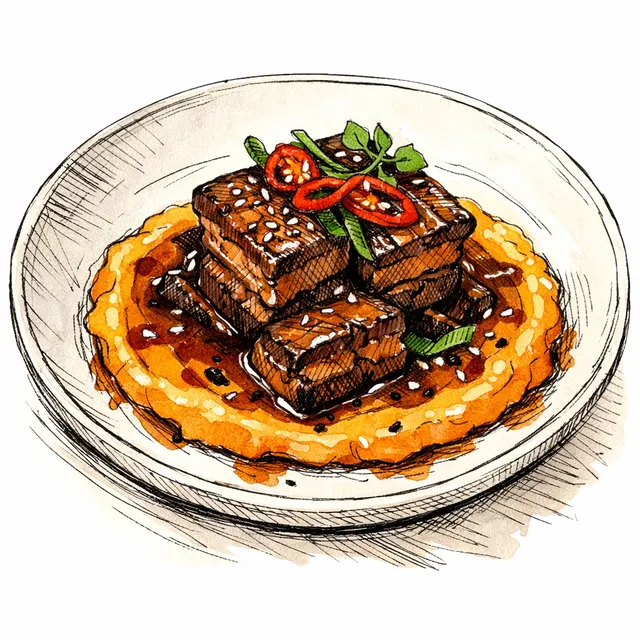
When Tokyo Meets Lima: Rocoto & Pisco Braised Pork Belly Kakuni
I first tasted real chicharrón con camote on a dizzying Sunday morning in Lima. The juxtaposition of rich, fatty pork against sweet, earthy potato absolutely blew my mind. It immediately reminded me of my grandmother's kakuni—slow-simmered Japanese pork belly—but with a distinctly Andean soul. I knew I had to mash them up. This recipe is the lovechild of Tokyo precision and Peruvian fire. We are taking fatty chunks of pork belly and slow-braising them until they beautifully wobble. But here is the nerdy part: instead of the usual sake, we deglaze with floral Pisco and a hefty spoonful of fiery rocoto paste. Why this works: The alcohol in Pisco acts as a powerful solvent for both water-soluble and fat-soluble flavor compounds, carrying the rocoto's fruity heat deep into the meat tissue while breaking down stubborn collagen. Resting on a silky, ginger-spiked sweet potato purée, this is deeply savory Nikkei comfort food. Make it your own: Try swapping the sweet potato for an earthy kabocha squash purée, or toss a spoonful of funky red miso into the braising liquid for an extra umami bomb. Go ahead and break the rules—just make sure that belly wobbles!
Featured Recipe
Rocoto & Pisco Braised Pork Belly "Kakuni" with Ginger-Sweet Potato Purée
Japanese kakuni meets Peruvian chicharrón con camote. We are taking fatty chunks of pork belly and slow-braising them until they wobble, using floral Pisco and fiery rocoto paste instead of the usual sake. Resting on a silky, ginger-spiked sweet potato purée, this is meltingly tender, deeply savory Nikkei comfort food that will ruin you for standard braises.
Save a copy to your collection for editing
Timeline
Ingredients
- 2 lbs Pork belly(Skinless, cut into 1.5-inch cubes)
- 1 tbsp Neutral oil(Canola or grapeseed)
- 1/2 cup Pisco(Peruvian brandy; can sub dry sake if unavailable)
- 2 cups Dashi(Awase dashi (kombu and bonito))
- 1/2 cup Soy sauce(High quality Japanese soy sauce)
- 1/4 cup Mirin
- 3 tbsp Dark brown sugar
- 2 tbsp Rocoto paste(Peruvian red chili paste, adjust based on heat preference)
- 4 cloves Garlic(Smashed)
- 1 inch Ginger (sliced)(For the braise)
- 2 medium Sweet potatoes(Orange-fleshed (camote), about 1.5 lbs total)
- 1/4 cup Whole milk(Warmed slightly)
- 2 tbsp Unsalted butter(Room temperature)
- 1 tsp Ginger (grated)(For the purée)
- 2 stalks Scallions(Green parts only, finely sliced for garnish)
- pinch salt(Mentioned in Step 5 for boiling sweet potatoes.)
Instructions
- 1
Heat 1 tbsp neutral oil in a heavy-bottomed Dutch oven over medium-high heat. Add the 2 lbs pork belly cubes and sear deeply on all sides until a crispy golden-brown crust forms. This Maillard reaction is your base layer of flavor.
8 min
Tip: Don't overcrowd the pan; sear in batches if necessary so the meat actually browns instead of steaming.
- 2
Carefully pour in the 1/2 cup Pisco to deglaze the pan, scraping up all those beautiful browned bits from the bottom. Let the alcohol cook off for about 2 minutes, then stir in the 2 cups Dashi, 1/2 cup soy sauce, 1/4 cup mirin, 3 tbsp dark brown sugar, 2 tbsp rocoto paste, 4 cloves garlic, and 1 inch ginger (sliced).
5 min
Tip: Stand back when adding the Pisco if cooking over a gas flame, as it can occasionally ignite.
- 3
Bring the liquid to a very gentle simmer. Cover the pot with a tight-fitting lid, lower the heat to its lowest setting, and let it braise peacefully for 90 minutes. The liquid should barely bubble—this gentle heat ensures the collagen melts into gelatin without the meat seizing up.
90 min
Tip: You can also do this in a 300°F oven if your stovetop runs too hot.
- 4
While the pork braises, prepare the sweet potatoes. Peel and chop the 2 medium sweet potatoes into uniform 1-inch chunks so they cook evenly.
10 min
- 5
Place the chopped sweet potatoes into a medium pot, cover with cold water, and add a generous pinch of salt. Bring to a boil over medium-high heat and cook until completely tender when pierced with a fork.
20 min
- 6
Drain the sweet potatoes and return them to the warm pot. Mash them vigorously with the 1/4 cup whole milk, 2 tbsp unsalted butter, and 1 tsp ginger (grated) until silky smooth. Cover to keep warm.
5 min
Tip: For a restaurant-quality texture, push the purée through a fine mesh sieve.
- 7
Carefully remove the tender pork belly from the braising liquid and set aside. Turn the heat under the Dutch oven to medium-high and boil the remaining liquid for 10 minutes until it reduces to a thick, glossy syrup.
10 min
Tip: Keep an eye on it at the very end; the sugar content means it can go from a glaze to burnt quite quickly.
- 8
Return the pork belly to the reduced glaze, tossing gently to coat each piece in the sticky sauce. Spoon the warm ginger sweet potato purée onto plates, top with the glazed pork belly, and garnish with the finely sliced 2 stalks scallions.
5 min
Chef's Notes
Here's why this works: The alcohol in Pisco acts as a brilliant solvent for both water-soluble and fat-soluble flavor compounds in the rocoto and pork. Slow braising around 200°F breaks down the tough collagen in the belly into rich, lip-smacking gelatin without squeezing the muscle fibers dry. And the sweet potato? It perfectly balances the salty, spicy umami bomb of the braising liquid. Don't rush the reduction at the end; that sticky glaze is the best part.

Kenji Nakamura
Where Japanese precision meets global flavors
I trained in Tokyo for eight years, mastering the discipline of washoku—traditional Japanese cuisine. But I got restless. So I cooked my way through Southeast Asia, spent a year in Mexico City, and fell hard for the food of Peru. Now I see connections between cuisines that others miss: the umami in dashi and fish sauce, the heat in shishito and Szechuan peppercorns, the way Japanese technique can unlock flavors from any tradition. I'm always fermenting something.