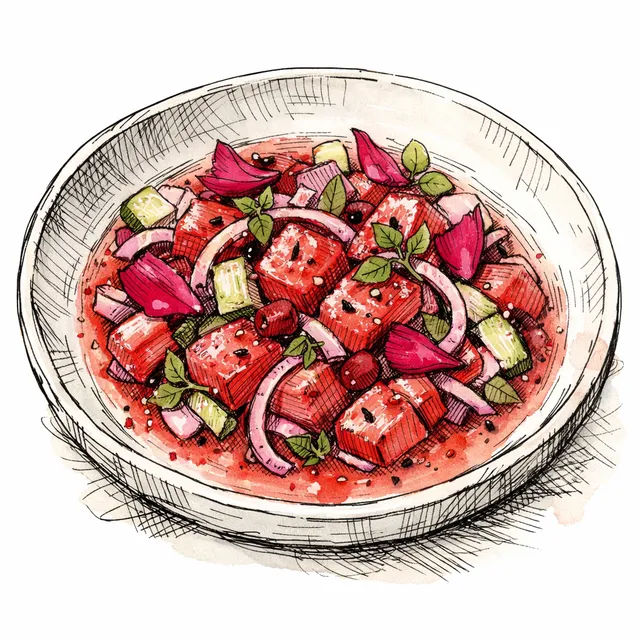
Ruby-Cured Red Snapper Ceviche with Hibiscus & Umeboshi
April in Tokyo brings soft pink cherry blossoms, but my mind is always thousands of miles away in a bustling Oaxaca market, staring at vats of brilliant ruby-red agua de jamaica. Years ago, sweating through a humid Mexican summer, I tasted that tart hibiscus tea and realized it shares the exact same fruity, sour backbone as Japanese umeboshi (pickled plum). I rushed back to my makeshift kitchen, determined to marry the two.
This Ruby-Cured Red Snapper Ceviche is the beautiful result. We use a highly acidic, ice-cold hibiscus and lime tea spiked with mashed umeboshi to quick-cure the fish.
Why this works: The high citric acid from the lime and hibiscus denatures the proteins on the snapper's surface in exactly 4 minutes. It "cooks" the exterior to a firm, opaque pink while the center remains buttery and raw—sharing the DNA of a perfect Japanese tataki. Meanwhile, the umeboshi acts as a salty-sour umami bomb that grounds the floral hibiscus.
Make it your own: Can't find snapper? Sweet sea scallops are incredible here. Want some heat? Toss in finely diced serrano or a smear of yuzu kosho. The rules are just a starting point. Get in there and play!
Featured Recipe
Ruby-Cured Red Snapper Ceviche with Hibiscus & Umeboshi
April means cherry blossoms in Tokyo, but my mind always wanders to the brilliant ruby red of Mexican Jamaica (hibiscus). Here, we're using a highly acidic, ice-cold hibiscus and lime tea spiked with salty-sour umeboshi to quick-cure fresh red snapper. The acid "cooks" the exterior to a firm, opaque pink while leaving the center buttery and raw—an absolute stunner on the plate.
Save a copy to your collection for editing
Timeline
Ingredients
- 1 lb Red snapper fillet(Sushi-grade, skinless, pin bones removed)
- 1/4 cup Dried hibiscus flowers (Jamaica)(Found in Latin markets or tea aisles)
- 1/2 cup Boiling water
- 1/2 cup Fresh lime juice(Chilled)
- 1 tbsp Umeboshi paste(Japanese pickled plum paste)
- 1 tbsp Mirin
- 1 tsp Kosher salt
- 1/2 small Red onion(Thinly sliced)
- 1 whole Serrano pepper(Finely diced (keep seeds for heat))
- 1 whole Avocado(Cubed)
- 2 whole Radishes(Thinly sliced)
- 2 tbsp White sesame seeds
- 1/4 cup Fresh cilantro(Loosely packed)
- 1 tbsp Extra virgin olive oil(A fruity, high-quality finishing oil)
Instructions
- 1
In a small heatproof bowl, combine 1/4 cup dried hibiscus flowers with 1/2 cup boiling water. Let steep for 5 minutes to create a highly concentrated, tart tea.
5 min
Tip: Hibiscus is packed with ascorbic acid, which will work with the lime juice to denature the fish proteins.
- 2
While the hibiscus steeps, cut 1 lb red snapper fillet into 1/2-inch cubes. Thinly slice 1/2 small red onion and 2 whole radishes, dice 1 whole serrano pepper, and cube 1 whole avocado. Keep the snapper in the fridge until needed.
8 min
Tip: A sharp knife is crucial here so you don't bruise the fish. Clean, even cuts ensure an even cure.
- 3
Strain the steeped hibiscus liquid into a metal bowl set over an ice bath (discard the flowers). Whisk in 1/2 cup fresh lime juice, 1 tbsp umeboshi paste, 1 tbsp mirin, and 1 tsp kosher salt. Chill until the liquid is ice-cold.
5 min
Tip: The curing liquid MUST be cold. Warm citrus juice breaks down the fish enzymatically, turning it mushy instead of firming it.
- 4
Add the chilled, diced snapper, sliced red onion, and diced serrano pepper to the ice-cold hibiscus-lime broth. Toss well to combine. Set a timer for exactly 10 minutes.
10 min
Tip: 10 minutes is the holy grail for a 1/2-inch dice of snapper. The edges will turn opaque and pink, while the center remains buttery and translucent.
- 5
While the fish cures, heat a small dry skillet over medium heat. Add 2 tbsp white sesame seeds and toast for 2-3 minutes, tossing frequently, until fragrant and golden. Transfer to a small plate.
3 min
Tip: Toasting brings out the nutty oils, creating a bridge between the fruity hibiscus and the savory fish.
- 6
Using a slotted spoon, divide the cured snapper and onions among shallow serving bowls. Arrange the cubed avocado and sliced radishes around the fish. Spoon about 2-3 tablespoons of the remaining vibrant hibiscus curing liquid over each portion.
3 min
Tip: Don't drown the fish in the plate; you want just enough liquid (leche de tigre) to sip at the end.
- 7
Drizzle each plate with a few drops of 1 tbsp extra virgin olive oil to add richness. Garnish evenly with the toasted sesame seeds and 1/4 cup fresh cilantro. Serve immediately.
2 min
Tip: Serve with crispy tostadas or sturdy plantain chips to scoop up the fish and juices.
Chef's Notes
Let's geek out on acid curing for a second. When you drop raw fish into an acidic environment (like our lime and hibiscus mix), the sudden drop in pH causes the protein strings in the fish to unwind (denature) and bump into each other, linking together. This is why the flesh turns opaque and firm—it's visually identical to what happens when you apply heat! Hibiscus brings ascorbic acid to the party, while lime brings citric acid. Together, they create a rapid, punchy cure that leaves a stunning ruby ring around the fish. Umeboshi (pickled plum) rounds out that sharp acidity with fermented, salty fruitiness. Do not exceed the 10-minute cure, or you'll lose that beautiful raw interior texture!

Kenji Nakamura
Where Japanese precision meets global flavors
I trained in Tokyo for eight years, mastering the discipline of washoku—traditional Japanese cuisine. But I got restless. So I cooked my way through Southeast Asia, spent a year in Mexico City, and fell hard for the food of Peru. Now I see connections between cuisines that others miss: the umami in dashi and fish sauce, the heat in shishito and Szechuan peppercorns, the way Japanese technique can unlock flavors from any tradition. I'm always fermenting something.