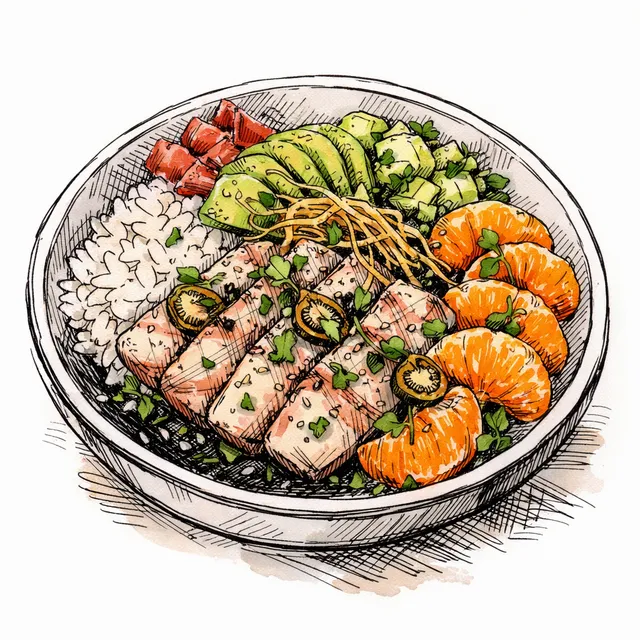
Satsuma Mandarin & Charred Serrano-Cured Yellowtail Kingfish Bowl
When I was working in a tiny, chaotic kitchen in Lima, I fell in love with the effortless dance between raw fish and bright citrus. Years later, sitting in my Tokyo apartment peeling sweet Satsuma mandarins, a lightbulb went off. Why not bridge the gap between Japanese tataki and Peruvian ceviche using seasonal winter citrus? That craving birthed this Satsuma Mandarin and Charred Serrano-Cured Yellowtail Kingfish Bowl. What makes this recipe so special to me is the tension on the palate. We dry-cure the kingfish briefly in mandarin zest and sea salt to firm up the protein and concentrate the umami, then contrast that richness with smoky charred serrano chiles and a punchy mandarin-tamari emulsion. Why this works: the salt gently denatures the fish proteins just like cooking does, but leaves the buttery fat completely intact to melt on your tongue. Tip for making it your own? Don't skip the char on the serranos—that hint of smoke grounds the electric citrus. Grab a jar of something fermenting from your fridge, toss it on top, and break some rules today!
Featured Recipe
Satsuma Mandarin & Charred Serrano-Cured Yellowtail Kingfish Bowl
Buttery slices of yellowtail kingfish dry-cured in aromatic Satsuma mandarin zest and sea salt, paired with smoky charred serrano, creamy avocado, and warm sesame sushi rice. Finished with an electric mandarin-tamari emulsion, this lunch bowl balances luscious rich fat with vibrant citrus acidity.
Save a copy to your collection for editing
Timeline
Ingredients
- 10 oz sashimi-grade yellowtail kingfish loin(skinless, bloodline trimmed)
- 2 Satsuma mandarins(finely zested to yield 1 tsp zest, then juiced to yield 3 tbsp juice)
- 1 tsp fine sea salt
- 0.5 tsp cane sugar
- 1 serrano pepper
- 1 cup short-grain sushi rice(rinsed thoroughly until water runs clear)
- 1.25 cups water(for cooking rice)
- 1.5 tbsp rice vinegar
- 1 tsp toasted sesame oil
- 1 tbsp toasted white sesame seeds
- 1 tbsp fresh lime juice
- 1.5 tbsp white tamari(or light shoyu)
- 0.5 tsp fresh ginger(microplaned)
- 1 ripe Hass avocado(peeled, pitted, and diced)
- 2 watermelon radishes(shaved paper-thin)
- 2 scallions(thinly sliced on a bias)
- 2 tbsp crispy fried shallots(store-bought or homemade)
- 4 fresh shiso leaves(torn into bite-sized shards)
Instructions
- 1
Add 1 cup short-grain sushi rice and 1.25 cups water to a small heavy-bottomed saucepan. Bring to a boil over high heat, cover tightly, reduce heat to low, and cook for 15 minutes. Turn off the heat and let steam undisturbed with the lid on for an additional 5 minutes.
20 min
Tip: Resist the urge to lift the lid while steaming; trapping that trapped steam completes the gelatinization of the starch without making it mushy.
- 2
Hold 1 serrano pepper with tongs directly over an open gas burner (or under a high broiler) for about 3 minutes until blistered and charred in spots. Finely mince half of the charred pepper (seeding if you want lower heat) and cut the remaining half into thin rings for garnish.
3 min
Tip: Charring the skin converts sharp capsicum bite into sweet, smoky depth.
- 3
In a small bowl, combine 1 tsp fine sea salt, 0.5 tsp cane sugar, and 1 tsp Satsuma mandarin zest. Slice 10 oz sashimi-grade yellowtail kingfish loin against the grain into 1/4-inch slices. Rub the cure evenly onto all sides of the fish slices, arrange on a plate, and let cure for 12 minutes at room temperature. Rinse swiftly under ice-cold water to halt surface curing and thoroughly blot dry with paper towels.
15 min
Tip: Do not let it sit beyond 15 minutes; a quick cure draws excess moisture out through osmosis and concentrates savory glutamates without denaturing the tender muscle fibers.
- 4
In a small mixing bowl, whisk 3 tbsp Satsuma mandarin juice, 1 tbsp fresh lime juice, 1.5 tbsp white tamari, 0.5 tsp fresh ginger, and the minced charred serrano until emulsified. Prep the vegetables by dicing 1 ripe Hass avocado, shaving 2 watermelon radishes, and slicing 2 scallions.
6 min
Tip: White tamari brings clean, savory fermented umami without darkening the brilliant amber hue of the citrus dressing.
- 5
Uncover the steamed rice and drizzle in 1.5 tbsp rice vinegar and 1 tsp toasted sesame oil, then sprinkle with 1 tbsp toasted white sesame seeds. Gently cut and fold the rice with a spatula to disperse the seasoning without mashing the grains.
3 min
Tip: Use a slicing motion across the rice to distribute vinegar and oil evenly while fanning slightly to produce that signature glossy sheen.
- 6
Divide the warm seasoned rice between two shallow bowls. Fan the cured yellowtail slices across one side, then nestle the diced 1 ripe Hass avocado and shaved 2 watermelon radishes alongside. Spoon the citrus-tamari dressing generously over the fish and avocado. Garnish with 2 tbsp crispy fried shallots, 2 scallions, charred serrano rings, and 4 fresh shiso leaves.
5 min
Tip: Dressing the fish right before eating ensures the raw texture remains snappy rather than turning chalky like a prolonged ceviche.
Chef's Notes
Why this works: Yellowtail kingfish (Hiramasa) carries substantial intramuscular fat (roughly 12-18%), which makes it luxurious but prone to feeling overly heavy if unmediated. Traditional ceviche introduces heavy acid directly into the flesh for a long soak, which rapidly coagulates and denatures the myosin proteins, turning the exterior milky and rubbery. Instead, we use a hybrid Japanese shime technique: an initial 12-minute dry-cure of mandarin zest, fine salt, and raw sugar. The salt draws out intracellular moisture, firming the texture and intensifying the kingfish's natural sweetness, while the fat-soluble citrus oils from the zest bind directly to the fish's lipids. The sharp acidity is delivered as a finishing emulsion right at the table, slicing through the avocado and rich kingfish fat with clean, explosive brightness.

Kenji Nakamura
Where Japanese precision meets global flavors
I trained in Tokyo for eight years, mastering the discipline of washoku—traditional Japanese cuisine. But I got restless. So I cooked my way through Southeast Asia, spent a year in Mexico City, and fell hard for the food of Peru. Now I see connections between cuisines that others miss: the umami in dashi and fish sauce, the heat in shishito and Szechuan peppercorns, the way Japanese technique can unlock flavors from any tradition. I'm always fermenting something.