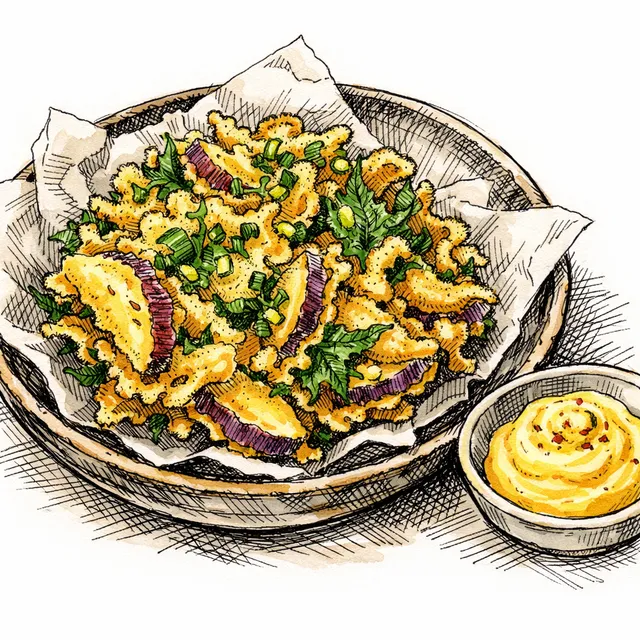
Satsumaimo & Shiso Kakiage with Aji Amarillo Kewpie
I remember standing at a street cart in Lima, eating picarones—sweet potato doughnuts—thinking: this is incredible, but it needs crunch. Fast forward to my Tokyo days, frying kakiage (those shatteringly crisp bird's nests of julienned vegetables), and the connection hit me. Why not bridge these two worlds? Satsumaimo (Japanese sweet potato) has a dense, chestnut-like sweetness that begs for acid and heat. Enter my obsession with Peruvian aji amarillo. Why this works: When you fold this bright, fruity chili paste into rich Kewpie mayo, magic happens. The MSG in the Kewpie amplifies the pepper's floral notes while taming its bite, creating an umami bomb that cuts right through the lacy fried tempura. This recipe is special because it's pure me: Japanese precision meeting chaotic global joy. Want to make it your own? Remember the golden rule of kakiage: keep your batter freezing cold. Drop a literal ice cube in it! This slows gluten formation, giving you a delicate crunch instead of a heavy fritter. Swap the shiso for cilantro if you want to lean into the Latin profile, or toss in some julienned carrots. Just keep that oil steady at 350F and get ready for the ultimate crunchy snack.
Featured Recipe
Satsumaimo & Shiso Kakiage with Aji Amarillo Kewpie
Kakiage is the unsung hero of Japanese tempura—a crispy, shatteringly light bird's nest of julienned vegetables. Here, the dense, chestnut-like sweetness of satsumaimo meets the sunny, fruity heat of Peruvian aji amarillo in a street-food snack that hits every single pleasure center in your brain.
Save a copy to your collection for editing
Timeline
Ingredients
- 1 medium Satsumaimo (Japanese sweet potato)(peeled and cut into thin matchsticks (approx 300g))
- 1/2 medium Red onion(thinly sliced)
- 6 leaves Shiso leaves(roughly chopped (substitute cilantro if needed))
- 1 cup plus 1 tbsp cup Cake flour(divided use (low protein is crucial))
- 1/4 cup Cornstarch
- 2 tbsp Vodka(straight from the freezer)
- 3/4 cup Sparkling water(must be ice-cold)
- 1/2 cup Kewpie mayo
- 2 tbsp Aji Amarillo paste
- 1 tbsp Lime juice(freshly squeezed)
- 1 tsp Shio Koji(liquid or paste)
- 4 cups Neutral oil(for frying (canola, grapeseed, or rice bran))
- 1 tbsp Flaky sea salt(for finishing)
- As needed Aji Amarillo Kewpie(Mentioned as a serving suggestion, but not explicitly in ingredient list.)
Instructions
- 1
In a small bowl, whisk together the 1/2 cup Kewpie mayo, 2 tbsp Aji Amarillo paste, 1 tbsp lime juice, and 1 tsp Shio Koji until smooth. Place in the refrigerator to let the flavors meld.
5 min
Tip: The shio koji acts as an umami amplifier here, bridging the gap between the rich egg yolks in the Kewpie and the bright chili paste.
- 2
In a large mixing bowl, combine the julienned 1 medium Satsumaimo, sliced 1/2 medium red onion, and chopped 6 shiso leaves. Sprinkle with the 1 tbsp cake flour and toss well so the vegetables are lightly and evenly coated.
10 min
Tip: This pre-dusting step is crucial. It gives the tempura batter something to cling to, ensuring your fritter stays together in the hot oil.
- 3
Pour the 4 cups neutral oil into a heavy-bottomed Dutch oven or deep skillet. Place over medium-high heat and attach a deep-fry thermometer. Heat the oil to 350°F (175°C).
15 min
Tip: Keep an eye on the temperature; if the oil drops below 325°F when you add the batter, the fritters will absorb oil and become greasy.
- 4
While the oil heats, make the batter. In a separate bowl, add the remaining 1 cup cake flour and the 1/4 cup cornstarch. Pour in the freezing cold 2 tbsp vodka and 3/4 cup sparkling water. Use chopsticks to barely mix the batter—it should look lumpy and have dry streaks of flour. Do not overmix!
5 min
Tip: Here is the science: vodka evaporates violently in hot oil, creating a shatteringly crisp crust. Keeping the liquids ice-cold and barely mixing prevents gluten development.
- 5
Pour the lumpy tempura batter over the floured vegetables. Fold gently with a spatula just until the vegetables are coated in the wet batter.
2 min
Tip: Work quickly once the wet meets the dry. The longer the batter sits, the heavier the final tempura will be.
- 6
Using a large spoon or a spider skimmer, gently drop roughly 1/4 cup mounds of the coated vegetables into the 350°F oil. Fry 2 to 3 fritters at a time to avoid dropping the oil temperature. Fry for about 2 minutes, carefully flip with tongs, and fry for another 2 minutes until golden and crisp.
15 min
Tip: If the fritters seem to be spreading out too much in the oil, use your tongs or chopsticks to gently nudge the edges back toward the center during the first 10 seconds of frying.
- 7
Transfer the fried kakiage to a wire rack set over a baking sheet to drain. Immediately hit them with the 1 tbsp flaky sea salt while they are still hot and glistening. Serve immediately alongside the chilled Aji Amarillo Kewpie.
2 min
Tip: Never drain tempura on paper towels! The steam gets trapped under the food and ruins that delicate, lacy crunch you just worked so hard for.
Chef's Notes
I've eaten a lot of street food, from the yatai stalls of Fukuoka to the carretillas in Lima. This dish is my love letter to both. Let's talk tempura science for a second: gluten is the absolute enemy of a light, lacy crust. By using low-protein cake flour, ice-cold sparkling water, and a splash of vodka (which evaporates faster than water in the hot oil), we actively inhibit gluten formation and maximize that delicate crunch. Don't overmix your batter; seeing dry pockets of flour is actually exactly what you want. The dip uses one of my favorite tricks: spiking the aji amarillo and mayo with shio koji. It brings a deep, fermented umami backbone to the bright, fruity heat of the chili, turning a simple mayo into a wildly addictive sauce.

Kenji Nakamura
Where Japanese precision meets global flavors
I trained in Tokyo for eight years, mastering the discipline of washoku—traditional Japanese cuisine. But I got restless. So I cooked my way through Southeast Asia, spent a year in Mexico City, and fell hard for the food of Peru. Now I see connections between cuisines that others miss: the umami in dashi and fish sauce, the heat in shishito and Szechuan peppercorns, the way Japanese technique can unlock flavors from any tradition. I'm always fermenting something.