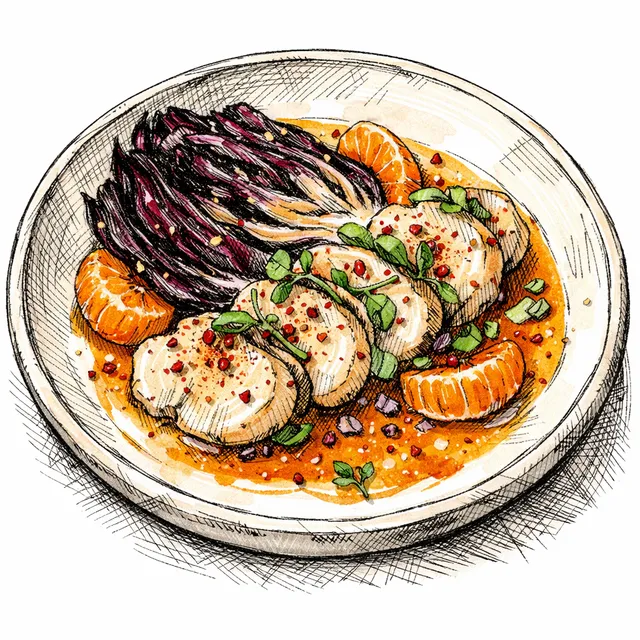
Scallop Tataki, Winter Clean Heat: Shio-Koji Cure, Charred Radicchio, Tangerine–Shoyu, Gochugaru
Winter always makes me crave food that’s sharp and awake—warm, but not heavy. This dish was born from that craving, plus the way my brain keeps cross-referencing cuisines like a messy notebook. In Tokyo I learned tataki as pure restraint: kiss the outside with fire, protect the center. Years later in Seoul, gochugaru taught me a different kind of restraint—heat that blooms and lingers without screaming.
The trick here is the shio-koji quick cure. It’s my precision tool: a 10–15 minute cure seasons the scallops evenly and nudges the proteins so they brown faster. That means you can sear hard enough to get that caramelized shell, but still land on a barely-there center. I first cooked a version of this after a long, freezing service—standing over a ripping-hot pan, smelling the first Maillard notes hit the air, I felt my shoulders drop.
Charred radicchio brings bitter smoke, and the tangerine–shoyu emulsion turns glossy and clingy—sweet, salty, and electric with gochugaru.
Make it yours: swap tangerine for yuzu or blood orange, add a spoon of chili crisp, or cure the scallops with miso if you want deeper funk. Rules are just seasoning—use them, then break them.
Featured Recipe
Scallop Tataki with Shio-Koji Quick Cure, Charred Radicchio, and Tangerine–Shoyu Emulsion (with Gochugaru Heat)
This is my winter “clean heat” dinner: sweet, briny scallops quickly cured for precision, then hard-seared tataki-style so you get a caramelized shell and a barely-just-there center. I plate them on bitter charred radicchio and drag everything through a glossy tangerine–shoyu emulsion spiked with gochugaru for a bright, lingering burn. It’s Japanese technique wearing a global chili jacket—sharp, high-contrast, and insanely satisfying.
Save a copy to your collection for editing
Ingredients
- 12 pieces Dry sea scallops (U10–U15), side muscle removed(About 1 to 1 1/4 lb (450–560 g) total)
- 2 1/2 tbsp Shio koji(For quick cure; if very thick, loosen with 1 tsp water)
- 1/4 tsp Kosher salt(Only if your shio koji is mild; optional)
- 2 tbsp Neutral oil (grapeseed, rice bran, or canola)
- 1 tbsp Unsalted butter(For basting (optional but great))
- 1 head Radicchio, quartered into wedges(Or 2 small heads)
- 2 pieces Scallions, cut into 2-inch lengths(For quick char + aromatic bite)
- 1 tsp Toasted sesame oil(Finishing aroma; don’t cook it hard)
- 1/4 cup Tangerine juice(Fresh; clementine/mandarin works too)
- 1 tsp Tangerine zest(Microplane)
- 2 tbsp Soy sauce (regular or light)
- 1 1/2 tbsp Rice vinegar(Adds snap and keeps the sauce clean)
- 1 tsp Dijon mustard(My “secret” emulsifier; not traditional, very effective)
- 3 tbsp Neutral oil (for emulsion)(Add slowly to build gloss)
- 1 1/2 tsp Gochugaru (Korean red pepper flakes)(Adjust to heat tolerance)
- 1 tsp Fresh ginger, finely grated(Optional but nice for winter brightness)
- 1/2 tsp Black pepper, freshly ground
- 2 tbsp Chives or shiso, sliced(For a clean green finish)
- to taste Flaky salt(Finish only if needed after saucing)
Instructions
- 1
Quick cure the scallops: Pat scallops 12 pieces Dry sea scallops (U10–U15), side muscle removed very dry. In a bowl, coat them evenly with 2 1/2 tbsp Shio koji (and the optional pinch of 1/4 tsp Kosher salt only if your shio koji tastes mild). Cure in the fridge for 12–18 minutes.
18 min
Tip: Why this timing: ~15 minutes tightens the surface proteins and seasons the exterior without turning the scallop hammy. Past ~25 minutes, the texture can get a little bouncy—still tasty, but less “tataki clean.”
- 2
Build the tangerine–shoyu emulsion: In a small bowl, whisk 1/4 cup Tangerine juice, 1 tsp Tangerine zest, 2 tbsp Soy sauce (regular or light), 1 1/2 tbsp Rice vinegar, 1 tsp Dijon mustard, 1 1/2 tsp Gochugaru (Korean red pepper flakes), 1 tsp Fresh ginger, finely grated (if using), and 1/2 tsp Black pepper, freshly ground. While whisking, slowly stream in 3 tbsp Neutral oil (for emulsion) until glossy and lightly thickened. Taste and adjust: more vinegar for snap, more soy for depth, more gochugaru for heat.
6 min
Tip: Dijon gives you a stable emulsion so the sauce clings to scallops instead of sliding off—this is the ‘precision’ part that makes the whole dish feel restaurant-sharp.
- 3
Char the radicchio and scallions: Heat a cast-iron skillet (or heavy stainless) over high heat until just smoking. Add 2 tbsp Neutral oil (grapeseed, rice bran, or canola). Sear 1 head Radicchio, quartered into wedges cut-side down until deeply browned, 2–3 minutes, then flip and give the other cut side 1–2 minutes. Toss in 2 pieces Scallions, cut into 2-inch lengths for the last minute to blister. Remove to a plate, drizzle with 1 tsp Toasted sesame oil, and set aside.
6 min
Tip: Radicchio’s bitterness is your winter counterpoint. Hard char + a touch of sesame aroma turns it from ‘salad bitter’ into ‘grilled chicory sweet-bitter.’
- 4
Rinse, dry, and prep scallops for the hard sear: Scrape off excess shio koji (a quick rinse is fine), then pat scallops extremely dry. Let them sit on a paper towel while the pan re-heats—dry surface equals better crust, less steaming.
4 min
Tip: If the pan is hot but the scallops are wet, you’ll get pale scallops and a broken vibe. Dry is non-negotiable.
- 5
Hard sear tataki-style: Get the same pan ripping hot again. Add 1 tbsp Neutral oil (grapeseed, rice bran, or canola). Place scallops in the pan with space between them. Sear 45–60 seconds on the first side until aggressively browned. Flip and sear 15–25 seconds on the second side. Optional: add 1 tbsp Unsalted butter and baste for 10 seconds, then pull immediately.
3 min
Tip: Tataki goal: crust outside, translucent-to-just-opaque center. If your scallops are very large, do 60–75 seconds first side, 20–30 seconds second side.
- 6
Plate with contrast: Arrange charred radicchio and scallions on plates. Slice scallops in half crosswise (or leave whole if smaller) and pile on top. Spoon the tangerine–shoyu emulsion over and around. Finish with 2 tbsp Chives or shiso, sliced and to taste Flaky salt only if needed.
4 min
Tip: Sauce goes around as much as on top—people should be able to drag radicchio and scallops through it like a warm, bitter-sweet ‘salad’ that eats like dinner.
Chef's Notes
Why this works (my nerdy version): Shio koji brings salt + enzymes that gently ‘condition’ the scallop surface—seasoning deeper than a surface sprinkle while keeping the center sweet. The hard sear gives you Maillard intensity fast, and the emulsion is engineered to cling: soy for umami, citrus for sharpness, vinegar for lift, and Dijon as the stabilizer. Gochugaru adds a wide, friendly heat that doesn’t bulldoze the scallop—more glow than fire. If you want to break the rules, add a pinch of toasted ground cumin to the sauce; it reads faintly ‘Mexico-meets-izakaya’ without turning the dish into a fusion costume.

Kenji Nakamura
Where Japanese precision meets global flavors
I trained in Tokyo for eight years, mastering the discipline of washoku—traditional Japanese cuisine. But I got restless. So I cooked my way through Southeast Asia, spent a year in Mexico City, and fell hard for the food of Peru. Now I see connections between cuisines that others miss: the umami in dashi and fish sauce, the heat in shishito and Szechuan peppercorns, the way Japanese technique can unlock flavors from any tradition. I'm always fermenting something.