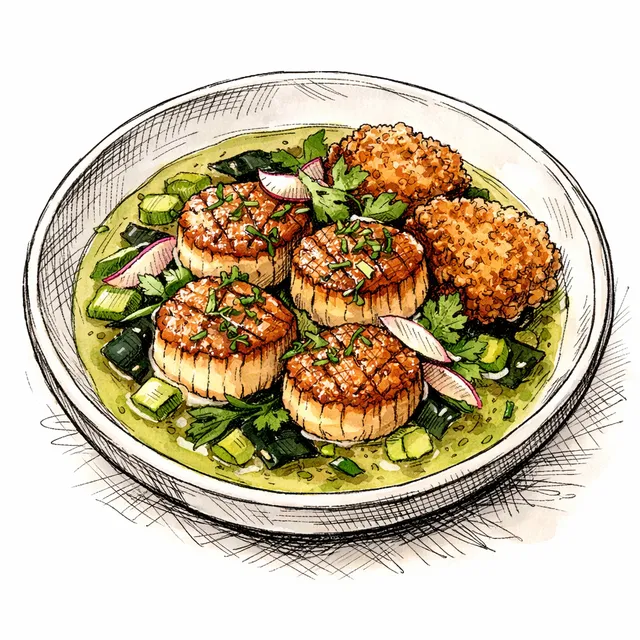
A Collision of Coasts: Scallops in Tomatillo-Kombu Broth
I first tasted raw tomatillo salsa on a sweltering afternoon in Oaxaca. The sharp, green bite and citrus punch hit me instantly. Years later, back in my kitchen, I realized that acidic profile is the perfect counterweight to the deep, oceanic umami of a cold Japanese kombu dashi. That realization birthed this recipe: Quick-Seared Scallops with Tomatillo-Kombu Broth & Crispy Sushi Rice. We are talking about screaming-hot, unilateral-seared scallops floating over crispy rice cakes in a vibrant, cooling broth. It is a total study in temperature and texture. Why this works: The glutamates in the kombu and white miso wrap around the sharp malic acid of the tomatillos, creating a rounded flavor bomb that elevates the sweet scallop without overpowering it. This dish is special to me because it proves that flavor DNA crosses borders. It is a conversation between two distinct coastal traditions. If you want to make it your own, try adding a spoonful of lacto-fermented jalapeños—I always have a jar bubbling on my counter—or swap the scallops for a quick-torched white fish. Play with the sear, keep the broth cold, and break the rules!
Featured Recipe
Quick-Seared Scallops with Tomatillo-Kombu Broth & Crispy Sushi Rice
I love playing with the sharp, green bite of raw tomatillos and lime. Here, that classic Mexican acid profile collides with the deep umami of cold kombu dashi and white miso to create a vibrant, cooling broth. We're floating screaming-hot, unilateral-seared scallops over crispy sushi rice cakes—a study in temperature, texture, and cross-cultural flavor DNA.
Save a copy to your collection for editing
Timeline
Ingredients
- 1 lb U-10 dry sea scallops(Tough abductor muscle removed. Must be 'dry' (unsoaked) for a proper sear.)
- 1 tsp kosher salt(For seasoning the scallops)
- 3 tbsp grapeseed oil(Divided use: 2 tbsp for rice cakes, 1 tbsp for scallops)
- 2 cups cooked short-grain sushi rice(Cooled to room temperature or chilled)
- 4 medium tomatillos(Husked and rinsed well)
- 1 cup cold kombu dashi(Can substitute water with 1 tsp high-quality dashi powder)
- 1/4 cup fresh lime juice(Freshly squeezed)
- 1 jalapeño(Stemmed. Remove seeds if you prefer less heat.)
- 1/2 bunch fresh cilantro(Include the tender stems, they pack the most flavor)
- 1 tbsp white miso paste(Provides the umami backbone to the broth)
- 1/4 cup finely diced red onion(For garnish)
- 4 leaves fresh shiso(Rolled and sliced into thin ribbons (chiffonade))
- 1 tbsp toasted white sesame seeds(For garnish)
Instructions
- 1
In a blender, combine 4 medium tomatillos, 1 cup cold kombu dashi, 1/4 cup fresh lime juice, 1 jalapeño, 1/2 bunch fresh cilantro, and 1 tbsp white miso paste. Blend on high until completely smooth. Pass the liquid through a fine-mesh strainer into a bowl and chill in the fridge until ready to use.
5 min
Tip: Straining is optional if you want a more rustic 'salsa' texture, but passing it through a sieve gives you that refined, elegant pool of broth.
- 2
Using wet hands to prevent sticking, form the 2 cups cooked short-grain sushi rice into 4 even, compact patties, about 3/4-inch thick. Press them firmly so they hold together in the pan.
3 min
Tip: Day-old, slightly dried-out rice actually works perfectly here for getting a crispy exterior.
- 3
Heat 2 tbsp grapeseed oil in a large non-stick skillet over medium-high heat. Add the rice cakes and pan-fry until a deep golden crust forms on the bottom, about 4-5 minutes per side. Transfer to a paper towel-lined plate and keep warm.
10 min
Tip: Don't flip them early! Let the Maillard reaction do its work. You want a shattering crust to contrast the tender scallop.
- 4
While the rice cakes are crisping, thoroughly pat dry the 1 lb U-10 dry sea scallops with paper towels. Removing surface moisture is critical for a good sear. Season the top side of the scallops evenly with 1 tsp kosher salt.
2 min
Tip: I leave the bottom unseasoned until the last second to prevent the salt from pulling out moisture and ruining the sear.
- 5
Place a heavy cast-iron skillet over high heat and let it get screaming hot—until it just begins to smoke. Add the remaining 1 tbsp grapeseed oil.
3 min
Tip: Cast iron retains heat beautifully. We need maximum thermal mass because adding 10 scallops will drop the pan's temperature quickly.
- 6
Carefully place the scallops in the pan, salted-side down. Press each one down lightly with two fingers for 3 seconds to ensure flush contact with the metal. Sear undisturbed for 2 minutes until a dark, crusty sear forms. Kiss the other side for just 15 to 30 seconds, then immediately remove from the pan.
3 min
Tip: This is a unilateral sear. Cooking it 90% on one side gives you incredible crust while leaving the center perfectly translucent and sweet.
- 7
To plate, place a warm, crispy rice cake in the center of 4 shallow bowls. Top each with 2-3 seared scallops. Pour the chilled tomatillo-kombu broth around the base. Garnish the scallops with the 1/4 cup finely diced red onion, ribbons of 4 leaves fresh shiso, and a sprinkle of 1 tbsp toasted white sesame seeds.
3 min
Tip: Pour the broth *around* the rice cake, not over the scallops, so you preserve that beautiful hard-earned crust on the seafood.
Chef's Notes
Why this works: Tomatillos bring malic acid to the table, which has a sharper, more lingering tartness than the citric acid in lime juice. By blending them with cold kombu dashi (hello, glutamic acid) and a touch of white miso, we create a complex umami-acid matrix. That bright, cold broth acts as a foil to the rich, naturally sweet, hot seared scallop. The trick here is the unilateral sear—you get the rich Maillard flavors on top without turning the center of the scallop into a rubber tire. Never precious, just pure food science.

Kenji Nakamura
Where Japanese precision meets global flavors
I trained in Tokyo for eight years, mastering the discipline of washoku—traditional Japanese cuisine. But I got restless. So I cooked my way through Southeast Asia, spent a year in Mexico City, and fell hard for the food of Peru. Now I see connections between cuisines that others miss: the umami in dashi and fish sauce, the heat in shishito and Szechuan peppercorns, the way Japanese technique can unlock flavors from any tradition. I'm always fermenting something.