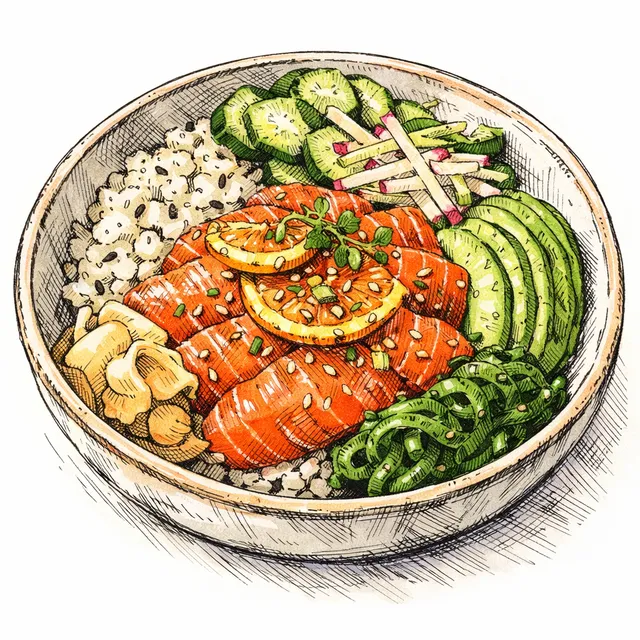
Seville Orange and Shiro Shoyu-Cured Wild Sockeye Salmon Bowl
When I was living in Oaxaca, I became obsessed with how the locals used tart, bitter wild oranges to 'cook' raw fish, bringing back memories of the pristine tataki bars in Tokyo. That cross-cultural spark is exactly how this bowl was born. I take brilliant crimson wild sockeye salmon and give it a quick, high-acid cure using intensely aromatic Seville orange juice paired with delicate, amber-hued shiro shoyu. Why this works: the gentle amino acids in the white soy preserve the fish's buttery texture while the citrus proteins firm up the exterior just enough, mimicking traditional curing without turning it chalky. Layered over warm ginger-scallion short-grain rice with smoky charred avocado and crunchy pickled chayote ribbons, it is an umami bomb of texture and temperature. Make it your own by swapping the chayote for jicama or cucumbers depending on what is in your fridge. Never be afraid to cross flavor borders—that is where the real magic happens. Now go check on your ferments!
Featured Recipe
Seville Orange & Shiro Shoyu-Cured Wild Sockeye Salmon Bowl
Brilliant crimson wild sockeye salmon takes a quick, high-acid cure in bitter Seville orange juice and delicate white shoyu. Served over warm ginger-scallion short-grain rice with smoky charred avocado and crunchy pickled chayote ribbons, this bowl bridges vibrant coastal Mexican ceviche and Tokyo sashimi precision.
Save a copy to your collection for editing
Timeline
Ingredients
- 14 oz wild sockeye salmon fillet(skin and pin bones removed, sashimi-grade, cut into 1/2-inch cubes)
- 0.33 cup fresh Seville orange juice(or equal parts fresh lime and naval orange juice)
- 2 tbsp shiro shoyu (white soy sauce)(provides clean umami without darkening the flesh)
- 1 tbsp mirin(Japanese sweet rice wine)
- 1 tbsp fresh ginger(microplaned)
- 1 serrano pepper(very thinly sliced into rounds, seeds removed if preferred milder)
- 0.75 tsp fine sea salt(split between cure and rice)
- 1.5 cups Japanese short-grain white rice(rinsed thoroughly until water runs clear)
- 1.75 cups water(for cooking rice)
- 1.5 tbsp toasted sesame oil(split between rice and avocado)
- 4 scallions(thinly sliced on a bias, whites and greens separated)
- 1 small chayote squash(peeled, seeded, and shaved into thin ribbons with a mandoline)
- 3 tbsp rice vinegar(for chayote quick pickle)
- 1 tsp granulated sugar(for chayote quick pickle)
- 1 large firm-ripe avocado(halved, pitted, and sliced into 1/2-inch wedges)
- 1 tbsp toasted white and black sesame seeds(for garnish)
- 2 tbsp roasted salted pepitas (pumpkin seeds)(coarsely crushed, for crunch)
- 0.25 cup fresh cilantro leaves(tender leaves and sprigs for finishing)
- 0.5 tbsp toasted sesame oil(mentioned in step 4 for brushing avocado)
- 0.25 tsp fine sea salt(mentioned in step 2 for pickling liquid)
Instructions
- 1
Place rinsed 1.5 cups Japanese short-grain white rice and 1.75 cups water into a medium saucepan with a tight-fitting lid. Bring to a vigorous boil over medium-high heat, cover tightly, reduce heat to the lowest setting, and cook undisturbed for 15 minutes. Remove from heat and let sit covered to steam for 10 minutes.
25 min
Tip: Resist lifting the lid during both the simmer and rest phases; captive steam ensures plump, separate grains.
- 2
While the rice simmers, whisk 3 tbsp rice vinegar, 1 tsp granulated sugar, and 0.25 tsp fine sea salt in a medium bowl until dissolved. Add shaved 1 small chayote squash ribbons and toss thoroughly. Set aside at room temperature to quick-pickle.
5 min
Tip: Tossing the squash ribbons gently every few minutes ensures they stay crisp while picking up a balanced acidity.
- 3
In a non-reactive glass bowl, whisk together 0.33 cup fresh Seville orange juice, 2 tbsp shiro shoyu (white soy sauce), 1 tbsp mirin, 1 tbsp microplaned fresh ginger, and the white parts of 4 scallions. Gently fold in cubed 14 oz wild sockeye salmon fillet and sliced 1 serrano pepper. Transfer to the refrigerator to cure for precisely 12 minutes.
14 min
Tip: Wild sockeye has low intramuscular fat compared to farmed salmon, meaning citric acid denatures surface proteins rapidly. Do not exceed 15 minutes or the exterior turns chalky.
- 4
Heat a heavy cast-iron skillet over high heat until smoking. Brush sliced 1 large firm-ripe avocado wedges with 0.5 tbsp toasted sesame oil. Sear avocado wedges for 45 to 60 seconds per side until dark char marks develop while the interior stays creamy. Transfer to a cutting board.
4 min
Tip: High heat is key here—you want intense contact color without cooking through the delicate avocado fat.
- 5
Uncover the rested rice and fluff gently with a paddle. Fold in 1 tbsp toasted sesame oil, the remaining 0.5 tsp fine sea salt, and the sliced green tops of 4 scallions until glossy and fragrant.
3 min
Tip: Adding warm sesame oil directly to hot rice coats the amylose starch molecules, preserving a gorgeous aroma and preventing clumpiness.
- 6
Divide seasoned warm rice among 4 wide shallow bowls. Lift cured 14 oz wild sockeye salmon fillet and 1 serrano pepper rounds from the marinade with a slotted spoon and arrange over half of each bowl, spooning 1 tablespoon of the tangy curing liquid over each portion. Arrange charred 1 large firm-ripe avocado and drained pickled 1 small chayote squash alongside. Garnish with 1 tbsp toasted white and black sesame seeds, crushed 2 tbsp roasted salted pepitas (pumpkin seeds), and fresh 0.25 cup fresh cilantro leaves.
5 min
Tip: Serve immediately while the contrast between warm, nutty rice and cold, tartly cured ruby salmon is at its absolute peak.
Chef's Notes
Why this works: Seville orange (naranja agria) packs high concentrations of citric and malic acid with a distinctive bitter aromatic profile from its peel oils. When paired with wild sockeye—which possesses intense natural astaxanthin pigment and lean muscle structure—the acid tightens the surface myosin proteins in about 12 minutes without bleaching the flesh or turning it rubbery. Shiro shoyu (white soy) supplies rich glutamates without staining the stunning deep ruby hue of the salmon.

Kenji Nakamura
Where Japanese precision meets global flavors
I trained in Tokyo for eight years, mastering the discipline of washoku—traditional Japanese cuisine. But I got restless. So I cooked my way through Southeast Asia, spent a year in Mexico City, and fell hard for the food of Peru. Now I see connections between cuisines that others miss: the umami in dashi and fish sauce, the heat in shishito and Szechuan peppercorns, the way Japanese technique can unlock flavors from any tradition. I'm always fermenting something.