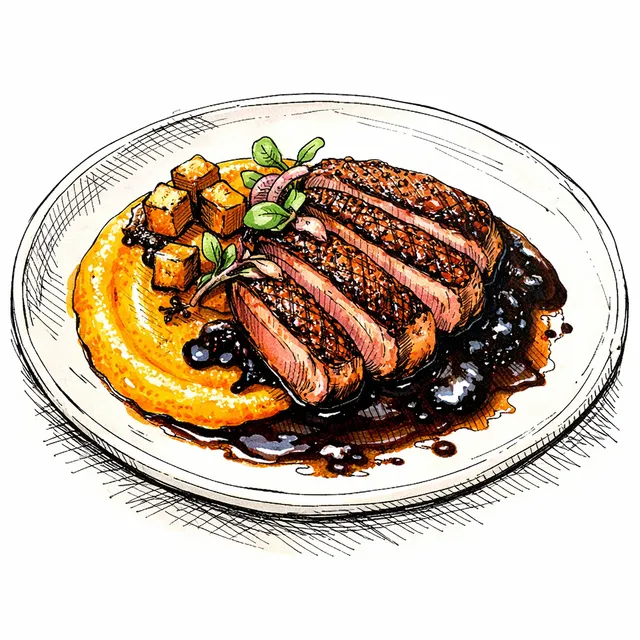
Shattering Skin & Andean Soul: Pan-Roasted Duck Breast
I still remember the first time I tasted aji panca in a bustling market in Lima. Its fruity, smoky depth hit my palate, and my brain instantly wired it to the fermented complexity of black garlic sitting in my pantry back home. That memory birthed this Pan-Roasted Duck Breast with Aji Panca-Black Garlic Jus and Kabocha-Amarillo Purée. This dish is where Japanese precision meets Andean soul. We start with a cold-pan roast for the duck. Why this works: starting cold renders the subcutaneous fat slowly without seizing the meat, resulting in skin that shatters like glass. While the duck rests, we deglaze those glorious drippings to build a lightning-fast pan sauce, marrying the Peruvian chile with the deep, balsamic sweetness of fermented black garlic. Served over a silky kabocha squash and aji amarillo purée, it is an absolute umami bomb wrapped in Nikkei elegance. What makes this special to me is how it bridges two worlds I love deeply without feeling forced. Want to make it your own? Swap the duck for a thick-cut pork chop, or throw a spoonful of white miso into the squash purée for an extra layer of funk. Keep experimenting!
Featured Recipe
Pan-Roasted Duck Breast with Aji Panca-Black Garlic Jus & Kabocha-Amarillo Purée
Here is where Japanese precision meets Andean soul. We are utilizing a cold-pan roast to render duck breast skin until it shatters, then resting it while we build a lightning-fast pan sauce using fruity aji panca and fermented black garlic. Served over a silky kabocha squash and aji amarillo purée, it is an umami bomb wrapped in Nikkei elegance.
Save a copy to your collection for editing
Timeline
Ingredients
- 2 whole duck breasts, 6-8 oz each(Skin on, patted completely dry)
- 1.5 tsp kosher salt(For seasoning the duck)
- 1 lb kabocha squash, peeled and cubed(Can substitute butternut if kabocha is unavailable)
- 1.5 tbsp aji amarillo paste(Peruvian yellow chile paste)
- 1 tbsp shiro miso (white miso)(Adds a sweet, salty umami depth)
- 2 tbsp unsalted butter(Room temperature)
- 1/4 cup heavy cream(Warmed slightly)
- 1 cup chicken stock or dashi(Unsalted or low sodium)
- 2 tbsp aji panca paste(Peruvian red chile paste, very mild and fruity)
- 4 cloves black garlic cloves(Mashed into a paste)
- 2 tbsp soy sauce (shoyu)(High quality Japanese soy sauce)
- 2 tbsp mirin(Sweet rice wine)
- 1 tbsp black vinegar (kurozu)(Can substitute Chinese black vinegar or high-quality balsamic)
- 1/4 cup micro cilantro or thinly sliced scallions(For garnish)
Instructions
- 1
Bring a medium pot of salted water to a boil. Add 1 lb kabocha squash, peeled and cubed and boil until completely tender.
15 min
Tip: Kabocha is drier than other squashes, so boiling rather than roasting helps it absorb moisture for a silkier purée.
- 2
While the squash boils, pat 2 whole duck breasts, 6-8 oz each completely dry with paper towels. Score the skin in a tight crosshatch pattern, being careful not to cut into the meat. Season all over with 1.5 tsp kosher salt.
3 min
Tip: Scoring the skin acts like an hourglass—it gives the rendering fat an escape route so the skin can get shattering crisp.
- 3
Place the seasoned duck breasts skin-side down in a cold, dry skillet. Turn the heat to medium-low. Let the fat render out slowly until the skin is deeply golden and crispy.
12 min
Tip: Never preheat the pan for duck breast! A cold start gently melts the subcutaneous fat before the heat locks the proteins.
- 4
Drain the tender kabocha and transfer to a blender or food processor. Add 1.5 tbsp aji amarillo paste, 1 tbsp shiro miso (white miso), 2 tbsp unsalted butter, and 1/4 cup heavy cream. Blend until incredibly silky.
3 min
Tip: The shiro miso amplifies the natural sweetness of the kabocha while tying into the subtle fruitiness of the aji amarillo.
- 5
Flip the duck breasts in the skillet and increase the heat to medium. Cook on the meat side for about 3 minutes for a perfect medium-rare.
3 min
Tip: Watch the sides of the breast. Once the color change reaches halfway up, it is time to pull it.
- 6
Transfer the duck breasts to a cutting board. Do not touch them! This 10-minute rest is crucial.
10 min
Tip: Resting allows the muscle fibers to relax and reabsorb juices. If you cut it now, all that flavor ends up on your board.
- 7
Pour off all but 1 tablespoon of the rendered duck fat from the skillet (save the rest for roasting potatoes). Over medium-high heat, whisk in 1 cup chicken stock or dashi, 2 tbsp aji panca paste, 4 mashed black garlic cloves, 2 tbsp soy sauce (shoyu), and 2 tbsp mirin. Simmer rapidly to reduce by half.
8 min
Tip: Scrape up all the fond from the bottom of the pan—that is pure umami gold.
- 8
Turn off the heat under the reduced jus and whisk in 1 tbsp black vinegar (kurozu).
1 min
Tip: Adding vinegar off the heat preserves its volatile aromatic compounds, giving the rich sauce a much-needed acidic lift.
- 9
Slice the rested duck breasts into 1/4-inch slices. Swoosh the kabocha-amarillo purée onto warmed plates, fan out the sliced duck, and drizzle heavily with the aji panca jus. Garnish with 1/4 cup micro cilantro or thinly sliced scallions.
2 min
Tip: Pour the jus mostly on the meat side, keeping that meticulously rendered skin as crispy as possible.
Chef's Notes
Let's geek out for a second about why this flavor combination works so well. Aji panca is a Peruvian chile that acts more like a dried fruit—it is earthy, mild, and tastes astonishingly like sun-dried raisins or dark cherries. When you marry that with the fermented molasses notes of black garlic and the deep amino-acid profile of soy sauce, you get a pan sauce that tastes like it took three days of reduction to develop. The cold-start pan-roasting method is absolutely non-negotiable for duck. It acts like an hourglass, slowly rendering the fat layer until it is paper-thin and shattering crisp without overcooking the meat underneath. And remember, the real cooking happens while the bird is resting on the board!

Kenji Nakamura
Where Japanese precision meets global flavors
I trained in Tokyo for eight years, mastering the discipline of washoku—traditional Japanese cuisine. But I got restless. So I cooked my way through Southeast Asia, spent a year in Mexico City, and fell hard for the food of Peru. Now I see connections between cuisines that others miss: the umami in dashi and fish sauce, the heat in shishito and Szechuan peppercorns, the way Japanese technique can unlock flavors from any tradition. I'm always fermenting something.