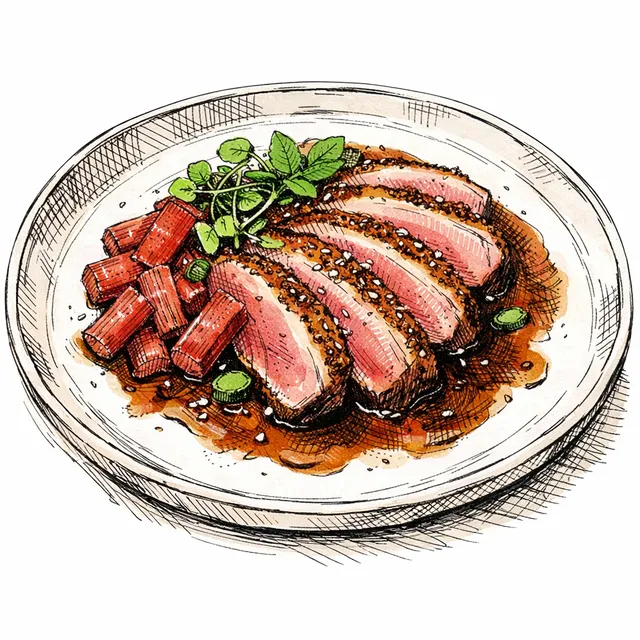
Shio Koji Cured Duck Breast with Smoky Rhubarb-Mezcal Tare
I was walking through a bustling market in Oaxaca when the smell of roasting meats and agave smoke hit me. It reminded me instantly of the yakitori alleys back in Tokyo. That cross-cultural spark led to this Shio Koji Cured Duck Breast with Smoky Rhubarb-Mezcal Tare. Here is the thing about duck breast: everyone treats it like a steak when they should be treating it like bacon. We are doing a rapid room-temperature shio koji cure. Why this works? The enzymes in the koji break down proteins into free amino acids, injecting massive umami fast. But here is the trick: only apply it to the flesh side. If you get koji on the skin, the sugars will burn before the fat renders! I paired this rich duck with a bracing tare made from charred spring rhubarb and mezcal. The aggressive, bright acidity of the rhubarb and the deep agave smoke cut straight through the heavy duck fat. This dish bridges my Japanese roots with my Mexican travels in one perfect bite. Want to play around? Swap the rhubarb for sour plums, or use a peaty Scotch if you are out of mezcal. Ferment, experiment, and break the rules!
Featured Recipe
Shio Koji Cured Duck Breast with Smoky Rhubarb-Mezcal Tare
Here's the thing about duck breast: everyone treats it like a steak when they should be treating it like bacon. We're doing a rapid room-temp shio koji cure to inject massive umami, but only on the flesh side so the skin doesn't burn. Paired with a bracing, smoky rhubarb and mezcal tare, this dish is a masterclass in balancing rich fats with aggressive, bright acidity.
Save a copy to your collection for editing
Timeline
Ingredients
- 2 pieces boneless duck breasts(About 1 lb total, skin-on)
- 2 tbsp shio koji(Store-bought or homemade)
- 1 cup rhubarb(Chopped into 1/2-inch pieces)
- 1/4 cup mezcal(A smoky espadín works perfectly)
- 3 tbsp soy sauce(Or tamari for gluten-free)
- 1 whole dried morita chile(Stem removed (substitute chipotle if needed))
- 2 tbsp agave nectar(Or granulated sugar)
- 1 inch piece fresh ginger(Thinly sliced, no need to peel)
- 1 bunch spring onions(Or large scallions, halved lengthwise)
- 1 tbsp neutral oil(Grapeseed or canola)
- 1 pinch flaky sea salt(For finishing)
Instructions
- 1
Score the skin of 2 boneless duck breasts in a tight crosshatch pattern, being careful not to pierce the meat. Rub the flesh side—and ONLY the flesh side—with 2 tbsp shio koji. Let sit at room temperature for 30 minutes to temper and cure.
5 min
Tip: Food science moment: The protease enzymes in shio koji are little umami-building pac-men. But if you coat the whole duck, the sugars in the koji will cause the skin to burn before the fat even starts to render. Keep the skin pristine!
- 2
In a small saucepan, combine 1 cup chopped rhubarb, 1/4 cup mezcal, 3 tbsp soy sauce, 1 dried morita chile, 2 tbsp agave nectar, and 1-inch piece fresh ginger, sliced. Bring to a gentle simmer over medium-low heat.
15 min
Tip: Spring rhubarb has this bracing, aggressive acidity that reminds me of underripe Mexican tomatillos. We're using it to cut right through the rich, fatty duck.
- 3
Once the rhubarb has completely broken down into a mush, strain the tare through a fine-mesh sieve, pressing the solids firmly with a spoon to extract all the flavorful syrup. Discard the solids and set the tare aside.
2 min
Tip: It should have the consistency of a thin glaze. If it's too loose, you can reduce it for another minute in the pan.
- 4
Use a paper towel to thoroughly wipe the shio koji off the duck flesh. Place the duck skin-side down in a cold, dry skillet. Turn the heat to medium-low and let the fat render slowly.
15 min
Tip: Always start duck in a cold pan! It gives the thick layer of subdermal fat time to melt away before the skin crisps up.
- 5
While the duck renders, heat a separate cast-iron skillet over high heat. Toss 1 bunch spring onions with 1 tbsp neutral oil and sear quickly until deeply charred but still retaining some crunch.
5 min
Tip: Don't move them too much. You want solid contact with the pan to get those bitter, smoky grill marks.
- 6
Check the duck skin. Once it is golden and shatteringly crisp, and most of the fat is in the pan, flip the breasts and cook the flesh side for just 1 to 2 minutes for a perfect medium-rare.
2 min
Tip: The koji has already started breaking down the proteins on the flesh side, so it will caramelize beautifully and quickly.
- 7
Transfer the duck to a cutting board and let it rest undisturbed.
8 min
Tip: Resting is non-negotiable. If you slice it now, you'll lose all that juicy goodness we just worked so hard to build.
- 8
Slice the rested duck breasts into 1/2-inch thick pieces. Arrange over the charred spring onions, drizzle generously with the smoky rhubarb tare, and finish with 1 pinch flaky sea salt.
3 min
Tip: Serve immediately while the skin is still audibly crispy.
Chef's Notes
Why this works: Shio koji contains proteases that break down protein into amino acids (pure umami). By only curing the meat side and doing it at room temperature for 30 minutes, we get a rapid tenderization and flavor injection while tempering the meat for a perfectly even cook. The cold-pan start ensures the skin gets shatteringly crisp. The smoky rhubarb tare acts like a Mexican chamoy and a Japanese ponzu had a baby.

Kenji Nakamura
Where Japanese precision meets global flavors
I trained in Tokyo for eight years, mastering the discipline of washoku—traditional Japanese cuisine. But I got restless. So I cooked my way through Southeast Asia, spent a year in Mexico City, and fell hard for the food of Peru. Now I see connections between cuisines that others miss: the umami in dashi and fish sauce, the heat in shishito and Szechuan peppercorns, the way Japanese technique can unlock flavors from any tradition. I'm always fermenting something.