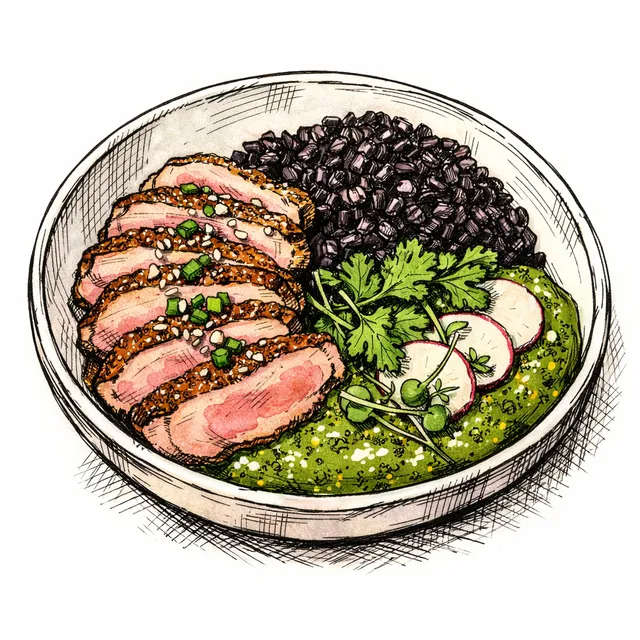
Shio Koji Duck Meets Mole Verde: A Cross-Continental Bowl
I fell in love with this flavor combination late one night in Oaxaca. Sitting at a tiny street stall eating a vibrant, herb-packed mole verde, my brain instantly bridged the gap to Japanese white miso—both bringing that deep, savory earthiness we crave. Back in my kitchen, I started playing. I cured a duck breast in shio koji—my absolute favorite umami secret weapon—to get that insanely crispy skin and tender bite, paired it with nutty forbidden black rice, and tied it all together with that miso-laced mole.
Why does this work? The active enzymes in shio koji break down proteins while drawing out surface moisture, guaranteeing a shatteringly crisp skin, while the white miso plays brilliantly with the toasted pumpkin seed richness of the green mole. A bright pop of pickled kumquat cuts right through the rich duck fat at the end.
Want to make it your own? Swap the duck for crispy pork belly or even thick-cut king oyster mushrooms if you are leaning plant-based. The magic is in understanding the fermentation technique, but the joy is in breaking the rules. Dive in!
Featured Recipe
Shio Koji Duck Breast Bowl with Forbidden Black Rice & Mole Verde Miso
Crispy shio koji-cured duck breast meets rich, nutty forbidden black rice and a bright, velvety Mole Verde laced with white miso. Fresh pickled kumquats and shiso add a vibrant citrus snap that perfectly cuts through the rich duck fat.
Save a copy to your collection for editing
Timeline
Ingredients
- 2 breasts duck breast(about 1 lb total, skin scored in crosshatch)
- 3 tbsp shio koji
- 1 cup forbidden black rice(rinsed well)
- 1.75 cups water
- 0.75 tsp kosher salt(divided)
- 1 tsp toasted sesame oil
- 0.5 cup raw pepitas(pumpkin seeds)
- 1 medium poblano pepper(quartered and seeded)
- 1 medium serrano pepper(halved)
- 3 small tomatillos(husked and halved)
- 2 cloves garlic(peeled)
- 1 tbsp white miso paste(shiro miso)
- 0.5 cup chicken stock(or Japanese dashi)
- 0.5 cup fresh cilantro leaves(packed)
- 8 leaves fresh shiso leaves(divided)
- 1 tbsp lime juice(freshly squeezed)
- 1 tbsp olive oil
- 0.5 cup fresh kumquats(thinly sliced into rings and seeded)
- 2 tbsp rice vinegar
- 1 tbsp mirin
- 1 medium radish(thinly sliced for garnish)
- 0.25 tsp kosher salt(Needed for kumquat pickle in Step 3.)
Instructions
- 1
Score the skin of 2 duck breast in a tight crosshatch pattern without cutting into the meat. Rub both sides with 3 tbsp shio koji. Set aside at room temperature to cure while preparing other components.
20 min
Tip: Shio koji enzymes work fast! 20 minutes is plenty of time to break down surface proteins and create intense savory flavor.
- 2
In a small saucepan, bring 1 cup forbidden black rice, 1.75 cups water, and 0.5 tsp kosher salt to a boil over high heat. Reduce heat to low, cover tightly, and simmer until water is absorbed.
25 min
Tip: Don't lift the lid while simmering; trapped steam ensures even cooking of dark whole grains.
- 3
In a small bowl, mix 0.5 cup fresh kumquats, 2 tbsp rice vinegar, 1 tbsp mirin, and 0.25 tsp kosher salt. Let pickle at room temperature to draw out sweet juices. Stir in 4 fresh shiso leaves (chiffonade cut) right before serving.
5 min
Tip: Kumquat peels are sweet while the flesh is tart, creating an instant balanced quick pickle.
- 4
Heat a dry skillet over medium heat and toast 0.5 cup raw pepitas until puffed and fragrant, about 3 minutes; transfer to a bowl. In the same skillet with 1 tbsp olive oil, char 1 medium poblano pepper, 1 medium serrano pepper, 3 small tomatillos, and 2 cloves garlic until blistered with dark spots.
10 min
Tip: A deep char on the peppers gives the mole its complex smoky depth.
- 5
Transfer charred vegetables to a blender. Add half of the toasted pepitas (reserve 2 tbsp toasted pepitas for garnish), 1 tbsp white miso paste, 0.5 cup chicken stock, 0.5 cup fresh cilantro leaves, 4 fresh shiso leaves, and 1 tbsp lime juice. Puree until smooth.
5 min
Tip: Miso replaces traditional Mexican chocolate/sweetness here with rich umami depth.
- 6
Wipe excess shio koji off 2 duck breast with a paper towel. Place skin-side down in a cold cast-iron skillet. Turn heat to medium-low and slowly render fat for 10-12 minutes until skin is golden and crisp. Flip and cook meat side for 3-4 minutes until internal temperature reaches 130°F (54°C).
15 min
Tip: Starting in a cold pan allows duck fat to render out gently without scorching the rice-koji sugars.
- 7
Transfer duck to a warm plate and rest for 5 minutes before slicing against the grain. Remove black rice from heat, fluff with a fork, and stir in 1 tsp toasted sesame oil.
5 min
Tip: Resting allows muscle fibers to relax so juices reabsorb into the duck.
- 8
Divide black rice between two wide shallow bowls. Pour a warm pool of Mole Verde Miso beside the rice. Fan sliced duck breast over top. Garnish with pickled kumquat-shio relish, 1 medium radish, and reserved 2 tbsp toasted pepitas.
5 min
Tip: Serve immediately while the duck skin is at its crunchiest.
Chef's Notes
Why this works: Shio koji contains active enzymes—specifically proteases and amylases—that break down duck muscle proteins into free amino acids (glutamate = pure umami) while converting starches into simple sugars. During the slow, cold-pan render, these sugars caramelize into an insanely crispy crust while keeping the meat juicy. Pairing this rich duck with a toasted pumpkin seed and white miso Mole Verde builds a seamless bridge between Oaxacan and Japanese flavor traditions, while the quick-pickled kumquat and herbal shiso provide the bright acid required to cut through every rich bite.

Kenji Nakamura
Where Japanese precision meets global flavors
I trained in Tokyo for eight years, mastering the discipline of washoku—traditional Japanese cuisine. But I got restless. So I cooked my way through Southeast Asia, spent a year in Mexico City, and fell hard for the food of Peru. Now I see connections between cuisines that others miss: the umami in dashi and fish sauce, the heat in shishito and Szechuan peppercorns, the way Japanese technique can unlock flavors from any tradition. I'm always fermenting something.