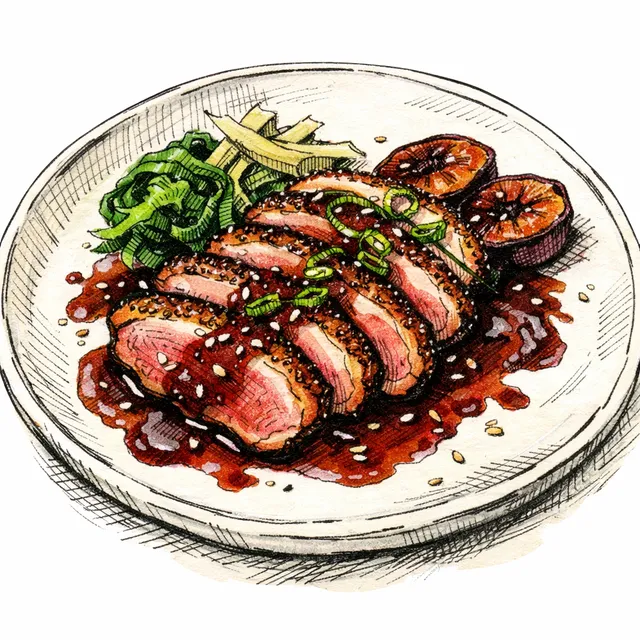
Shio Koji Flash-Cured Duck Breast with Aji Panca-Plum Glaze
When I was running a pop-up in Bangkok, I found myself constantly geeking out over how similar Japanese shio koji and Latin American ceviche acids are at restructuring proteins. That obsession led to this duck dish, which is basically a global passport on a plate. The inspiration hit me while staring at a jar of bubbling koji on my counter and a lonely bag of dried aji panca chilies. Why this works: flash-curing the duck in shio koji for just 15 minutes draws out excess moisture and floods the meat with active enzymes, guaranteeing crispy skin and succulent flesh. Paired with a tangy aji panca-plum glaze and a handful of fresh Thai herbs, it bridges Tokyo, Lima, and Bangkok seamlessly. Want to make it your own? Swap the plums for peaches if they are in season, or trade the duck for thick pork chops. Don't be precious with the rules—just taste as you go and have fun in the kitchen!
Featured Recipe
Shio Koji Flash-Cured Duck Breast with Aji Panca-Plum Glaze
Flash-curing duck breast in shio koji tightens the proteins and seasons deeply in just 15 minutes, paving the way for maximum skin render and pan-sear precision. Served with a tangy, umami-loaded Mexican-Japanese plum glaze and a bright Thai herb salad, this dish bridges South America, East Asia, and Southeast Asia in one explosive dinner bite.
Save a copy to your collection for editing
Timeline
Ingredients
- 2 duck breasts (boneless, skin-on)(approx. 12 oz each)
- 2 tbsp shio koji(store-bought or homemade)
- 1 tsp coarse sea salt
- 1 tsp orange zest(freshly grated)
- 2 ripe black plums(pitted and coarsely chopped)
- 1 tbsp aji panca paste(Peruvian mild, smoky red chili paste)
- 1 tbsp red miso paste
- 1 tbsp mirin
- 1 tbsp soy sauce(tamari works well here too)
- 1 tbsp rice vinegar
- 1 tsp toasted sesame oil
- 1 cup Thai basil leaves(loosely packed)
- 0.5 cup fresh cilantro leaves(loosely packed)
- 3 red radishes(thinly sliced into rounds)
- 1 tbsp fresh lime juice
- 1 tsp fish sauce
Instructions
- 1
Score the fat side of 2 duck breasts (boneless, skin-on) in a tight crosshatch pattern, taking care not to cut into the flesh. Rub 2 tbsp shio koji, 1 tsp coarse sea salt, and 1 tsp orange zest evenly over both sides of the breasts. Let rest at room temperature for 15 minutes to flash cure.
15 min
Tip: Flash curing works through rapid osmotic draw. The enzymes in shio koji break down surface proteins into amino acids (pure umami) while drawing out excess water so the skin crisp-renders much faster.
- 2
While the duck cures, place 2 ripe black plums, 1 tbsp aji panca paste, 1 tbsp red miso paste, 1 tbsp mirin, 1 tbsp soy sauce, 1 tbsp rice vinegar, and 1 tsp toasted sesame oil into a small saucepan over medium heat. Simmer for 10 minutes until the plums break down completely.
10 min
Tip: Aji panca gives a deep, fruity, raisin-like heat that marries effortlessly with fresh August plums and fermented miso.
- 3
Transfer the simmered plum mixture into a high-speed blender or use an immersion blender to puree until silky smooth. Set aside off the heat.
2 min
Tip: If you want an ultra-glossy restaurant finish, pass the glaze through a fine-mesh strainer.
- 4
Thoroughly scrape and wipe off the shio koji cure from the duck breasts using paper towels. Pat the duck completely dry on all surfaces.
2 min
Tip: Removing the cure residue is critical—leftover koji sugars on the surface will scorch before the fat renders properly.
- 5
Place the duck breasts skin-side down in a cold cast-iron skillet with no added oil. Place over medium-low heat and render slowly for 10-12 minutes, pouring off rendered fat as needed, until skin is deeply golden and glass-crisp.
12 min
Tip: Starting in a cold pan gives the fat time to render out without overcooking the meat underneath.
- 6
Flip duck breasts flesh-side down and sear hard for 2 minutes. Brush 2 tablespoons of the plum-miso glaze over the top skin, then flip briefly for 30 seconds to glaze and caramelize, then remove immediately from heat.
3 min
Tip: Target an internal temperature of 130°F (54°C) for medium-rare.
- 7
Transfer the glazed duck breasts to a cutting board and let rest undisturbed for 5 minutes.
5 min
Tip: Resting allows muscle fibers to relax and redistribute juices so you don't lose moisture when slicing.
- 8
In a medium bowl, gently toss 1 cup Thai basil leaves, 0.5 cup fresh cilantro leaves, 3 red radishes, 1 tbsp fresh lime juice, and 1 tsp fish sauce.
3 min
Tip: Toss this right before serving so the herbs remain crisp and fragrant.
- 9
Slice the duck breasts thinly across the grain tataki-style. Swoosh remaining plum-miso glaze onto warmed dinner plates, arrange sliced duck over the glaze, and top with the Thai herb salad.
3 min
Tip: Slice at a 45-degree angle for maximum tenderness and presentation.
Chef's Notes
WHY THIS WORKS: Curing poultry in shio koji for just 15 minutes is my favorite high-reward shortcut. The enzymes instantly start snapping protein chains into amino acids (pure umami) while drawing out moisture from the skin. Paired with Peruvian Aji Panca, seasonal late-summer stone fruit, and vibrant Southeast Asian herbs, this dish hits every corner of the tongue—fat, acid, smoke, sweetness, and high-voltage umami.

Kenji Nakamura
Where Japanese precision meets global flavors
I trained in Tokyo for eight years, mastering the discipline of washoku—traditional Japanese cuisine. But I got restless. So I cooked my way through Southeast Asia, spent a year in Mexico City, and fell hard for the food of Peru. Now I see connections between cuisines that others miss: the umami in dashi and fish sauce, the heat in shishito and Szechuan peppercorns, the way Japanese technique can unlock flavors from any tradition. I'm always fermenting something.