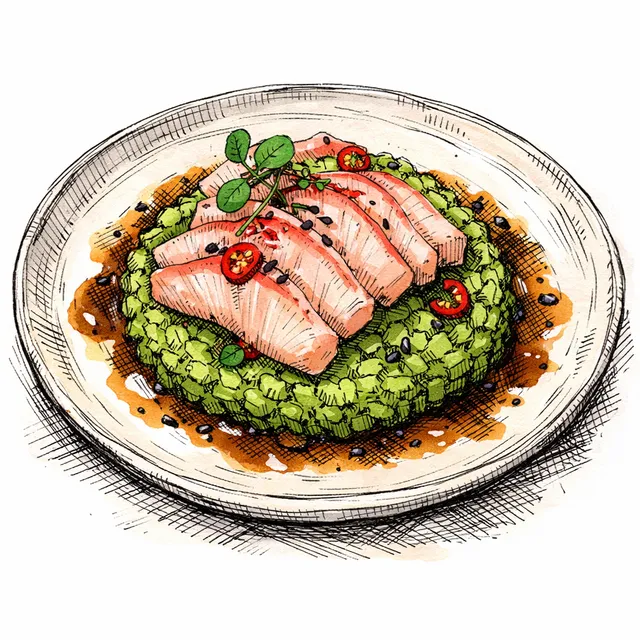
When Tokyo Met Lima: Shio Koji Hamachi & Arroz Verde
Years ago, sweating in a tiny cevicheria in Lima, I tasted aji limo for the first time. The bright, searing heat instantly made me crave the grounded depth of Japanese soy sauce. That vibrant memory birthed this dish: my take on a Nikkei chirashi bowl. It is deeply special to me because it physically bridges my Tokyo culinary roots with my wilder South American travels. Here is why this recipe works so well: we give buttery hamachi a quick 45-minute shio koji cure. The protease enzymes in the koji actively break down the fish's proteins into free amino acids, turning a delicate piece of yellowtail into an absolute umami bomb. We precision-slice that chilled, savory fish and drape it over warm, earthy cilantro-dashi rice, which is my personal spin on Peruvian Arroz Verde. The interplay between the warm rice, the cured fish, and the sharp bite of yuzu and aji limo-soy is electric. Make it your own, though! Cannot find hamachi? Fatty salmon or even snapper works beautifully. No aji limo? A touch of habanero brings a similar fruity fire. Trust the technique, then break the rules. And seriously, start fermenting some koji on your counter today!
Featured Recipe
Shio Koji-Cured Hamachi over Arroz Verde with Aji Limo-Soy
This is my take on a Nikkei chirashi bowl, designed for an elegant dinner. By applying a quick shio koji cure to buttery yellowtail, we harness natural enzymes to amplify its umami before precision-slicing it over warm, cilantro-dashi rice. The interplay between the chilled, savory fish, the earthy Peruvian-style rice, and the sharp bite of yuzu and aji limo is electric.
Save a copy to your collection for editing
Timeline
Ingredients
- 1 lb sashimi-grade hamachi block (saku)(Keep chilled until exactly when needed)
- 3 tbsp shio koji(Paste preferred)
- 1 tbsp pisco(Or sake if pisco is unavailable)
- 1.5 cups short-grain sushi rice(Uncooked)
- 1.5 cups kombu dashi(Cold or room temp)
- 1 bunch fresh cilantro(Stems and leaves, roughly chopped)
- 1 tbsp aji amarillo paste(Peruvian yellow chili paste)
- 1/4 cup pre-cooked tricolor quinoa(Make sure it's dry to the touch)
- 1 tbsp neutral oil(For crisping quinoa (e.g., grapeseed or canola))
- 3 tbsp soy sauce(Usukuchi (light soy) if you have it)
- 2 tbsp yuzu juice(Fresh lime juice works as a substitute)
- 1 tsp minced aji limo(Or habanero/fresno chili if you can't find aji limo)
- 1 tsp grated ginger(Freshly grated)
- 2 scallions(White and light green parts only)
- 1 tbsp rice vinegar(Unseasoned)
- 1/2 tsp flaky sea salt(For finishing)
Instructions
- 1
Mix 3 tbsp shio koji and 1 tbsp pisco in a shallow dish. Coat the 1 lb sashimi-grade hamachi block (saku) entirely. Wrap tightly in plastic wrap and refrigerate. The enzymes will work their magic over the next 45 minutes.
5 min
Tip: Why this works: Shio koji contains protease enzymes that break down the protein in the hamachi into amino acids (hello, glutamate!). This acts as a hyper-speed dry-aging, firming the flesh for precise slicing while massively boosting umami.
- 2
Rinse the 1.5 cups short-grain sushi rice under cold water until the water runs clear. Let it drain thoroughly in a fine-mesh strainer.
10 min
Tip: Don't skip the drain! Excess water clinging to the outside of the grains will throw off our dashi ratio.
- 3
In a blender, combine 1 bunch fresh cilantro, 1 tbsp aji amarillo paste, and 1.5 cups kombu dashi. Blend until bright green and smooth. Combine this cilantro-dashi with the drained rice in a rice cooker or heavy pot. Cook as you normally would for sushi rice.
30 min
Tip: This is our 'Arroz Verde' base—using kombu dashi instead of chicken stock keeps the dish firmly rooted in Japanese technique while honoring the Peruvian profile.
- 4
Heat 1 tbsp neutral oil in a small skillet over medium heat. Add the 1/4 cup pre-cooked tricolor quinoa and toast for about 5-7 minutes, stirring frequently, until crispy and fragrant. Drain on a paper towel.
10 min
Tip: Listen to the quinoa; it will pop slightly when it's crisping up. You want a deep, nutty aroma.
- 5
For the Aji Limo-Soy dressing, whisk together 3 tbsp soy sauce, 2 tbsp yuzu juice, 1 tsp minced aji limo, and 1 tsp grated ginger in a small bowl. Set aside so the flavors meld.
5 min
Tip: Aji limo brings a beautifully fruity, floral heat that cuts right through the fatty hamachi.
- 6
Cut the 2 scallions into two-inch segments, slice them open, remove the green core, and finely julienne the white parts into delicate threads (shiraga negi). Drop them into a bowl of ice water so they curl up beautifully.
5 min
Tip: The ice water bath removes the harsh allium bite and creates an elegant, architectural garnish.
- 7
When the rice finishes cooking, let it rest for 5 minutes, then gently fold in 1 tbsp rice vinegar using a slicing motion with a paddle so you don't mash the grains. Keep warm.
5 min
Tip: Only fold with the edge of your paddle. We want distinct, jewel-like green grains, not paste.
- 8
Remove the hamachi from the fridge. Gently wipe off the cure with a paper towel—do not rinse it! Using a long, sharp slicing knife, slice the fish into precise 1/4-inch pieces (hirazukuri style). Start at the heel of your blade and pull towards you in one fluid motion to cleanly sever the fibers.
5 min
Tip: Sawing back and forth causes cellular damage to the fish, which can ruin its silky texture. Let the sharp edge do the work in one long, confident pull.
- 9
Divide the warm arroz verde into elegant dinner bowls. Drape the cured hamachi slices gracefully over the rice. Drizzle generously with the aji limo-soy. Top with the crispy quinoa, the drained curled scallions, and a pinch of 1/2 tsp flaky sea salt.
5 min
Tip: Serve immediately. The contrast between the warm rice and the cool, umami-dense fish is the soul of this dish.
Chef's Notes
If you saw me off the clock, I'm usually eating something out of a fermentation jar, and this dish is a testament to why. That quick shio koji cure is my secret weapon for dinner parties. It elevates good fish to extraordinary fish. Remember, your slicing knife is an extension of your arm—keep it sharp, commit to the pull stroke, and let the ingredients shine.

Kenji Nakamura
Where Japanese precision meets global flavors
I trained in Tokyo for eight years, mastering the discipline of washoku—traditional Japanese cuisine. But I got restless. So I cooked my way through Southeast Asia, spent a year in Mexico City, and fell hard for the food of Peru. Now I see connections between cuisines that others miss: the umami in dashi and fish sauce, the heat in shishito and Szechuan peppercorns, the way Japanese technique can unlock flavors from any tradition. I'm always fermenting something.