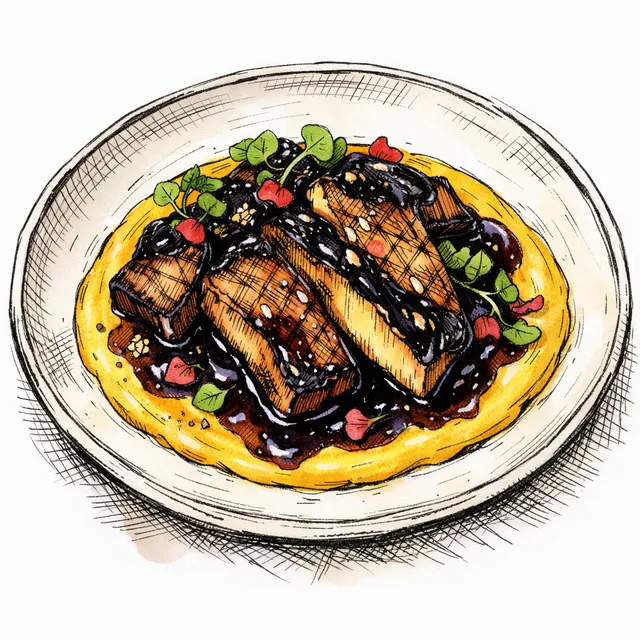
Shio Koji-Cured King Oyster Steaks with Aji Amarillo-Miso Purée & Hibiscus Black Garlic Glaze
Have you ever looked at a king oyster mushroom and seen a ribeye? I do. Inspiration for this dish struck during a late-night noodle crawl in Lima, where I was struck by how a smoky aji amarillo paste harmonized with the earthy funk of sweet white miso. Back in my Tokyo test kitchen, I wanted to recreate that profound depth using plant-based ingredients without sacrificing meaty satisfaction. The secret is a two-hour cure in shio koji and crushed pasilla chile. The active enzymes in the koji break down the mushroom proteins, tenderizing the texture and building massive umami before it even hits the pan. Sear it hard in foaming butter just like a prime tenderloin. What makes this recipe so special to me is the hibiscus and black garlic glaze—it brings a brilliant ruby tartness that cuts right through the rich miso purée. If you want to make it your own, swap the pasilla for chipotle if you love smoke, or use whatever citrusy dried chile you have hiding in your pantry. Break the rules and have fun with it!
Featured Recipe
Shio Koji-Cured King Oyster Steaks with Aji Amarillo-Miso Purée & Hibiscus Black Garlic Glaze
Thick-cut king oyster mushrooms are cured in enzymatic shio koji and Mexican pasilla chile, then hard-seared like prime tenderloin in foaming butter. Served over a silky Peruvian aji amarillo and sweet white miso purée, then glossed with a tart, deeply savory hibiscus and black garlic reduction.
Save a copy to your collection for editing
Timeline
Ingredients
- 1.25 lbs king oyster mushrooms(stems trimmed and cut crosswise into 1.5-inch thick medallions; caps reserved for another use or sliced)
- 3 tbsp shio koji(smooth paste style)
- 1 tsp ground pasilla chile(earthy, dried Mexican chile powder)
- 0.5 tsp fine sea salt
- 1 lb Japanese sweet potato(satsumaimo or white-fleshed sweet potato, peeled and cut into 1-inch chunks)
- 2 tbsp aji amarillo paste(Peruvian yellow chile paste)
- 2.5 tbsp shiro miso(sweet white miso)
- 4 tbsp unsalted butter(divided: 2 tbsp for the purée, 2 tbsp for basting)
- 0.5 cup kombu dashi(warm; or light vegetable stock)
- 0.25 cup dried hibiscus flowers(flor de jamaica)
- 0.25 cup mirin(hon-mirin preferred)
- 3 tbsp tamari(or dark soy sauce)
- 4 black garlic cloves(mashed into a smooth paste)
- 1 tbsp raw honey
- 2 tbsp grapeseed oil(or any high-smoke-point neutral oil)
- 2 cloves garlic(lightly crushed)
- 3 sprigs fresh thyme
- 1 tsp toasted white sesame seeds(for garnish)
- 2 stalks scallions(finely sliced on a sharp bias, ice-shocked to curl)
- 0.25 cup water(Used in step 3)
- tiny pinch salt(Used in step 4)
Instructions
- 1
Using the tip of a sharp paring knife, score a diamond crosshatch pattern about 1/8-inch deep into both cut surfaces of 1.25 lbs king oyster mushrooms. In a shallow dish, whisk together 3 tbsp shio koji, 1 tsp ground pasilla chile, and 0.5 tsp fine sea salt. Rub the mixture thoroughly over all sides of the scored mushroom medallions. Arrange in a single layer on a plate and let cure at room temperature for 25 minutes.
8 min
Tip: Scoring allows the koji enzymes and chile to penetrate deep into the mushroom matrix, while letting internal moisture weep out during the cure.
- 2
Place 1 lb Japanese sweet potato chunks into a medium saucepan, cover with cold salted water by 1 inch, and bring to a boil over medium-high heat. Simmer until the sweet potatoes are completely fork-tender, about 14 to 15 minutes, then drain thoroughly.
17 min
Tip: Start from cold water so the sweet potatoes cook evenly from core to edge without waterlogging.
- 3
While the potatoes simmer, combine 0.25 cup dried hibiscus flowers, 0.25 cup mirin, 3 tbsp tamari, mashed 4 black garlic cloves, 1 tbsp raw honey, and 0.25 cup water in a small saucepan. Bring to a gentle boil, then lower heat to medium-low and simmer until the liquid is syrupy and coats the back of a spoon, about 8 to 10 minutes. Strain through a fine-mesh sieve, discarding the hibiscus solids, and keep the reduction warm.
10 min
Tip: The hibiscus provides malic and citric acidity that cuts through the earthy richness of the black garlic and miso.
- 4
Transfer the drained, hot sweet potatoes to a blender or food processor. Add 2 tbsp aji amarillo paste, 2.5 tbsp shiro miso, 2 tbsp unsalted butter, and 0.5 cup kombu dashi. Purée on high speed until completely smooth, glossy, and satin-textured, adding an extra splash of dashi if needed. Season with a tiny pinch of salt to taste and keep warm over low heat.
6 min
Tip: Emulsifying hot potato starch with fat and miso creates a luscious texture without needing heavy cream.
- 5
Take the cured mushrooms and gently scrape off the excess shio koji solids using your fingers or a paper towel, then pat both cut sides thoroughly dry with clean paper towels.
3 min
Tip: Surface moisture and excess rice bits from koji will steam the mushroom or burn prematurely in the pan. Get them as dry as possible.
- 6
Heat 2 tbsp grapeseed oil in a large heavy cast-iron skillet over medium-high heat until shimmering. Add the cured mushroom medallions cut-side down, leaving space between each piece. Sear undisturbed for 4 minutes until deeply caramelized and bronze. Flip the steaks, then add remaining 2 tbsp unsalted butter, crushed 2 cloves garlic, and 3 sprigs fresh thyme to the skillet. As the butter foams, tilt the pan and baste the mushrooms continuously with the hot aromatic fat for 3 minutes until tender throughout.
8 min
Tip: Treat these exactly like filet mignon. The scored pattern will puff open and catch the browned butter and thyme oils.
- 7
To serve, spread a generous swoop of the warm aji amarillo-miso purée across four warmed dinner plates. Arrange 2 to 3 seared king oyster steaks over the purée. Drizzle the warm hibiscus-black garlic glaze around and over the mushrooms. Finish with a sprinkle of 1 tsp toasted white sesame seeds and the curled 2 stalks scallions.
5 min
Tip: Plate immediately while the mushrooms are sizzling and the sweet potato silk retains its sheen.
Chef's Notes
WHY THIS WORKS: King oyster mushrooms (Pleurotus eryngii) are structural powerhouses with dense chitinous cell walls that mimic the chew of animal protein. However, raw mushrooms are roughly 85-90% water. If you drop raw mushrooms directly into hot fat, they purge their intracellular water, boil in their own juices, and turn limp before ever developing a crust. Enter curing: By coating the scored stems in shio koji and salt for 25 minutes, we trigger rapid osmotic dehydration. Water gets pulled outward, while the living koji protease enzymes break down complex mushroom proteins into free amino acids (glutamate). When you pat them dry and hit the smoking hot cast iron, you get two miraculous things: immediate, intense Maillard browning without boiling, and an explosion of natural guanylate meeting the added koji glutamate for exponential, synergistic umami. Balancing that savory depth with the floral acidity of hibiscus and the fruity heat of Peruvian aji amarillo creates a dynamic, multi-layered dinner plate.

Kenji Nakamura
Where Japanese precision meets global flavors
I trained in Tokyo for eight years, mastering the discipline of washoku—traditional Japanese cuisine. But I got restless. So I cooked my way through Southeast Asia, spent a year in Mexico City, and fell hard for the food of Peru. Now I see connections between cuisines that others miss: the umami in dashi and fish sauce, the heat in shishito and Szechuan peppercorns, the way Japanese technique can unlock flavors from any tradition. I'm always fermenting something.