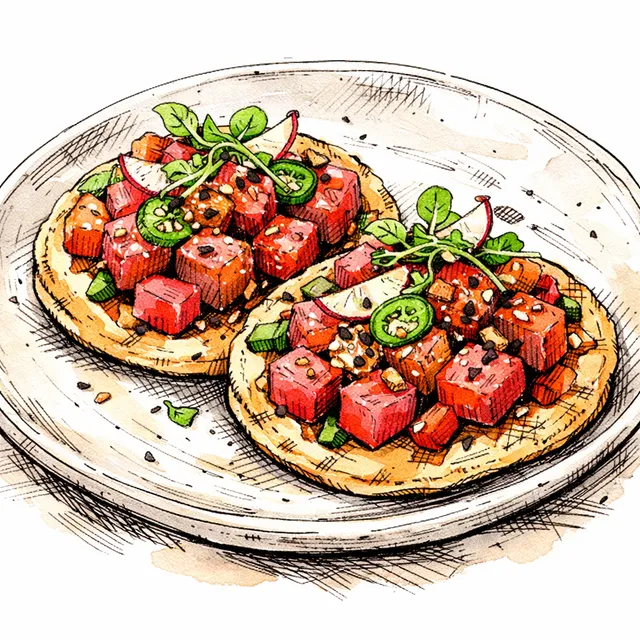
Shio Koji-Cured Watermelon & Tuna Tostadas with Yuzu-Gochujang
I still remember standing at a street cart in Ensenada, juice dripping down my chin from a flawless tuna tostada, thinking about my early days slicing sashimi in Tokyo. The connection between Mexican seafood culture and Japanese raw preparations has fascinated me ever since. That memory sparked these Shio Koji-Cured Watermelon and Tuna Tostadas. I wanted to play with expectations, so we are tossing raw yellowfin with cubed watermelon. But here is the nerdy part: we are curing that watermelon in shio koji first. Why does this work? The enzymes in the koji break down the pectin in the fruit, collapsing its cell walls just enough so it perfectly mimics the meaty, dense chew of the raw tuna. It is pure texture magic. Tossed in a bright yuzu-gochujang dressing and piled onto a crispy tortilla smeared with a creamy edamame-avocado base, it hits every single umami receptor at once. It is Japanese precision meeting a Mexican staple with a kick of Korean heat, which is exactly how my brain works on a plate. If you want to make it your own, ditch the tuna completely! Just let the watermelon cure in the koji for a full 45 minutes instead of 15, and you will have a phenomenal plant-based tostada. Keep fermenting and stay curious!
Featured Recipe
Shio Koji-Cured Watermelon & Tuna Tostadas with Yuzu-Gochujang
A cross-cultural summer lunch that plays with texture, temperature, and your expectations. We're using the enzymatic power of shio koji to compress watermelon until it matches the meaty chew of raw yellowfin tuna, then tossing both in a vibrant yuzu-gochujang dressing. Spread over a creamy edamame-avocado base on a crisp tostada, it is a wild, refreshing bite that hits every single umami receptor.
Save a copy to your collection for editing
Timeline
Ingredients
- 10 oz Sashimi-grade yellowfin tuna(Cut into 1/2-inch cubes)
- 1.5 cups Seedless watermelon(Cut into 1/2-inch cubes to match the tuna)
- 1.5 tbsp Shio koji(Liquid or puree form)
- 1 tsp Lime zest(Freshly grated)
- 1 tbsp Lime juice(Freshly squeezed)
- 2 tbsp Gochujang(Korean fermented chili paste)
- 1 tbsp Shiro shoyu(White soy sauce; substitute light soy if necessary)
- 1.5 tbsp Yuzu juice(Bottled 100% yuzu juice is perfect here)
- 1 tbsp Toasted sesame oil(High quality for finishing)
- 1 whole Ripe avocado(Pitted and peeled)
- 0.5 cup Shelled edamame(Thawed if frozen)
- 1 tbsp Kewpie mayonnaise(The Japanese standard)
- 1 whole Jalapeño(Thinly sliced)
- 0.25 cup Fresh cilantro leaves(Washed and dried)
- 4 whole Corn tostadas(Store-bought or freshly fried)
- pinch salt(Mentioned in Step 3 as optional seasoning.)
Instructions
- 1
In a mixing bowl, gently toss 1.5 cups Seedless watermelon with 1.5 tbsp Shio koji and 1 tsp Lime zest. Set aside at room temperature. The enzymes in the koji will break down the pectin while the salt draws out moisture, effectively curing and compressing the melon.
15 min
Tip: Don't skip the resting time! This 15-minute cure is exactly what transforms the watery melon into a dense, meaty texture that mimics the tuna.
- 2
While the melon cures, whisk together 2 tbsp Gochujang, 1 tbsp Shiro shoyu, 1.5 tbsp Yuzu juice, and 1 tbsp Toasted sesame oil in a large bowl. This is your dressing—it's bright, slightly funky, and deeply savory.
3 min
Tip: Shiro shoyu (white soy) is great here because it adds an umami bomb without muddying the vibrant red color of the tuna and gochujang.
- 3
In a mortar and pestle or a food processor, smash together the 1 whole Ripe avocado, 0.5 cup Shelled edamame, 1 tbsp Kewpie mayonnaise, and 1 tbsp Lime juice until it forms a chunky, spreadable puree. Season with a pinch of salt if needed.
5 min
Tip: I like leaving the edamame a little chunky for textural contrast against the soft avocado.
- 4
Using a very sharp knife, dice the 10 oz Sashimi-grade yellowfin tuna into 1/2-inch cubes. Try to match the exact size of your watermelon cubes for the best mouthfeel. Thinly slice your 1 whole Jalapeño.
5 min
Tip: A dull knife will tear the fish rather than slicing it cleanly. Keep your tuna in the fridge right until you're ready to cut it.
- 5
Drain the cured watermelon through a fine mesh sieve. Discard the excess liquid. You'll notice the melon is now significantly denser and slightly translucent.
2 min
Tip: Shake the sieve well; you don't want the drawn-out watermelon water diluting your beautiful gochujang dressing.
- 6
Add the drained watermelon and the diced tuna to the bowl with your yuzu-gochujang dressing. Gently fold everything together to coat evenly.
2 min
Tip: Do this right before serving! The acid in the yuzu will start 'cooking' the tuna like a ceviche if it sits too long.
- 7
To assemble, take your 4 whole Corn tostadas and spread a generous layer of the edamame-avocado puree on each. Top highly with the tuna-watermelon mixture. Garnish with the jalapeño slices and 0.25 cup Fresh cilantro leaves.
4 min
Tip: Serve immediately while the tostada is crisp and the tuna is cold.
Chef's Notes
Let's geek out for a second about the watermelon. When you toss it with shio koji, osmosis naturally pulls out the water. But more importantly, the amylase and protease enzymes in the koji slightly alter the cell walls. In just 15 minutes, the texture goes from crunchy and watery to dense, slightly chewy, and intensely savory. When you cut it to match your tuna, your brain gets completely tricked in the best way possible. Combined with the bridge of Korean gochujang and Mexican jalapeño, this dish is a masterclass in cross-cultural flavor building.

Kenji Nakamura
Where Japanese precision meets global flavors
I trained in Tokyo for eight years, mastering the discipline of washoku—traditional Japanese cuisine. But I got restless. So I cooked my way through Southeast Asia, spent a year in Mexico City, and fell hard for the food of Peru. Now I see connections between cuisines that others miss: the umami in dashi and fish sauce, the heat in shishito and Szechuan peppercorns, the way Japanese technique can unlock flavors from any tradition. I'm always fermenting something.