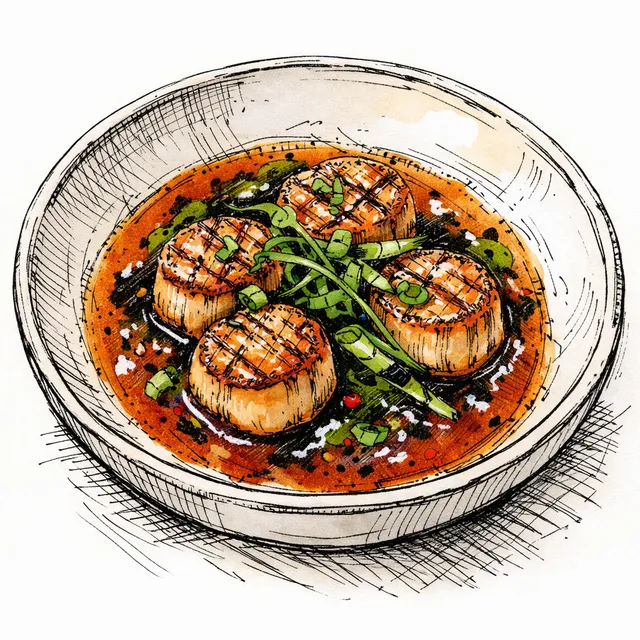
Smoke & Sea: Hard-Seared Scallops with Morita Dashi
The idea for this dish hit me during a late-night street food crawl in Oaxaca. I was eating a heavily smoked tlayuda, and my mind drifted straight back to my early days at the Tsukiji fish market. What if we brought Japanese precision to that intense, aggressive Mexican smoke? That is how the Smoked Morita Dashi was born. We are taking the deep, dried-fruit notes of Morita chiles and pairing them with smoky bonito flakes to create a crystal-clear umami bomb. It is the perfect, elegant pool for the real stars: hard-seared diver scallops. The trick to that perfect crust? Getting your pan aggressively hot and patting your scallops bone-dry. If there is even a drop of surface moisture, you are steaming, not searing. Why this works: the Maillard reaction on the scallop creates a sweet, caramelized crust that perfectly balances the savory, smoky broth. This recipe is special to me because it proves that culinary borders are just suggestions. To make it your own, do not be afraid to play with the charred scallion oil. Throw in a dash of fermented garlic honey or a squeeze of fresh lime. Break the rules. Just keep that sear hard and the dashi clear.
Featured Recipe
Hard-Seared Diver Scallops with Smoked Morita Dashi & Charred Scallion Oil
This is where Japanese minimalism meets aggressive Mexican smoke. We're creating a crystal-clear, umami-bomb dashi using smoke-dried Morita chiles and bonito flakes, which serve as an elegant pool for the star of the show: deeply crusty, hard-seared diver scallops.
Save a copy to your collection for editing
Timeline
Ingredients
- 12 oz Dry-packed diver scallops (U-10 or U-12 size)(Must be 'dry-packed'. Wet-packed scallops are treated with phosphates and will boil in their own liquid instead of searing.)
- 1.5 tsp Kosher salt(Divided use)
- 2.5 cups Water(Filtered or spring water)
- 1 piece Kombu(About 3x3 inches)
- 2 whole Morita chiles(Wiped clean with a damp cloth)
- 1 cup Bonito flakes (Katsuobushi)(Loosely packed)
- 1 tbsp Light soy sauce (Usukuchi)(Adds salt and umami without darkening the broth too much)
- 1 tsp Yuzu juice(Fresh lime juice works if yuzu is unavailable)
- 1 bunch Scallions (Spring onions)(Roots trimmed)
- 6 tbsp Grapeseed oil(Or any neutral, high-smoke-point oil (divided use))
- 2 tbsp Unsalted butter(Cold, cut into cubes)
Instructions
- 1
Place 12 oz dry-packed diver scallops (U-10 or U-12 size) on a paper towel-lined plate. Season all over with 1 tsp Kosher salt. Let them sit uncovered in the fridge. This dry-brining step draws out surface moisture—the mortal enemy of a good crust.
5 min
Tip: Never skip drying your scallops. If they hit the pan wet, you get steamed rubber instead of a mahogany crust.
- 2
In a medium saucepan, combine 2.5 cups water, 1 piece kombu, and 2 whole Morita chiles. Place over medium-low heat. You want to slowly coax the flavors out, bringing it to a bare simmer.
10 min
Tip: Don't let the kombu boil furiously; it can become bitter and slimy. Slow heating extracts the best glutamates.
- 3
Heat a dry, heavy skillet (cast iron or carbon steel) over high heat. Add 1 bunch scallions (Spring onions) and dry-char them until deeply blackened in spots and softened. Remove from heat.
7 min
Tip: We want actual char here. It echoes the smokiness of the Morita chile and adds a yakitori-like depth to the oil.
- 4
Just before the dashi hits a rolling boil, remove and discard the kombu. Let the chiles simmer for 3 more minutes. Turn off the heat, stir in 1 cup Bonito flakes (Katsuobushi), and let steep untouched.
5 min
Tip: Morita chiles and bonito flakes share an incredible smoke-dried DNA. Steeping them together builds massive, layered umami.
- 5
Roughly chop the charred scallions and transfer them to a blender. Add 4 tbsp Grapeseed oil and 0.5 tsp Kosher salt. Blend on high until vivid green, then strain through a fine-mesh sieve or coffee filter. Set the vibrant green oil aside.
5 min
Tip: If the oil gets too hot in the blender, it will lose its bright green color. Pulse it if your blender is very powerful.
- 6
Strain the steeped dashi through a fine-mesh sieve lined with a paper towel into a clean saucepan. Discard the solids. Season the clear broth with 1 tbsp Light soy sauce (Usukuchi) and 1 tsp Yuzu juice. Keep warm on very low heat.
2 min
Tip: Taste the broth—it should taste like a smoky, bright wave of the ocean. Adjust salt if necessary.
- 7
Wipe out your heavy skillet and place it over medium-high heat until it's ripping hot. Add the remaining 2 tbsp Grapeseed oil and let it heat until just starting to shimmer and smoke.
3 min
Tip: A hard sear demands high thermal mass. Cast iron or heavy stainless steel is non-negotiable here.
- 8
Remove scallops from the fridge and pat them completely dry with fresh paper towels one last time. Place them into the hot oil, pressing down gently for 2 seconds to ensure full surface contact. Step back and do not touch them for 2 full minutes.
2 min
Tip: The scallops will stick initially. When the Maillard reaction completes and the crust forms, they will naturally release from the pan.
- 9
Once a deep golden-brown crust has formed, flip the scallops. Immediately drop in 2 tbsp Unsalted butter. Tilt the pan and use a spoon to baste the foaming butter over the scallops for 60 seconds. Remove from the pan immediately.
2 min
Tip: The butter will brown rapidly, nuttifying the flavor and finishing the quick, gentle cooking of the scallop's interior.
- 10
To serve, pour a shallow pool of the warm Morita Dashi into wide bowls. Arrange the seared scallops in the broth. Use a spoon to dot the surface of the broth with the vibrant Charred Scallion Oil.
2 min
Tip: Serve immediately. The contrast between the crunchy, buttery crust of the scallop and the clean, smoky broth is pure magic.
Chef's Notes
I love connecting dots across oceans. Take the Mexican Morita chile—smoke-dried jalapeños—and Japanese katsuobushi—smoke-dried skipjack tuna. They are long-lost culinary cousins. They share this incredible, leathery, smoky DNA. When you steep them together in a dashi, it creates an umami bomb that is crystal clear and insanely elegant. But the real star here is technique: the hard sear. Most home cooks baby their scallops. Don't. You need a ripping hot pan, bone-dry surface area, and the patience to not touch them until they release themselves with a deep mahogany crust. This is where Japanese minimal presentation meets beautifully aggressive cooking.

Kenji Nakamura
Where Japanese precision meets global flavors
I trained in Tokyo for eight years, mastering the discipline of washoku—traditional Japanese cuisine. But I got restless. So I cooked my way through Southeast Asia, spent a year in Mexico City, and fell hard for the food of Peru. Now I see connections between cuisines that others miss: the umami in dashi and fish sauce, the heat in shishito and Szechuan peppercorns, the way Japanese technique can unlock flavors from any tradition. I'm always fermenting something.