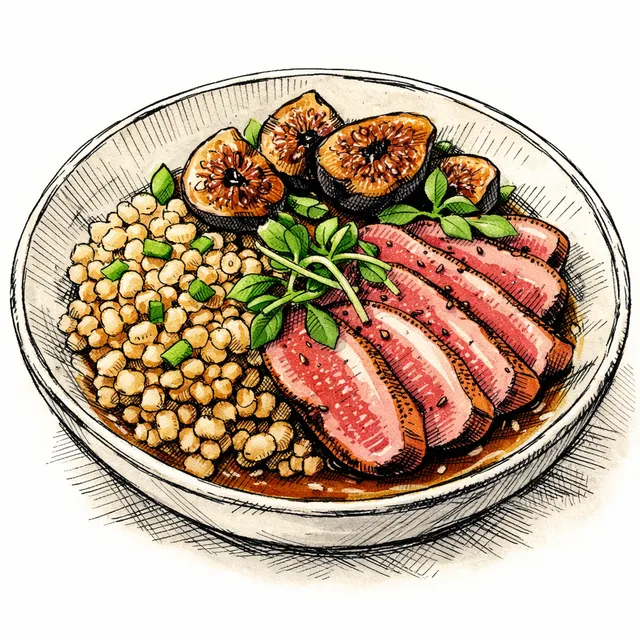
Smoked Tea and Red Miso Cured Duck Breast Bowl
Hey everyone! Let us talk about duck. Specifically, how a quick-curing session in Lapsang Souchong tea and dark red miso can completely blow your mind. I remember wandering through a smoky night market in Taipei, holding a cup of pine-smoked tea while snacking on grilled meats. That sensory collision stuck with me. Years later, tinkering in my Tokyo test kitchen, I realized that the tannins in smoked tea do the exact same thing to proteins that salt and acid do in a ceviche marinade—it tightens the surface proteins instantly. This 15-minute cure is a game-changer, drawing out excess moisture while packing in a woodsy, punchy umami that feels ancient and modern all at once. Pairing that shatteringly crisp skin with nutty, dashi-simmered pearl barley and a tart, charred fig-yuzu ponzu creates a bowl that hits every single tastebud. Why this works: the miso provides glutamates, the tea brings guaiacol for that campfire aroma, and the fig ponzu cuts right through the rich duck fat with vibrant fruit and acidity. Want to make it your own? Swap the barley for farro, or use whatever stone fruit you have grilling on the patio. Go break some rules and get fermenting!
Featured Recipe
Smoked Tea & Red Miso Cured Duck Breast Bowl with Toasted Pearl Barley & Charred Fig Ponzu
Quick-curing duck breast in a punchy mix of smoky Lapsang Souchong tea and dark red miso draws out surface moisture and infuses deep, woodsy umami in just 15 minutes. Rendered to shatteringly crisp skin and paired with dashi-simmered pearl barley and charred fig-yuzu ponzu, this bowl hits every tastebud with Japanese precision and smoky, vibrant fruit.
Save a copy to your collection for editing
Timeline
Ingredients
- 2 boneless duck breasts(approx. 14 oz total, skin-on)
- 1 tbsp ground Lapsang Souchong tea leaves(finely ground in a spice grinder or mortar)
- 1 tbsp kosher salt(coarse)
- 1 tbsp dark red miso paste (aka miso)
- 1 tsp raw brown sugar
- 1 cup pearl barley(rinsed and drained)
- 1 tsp toasted sesame oil
- 2 cups dashi stock(instant dashi or homemade kelp/bonito dashi)
- 3 tbsp light soy sauce(divided)
- 4 fresh ripe figs(halved)
- 2 tbsp yuzu juice(or equal parts lemon and lime juice)
- 1 tbsp mirin(Japanese sweet rice wine)
- 1 tsp fresh ginger(finely grated)
- 4 red radishes(sliced paper-thin)
- 2 tbsp rice vinegar(unseasoned)
- 4 fresh shiso leaves(chiffonade cut)
- 6 fresh mint leaves(roughly torn)
- 1 tbsp toasted sesame seeds(for garnish)
Instructions
- 1
Score 2 boneless duck breasts (approx 14 oz total) on the skin side in a fine 1/4-inch crosshatch pattern, taking care not to cut into the meat. In a small bowl, rub together 1 tbsp finely ground Lapsang Souchong tea leaves, 1 tbsp kosher salt, 1 tbsp dark red miso paste (aka miso), and 1 tsp raw brown sugar to create a damp cure paste. Massage the cure thoroughly over both sides of the duck breasts. Set aside at room temperature to quick-cure.
15 min
Tip: Scoring allows fat to render efficiently and gives the tea-miso cure direct contact with the subcutaneous fat layer.
- 2
Heat 1 tsp toasted sesame oil in a small saucepan over medium heat. Add 1 cup pearl barley and toast for 2 minutes until fragrant and lightly nutty. Pour in 2 cups dashi stock and 1 tbsp light soy sauce. Bring to a boil, then reduce heat to low, cover, and simmer until barley is tender and chewy.
25 min
Tip: Toasting the raw grain before boiling amplifies its natural nutty flavor profile to match the rich duck fat.
- 3
Place a small cast-iron skillet over high heat until smoking hot. Place 4 fresh ripe figs cut-side down and char without moving for 2 minutes until deeply caramelized and blackened around the edges. Transfer 2 charred fig halves into a bowl and mash with a fork; whisk in 2 tbsp yuzu juice, remaining 2 tbsp light soy sauce, 1 tbsp mirin, and 1 tsp finely grated fresh ginger to complete the vinaigrette. Reserve the remaining 2 charred fig halves for bowl garnish.
10 min
Tip: Charring the figs concentrates their natural sugars, balancing the high acidity of yuzu juice.
- 4
In a small bowl, toss 4 red radishes with 2 tbsp rice vinegar and a pinch of salt. Set aside to flash-pickle. Thinly slice 4 fresh shiso leaves and tear 6 fresh mint leaves.
5 min
Tip: Quick pickling the radishes provides a bright, crunchy palate cleanser against the rich duck breast.
- 5
Wipe the excess tea-miso cure off the duck breasts with a paper towel and pat completely dry. Place the duck breasts skin-side down in a cold, unheated cast-iron skillet. Set heat to medium-low. Render the fat slowly for 10-12 minutes, pouring off rendered liquid fat as needed, until skin is deep mahogany and crackling crisp. Turn duck breasts over and sear meat side for 2-3 minutes until internal temperature reaches 130°F (54°C). Transfer to a cutting board and rest for 5 minutes before thinly slicing.
15 min
Tip: Starting in a cold pan is non-negotiable! It slowly melts the thick fat cap without overcooking the tender breast meat beneath.
- 6
Fluff the warm dashi barley and divide between two serving bowls. Fan out sliced duck breast alongside quick-pickled radishes and reserved charred fig halves. Drizzle charred fig-yuzu ponzu generously over the duck and grain. Garnish with 1 tbsp toasted sesame seeds, sliced shiso, and torn mint.
5 min
Tip: Pour any resting juices from the sliced duck back into the fig ponzu for extra savory depth.
Chef's Notes
WHY THIS WORKS: Curing isn't reserved only for long-term preservation! A fast, 15-minute high-surface cure using salt, tea tannins, and fermented miso pulls bound surface moisture out of the duck skin through osmosis. This dry-surface effect combined with a cold-pan rendering technique allows sub-cutaneous fat to melt off gradually while guaranteeing crackling skin and perfectly tender medium-rare meat. Pairing smoky tea notes with bright yuzu and charred figs bridges Japanese micro-seasonality with global street food flair.

Kenji Nakamura
Where Japanese precision meets global flavors
I trained in Tokyo for eight years, mastering the discipline of washoku—traditional Japanese cuisine. But I got restless. So I cooked my way through Southeast Asia, spent a year in Mexico City, and fell hard for the food of Peru. Now I see connections between cuisines that others miss: the umami in dashi and fish sauce, the heat in shishito and Szechuan peppercorns, the way Japanese technique can unlock flavors from any tradition. I'm always fermenting something.