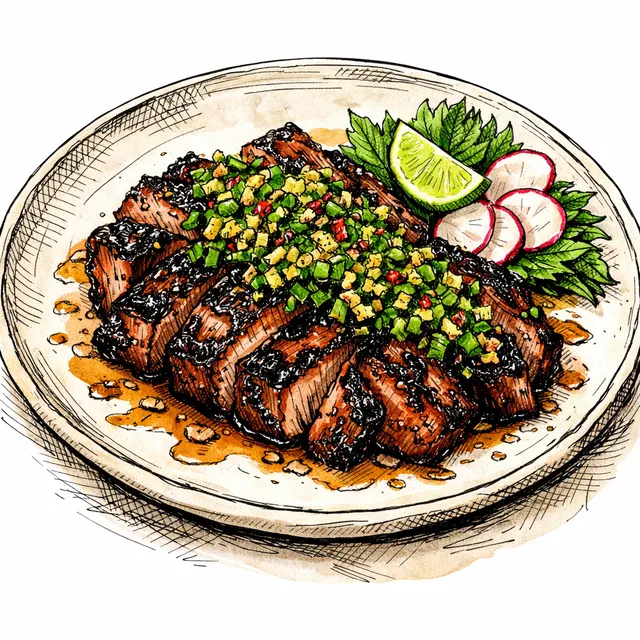
Smoky Ancho-Miso Char-Grilled Pork Shoulder with Shiso Salsa Crunch
The idea for this dish hit me years ago while wandering through a bustling market in Oaxaca. The air was thick with the scent of roasted chiles, and my mind instantly jumped to the dark, funky red miso I had bubbling away in a jar back in Tokyo. I realized they share the exact same deep, earthy DNA.
This Smoky Ancho-Miso Char-Grilled Pork Shoulder is where those two worlds collide. I love taking hardworking cuts like pork shoulder and transforming them. Here is the geeky part (you know I can't resist): why does this work? Miso is loaded with proteases—enzymes that break down complex proteins. When you slice the shoulder like a steak and cure it in a smoky ancho-miso paste, those enzymes tenderize the meat, while the sugars prime it for the ultimate caramelized char on the grill.
To cut through that rich, rendered fat, I finish it with a Shiso Salsa Crunch. The herbaceous snap of shiso mixed with toasted pumpkin seeds hits every single taste receptor.
Make it your own! Don't have shiso? Swap in a mix of cilantro and mint. Want it spicier? Throw some toasted guajillo into the marinade. Trust the enzymes, get that grill screaming hot, and break some rules!
Featured Recipe
Smoky Ancho-Miso Char-Grilled Pork Shoulder with Shiso Salsa Crunch
I love taking hardworking cuts like pork shoulder and transforming them through the magic of enzymatic marinades. By slicing it like a steak and curing it in a smoky ancho-miso paste, we get a tender, caramelized crust on the grill that screams summer BBQ. The rich fat is perfectly balanced by a highly textured, herbaceous shiso and pumpkin seed salsa that hits every single taste receptor.
Save a copy to your collection for editing
Timeline
Ingredients
- 2 lbs Pork shoulder (blade or boston butt), cut into 1/2-inch steaks(bone removed)
- 3 tbsp Shio koji(can be found in Japanese markets or made at home)
- 2 tbsp Aka (red) miso(provides a deep, earthy umami)
- 1 tbsp Ancho chile powder(adds a mild, raisiny smoke)
- 2 tbsp Black vinegar (Chinkiang)(substitute unseasoned rice vinegar if unavailable)
- 1 tbsp Fresh ginger(grated)
- 3 cloves Garlic(grated)
- 1 tbsp Toasted sesame oil
- 20 leaves Fresh shiso leaves(finely chopped)
- 1 medium Jalapeño(finely diced, keep seeds if you like heat)
- 0.5 cup Toasted pumpkin seeds (pepitas)(roughly chopped for texture)
- 2 stalks Scallions(thinly sliced)
- 3 tbsp Grapeseed oil(or any neutral high-heat oil)
- 1 tbsp Lime juice(freshly squeezed)
Instructions
- 1
Mix 3 tbsp Shio koji, 2 tbsp Aka (red) miso, 1 tbsp Ancho chile powder, 2 tbsp Black vinegar (Chinkiang), 1 tbsp Fresh ginger, 3 cloves Garlic, and 1 tbsp Toasted sesame oil in a large bowl. Toss the 2 lbs Pork shoulder (blade or boston butt), cut into 1/2-inch steaks in the marinade, massaging it aggressively into the meat.
10 min
Tip: Shio koji contains protease enzymes that break down tough shoulder proteins. Even a 30-minute marinade does wonders, but 4-6 hours in the fridge is the sweet spot for maximum tenderness.
- 2
While the pork rests in its marinade, build the salsa. In a medium bowl, combine the 20 leaves Fresh shiso leaves, 1 medium Jalapeño, 0.5 cup Toasted pumpkin seeds (pepitas), 2 stalks Scallions, 3 tbsp Grapeseed oil, and 1 tbsp Lime juice. Stir well to incorporate.
10 min
Tip: Letting this sit at room temperature allows the neutral oil to extract and carry the fat-soluble aromatic compounds from the jalapeño and shiso, deepening the flavor.
- 3
Fire up your grill for two-zone cooking, aiming for high, direct heat on one side. If using charcoal, get the coals blazing white hot. If cooking indoors, preheat a heavy cast-iron skillet over high heat.
10 min
Tip: Pork shoulder has enough internal fat that we want a serious, aggressive sear. The sugars and amino acids in the miso and shio koji will char quickly, giving us beautiful, bittersweet grill marks via the Maillard reaction.
- 4
Scrape any thick excess marinade off the pork steaks to prevent burning, then place them directly over the hottest part of the grill. Cook for about 4 minutes per side, until deeply charred and the fat begins to render and crisp.
8 min
Tip: Don't panic if you get flare-ups from the rendering fat; just slide the steaks over to the cooler zone for a moment to let the flames die down, then move them back to the fire.
- 5
Pull the pork from the grill and let it rest on a cutting board.
5 min
Tip: A 5-minute rest gives the muscle fibers time to relax and reabsorb juices. Skipping this means your cutting board drinks all that flavorful liquid instead of you.
- 6
Slice the rested pork against the grain into thin strips. Arrange on a serving platter and spoon the shiso salsa crunch generously over the top of the meat.
2 min
Tip: Serve immediately while the contrast between the hot pork and room-temperature salsa is at its peak.
Chef's Notes
Why this works: We're borrowing the Korean BBQ approach of grilling tough, well-marbled cuts quickly over high heat, but injecting it with a Japanese-Mexican flavor profile. The Ancho chile and red miso are long-lost cousins - both bring dark, raisiny, earthy depth. By employing shio koji as our tenderizer, we avoid the mushy texture that highly acidic or pineapple marinades can sometimes cause. The shiso acts as our herbaceous bridge, cutting through the rich pork fat with its bright, minty-basil bite.

Kenji Nakamura
Where Japanese precision meets global flavors
I trained in Tokyo for eight years, mastering the discipline of washoku—traditional Japanese cuisine. But I got restless. So I cooked my way through Southeast Asia, spent a year in Mexico City, and fell hard for the food of Peru. Now I see connections between cuisines that others miss: the umami in dashi and fish sauce, the heat in shishito and Szechuan peppercorns, the way Japanese technique can unlock flavors from any tradition. I'm always fermenting something.