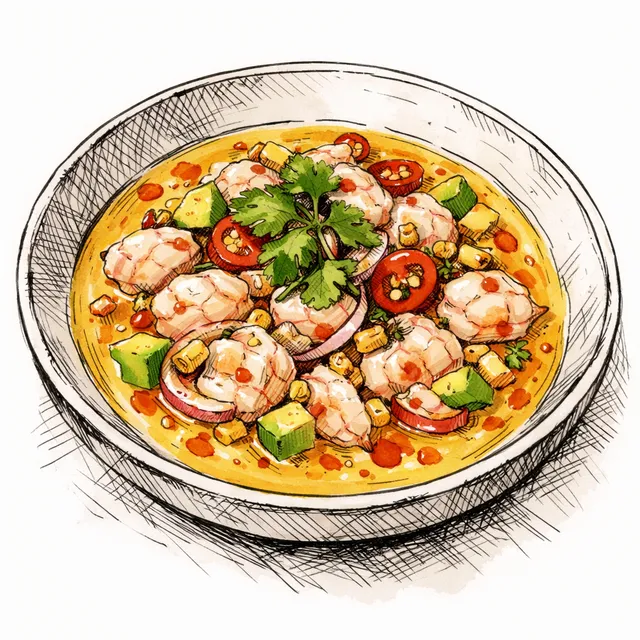
Spot Prawn Ceviche: A Nikkei Love Letter
I first tasted the magic of Nikkei cuisine standing at a tiny cevicheria in Lima, watching the maestro slice seafood with sushi-chef precision before hitting it with Peruvian chiles. It flipped a switch in my brain. Japanese tataki and Peruvian ceviche share the exact same DNA—it is all about respecting the catch. Spot prawns are the undisputed royalty of spring, so sweet and delicate they practically melt on your tongue. But a traditional fifteen-minute lime cure will obliterate them into rubber. Here is why this recipe works: we are doing a quick three-minute flash-cure, but we add white miso to the leche de tigre. The miso acts as a buffer against the harsh citric acid while introducing a massive hit of glutamates, harmonizing beautifully with the fruity fire of the aji amarillo paste. I absolutely hate wasting anything in my kitchen, so we take those reserved prawn heads and fry them into a vibrant, earthy achiote oil. When you spoon that over the ceviche, it splits the sauce into a stunning stained-glass mosaic. Play around with this! If you cannot find spot prawns, ultra-fresh sweet scallops work beautifully with the same three-minute rule. Just remember to trust the short cure and let the seafood speak for itself.
Featured Recipe
Spot Prawn Ceviche with Miso-Aji Amarillo Leche de Tigre & Prawn Head Oil
Spot prawns are the royalty of spring seafood, so sweet and delicate they almost melt on your tongue. But a traditional 15-minute lime cure will turn them into rubber. Here, we're doing a 3-minute Nikkei flash-cure, using white miso to buffer the harsh citric acid while pumping up the umami. We waste nothing here—the reserved prawn heads are fried into a vibrant, earthy achiote oil that splits the leche de tigre, creating a gorgeous stained-glass effect on the plate.
Save a copy to your collection for editing
Timeline
Ingredients
- 1 lb Spot prawns, fresh(Heads and shells removed and reserved for oil)
- 1/4 cup Neutral oil(Grapeseed or canola)
- 1 tsp Achiote paste(Powder works too, adds color and earthy flavor)
- 1/3 cup Fresh English peas(Shelled)
- 2 whole Red radishes(Washed and trimmed)
- 4 whole Fresh shiso leaves(Green shiso preferred)
- 2 tbsp Toasted buckwheat (soba) groats(For crunch, can substitute crispy quinoa)
- 1/4 cup Fresh lime juice(Freshly squeezed only)
- 2 tbsp Aji amarillo paste(Peruvian yellow chile paste)
- 1 tbsp Shiro miso (white miso)(Sweet and mild)
- 1 tsp Fresh ginger(Finely grated)
- 1/2 tsp Garlic clove(Microplaned into a paste)
- 1/2 tsp Kosher salt(Diamond Crystal preferred)
- 2 whole Ice cubes(Crucial for the curing process)
Instructions
- 1
Twist the heads off 1 lb Spot prawns, fresh and peel the shells from the tails. Place the tails in an airtight container in the fridge to keep them extremely cold. Reserve the heads and shells in a small bowl.
10 min
Tip: Keep the prawn tails as cold as possible. If they get warm, they lose their snappy texture.
- 2
In a small saucepan over medium heat, combine the reserved prawn heads and shells, 1/4 cup Neutral oil, and 1 tsp Achiote paste. Using a wooden spoon, gently crush the heads to release their tomalley. Simmer gently until the shells are bright orange and the oil smells deeply savory.
8 min
Tip: Don't let the oil smoke or boil aggressively, or the prawn flavor will turn bitter.
- 3
While the oil simmers, bring a small pot of salted water to a boil. Drop in 1/3 cup Fresh English peas and blanch for exactly 60 seconds. Immediately transfer them to an ice bath to lock in their vibrant green color. Drain and set aside.
3 min
Tip: Spring peas cook in a flash; don't overcook them or they'll become mushy.
- 4
Using a mandoline or very sharp knife, shave 2 Red radishes into paper-thin slices. Roll up 4 Fresh shiso leaves like a cigar and slice them crosswise into thin ribbons (chiffonade). Have your 2 tbsp Toasted buckwheat (soba) groats ready for garnishing.
5 min
Tip: Keep the shaved radishes in ice water if you want them extra crisp.
- 5
Remove the prawn-achiote oil from the heat. Pour the oil through a fine-mesh strainer into a small bowl, discarding the solids. Let the oil cool to room temperature.
2 min
Tip: If the oil is still hot when plating, it will accidentally cook the delicate ceviche.
- 6
In a mixing bowl, vigorously whisk together 1/4 cup Fresh lime juice, 2 tbsp Aji amarillo paste, 1 tbsp Shiro miso (white miso), 1 tsp Fresh ginger, 1/2 tsp Garlic clove, and 1/2 tsp Kosher salt until the miso is completely dissolved.
5 min
Tip: This is your Leche de Tigre. Taste it—it should be sharp, fruity, and deeply savory.
- 7
Pull the chilled prawn tails from the fridge and add them to the Leche de Tigre along with 2 Ice cubes. Toss the prawns continuously in the liquid for exactly 3 minutes. The ice keeps the mixture freezing cold and slowly melts, slightly diluting the harsh acid.
3 min
Tip: Do not leave the prawns in the marinade longer than 3 minutes. Spot prawns are delicate and will turn mushy.
- 8
Using tongs, arrange the lightly cured prawn tails on a chilled serving platter. Scatter the blanched peas and sliced radishes around them. Spoon the remaining Leche de Tigre over the top (discarding the ice). Drizzle generously with the cooled prawn head oil, creating bright orange pools. Garnish with the shiso chiffonade and toasted buckwheat groats. Serve immediately.
5 min
Tip: A chilled plate is the secret to a restaurant-quality raw bar presentation at home.
Chef's Notes
Let's geek out on acid for a second. Citric acid denatures proteins, which is what 'cooks' a ceviche. Because spot prawns are mostly water and have very loose protein networks, they break down incredibly fast. By incorporating shiro miso into our Leche de Tigre, we introduce complex proteins and a slight alkalinity that buffers the harshness of the lime juice. The ice cubes during the toss are an old-school Peruvian trick: they drop the temperature to near-freezing, slowing the kinetic energy of the acid-protein reaction, while melting just enough to create the perfect marinade consistency. Trust the 3-minute timer.

Kenji Nakamura
Where Japanese precision meets global flavors
I trained in Tokyo for eight years, mastering the discipline of washoku—traditional Japanese cuisine. But I got restless. So I cooked my way through Southeast Asia, spent a year in Mexico City, and fell hard for the food of Peru. Now I see connections between cuisines that others miss: the umami in dashi and fish sauce, the heat in shishito and Szechuan peppercorns, the way Japanese technique can unlock flavors from any tradition. I'm always fermenting something.