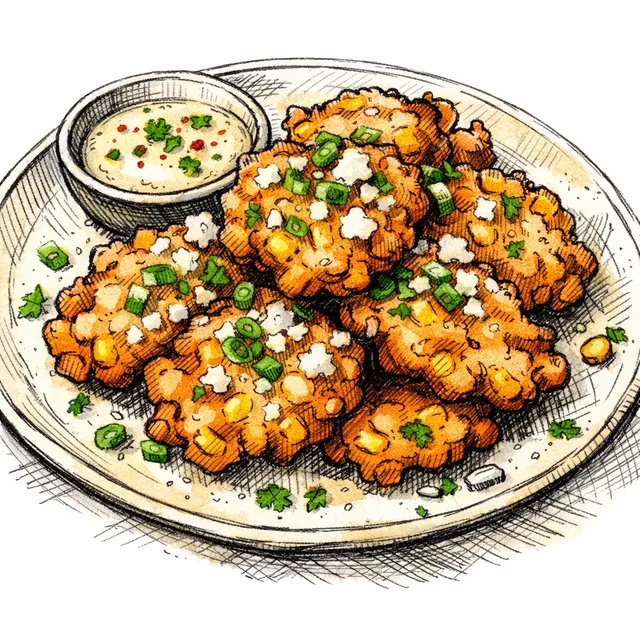
Chewy Sweet Corn & Cotija Mochiko Fritters: A Tokyo-Oaxaca Mashup
I still remember the first time I bit into a charred, mayo-slathered elote in Oaxaca. The sweet crunch of the corn against the salty, funky cotija cheese immediately triggered a memory of eating savory okonomiyaki back in Tokyo. That is exactly where the inspiration for these Chewy Sweet Corn and Cotija Mochiko Fritters was born. Imagine Mexican street corn and a Japanese savory pancake had a beautifully chewy, crispy baby. What makes this recipe so special to me is how it perfectly bridges my Japanese roots with my time cooking in Mexico. Let us geek out on why this works: by binding fresh sweet summer corn and salty cotija cheese with glutinous rice flour (mochiko), we get an ultra-crispy, pan-fried exterior with a bouncy, mochi-like center. Mochiko is extremely high in amylopectin, a starch that gelatinizes into that crave-worthy, stretchy texture, perfectly cradling the juicy pops of corn. It is an umami bomb wrapped in a textural wonderland. To make it your own, do not be afraid to break the rules. Fold in some of your favorite fermented chilies, or swap the cotija for a funky aged cheddar. I personally love dipping these in a quick gochujang mayo for a little Korean heat. Grab a cold beer, fire up the skillet, and let us get frying!
Featured Recipe
Chewy Sweet Corn & Cotija Mochiko Fritters
Imagine Mexican street corn (elote) and a Japanese savory pancake had a beautifully chewy, crispy baby. By binding fresh sweet summer corn and salty cotija cheese with glutinous rice flour, we get an ultra-crispy, pan-fried exterior with a bouncy, mochi-like center that's perfect for a summer izakaya night.
Save a copy to your collection for editing
Timeline
Ingredients
- 2 cups fresh sweet corn kernels(Cut from about 2-3 cobs)
- 1/2 cup cotija cheese(Crumbled, plus extra for garnish)
- 1/4 cup scallions(Finely sliced)
- 1 cup mochiko(Sweet glutinous rice flour)
- 1/4 cup all-purpose flour(Provides structural integrity to the mochi chew)
- 3/4 cup kombu dashi(Or vegetable broth / water)
- 1 large egg(Beaten)
- 1 tbsp shiro miso(White miso paste)
- 3 tbsp unsalted butter(Divided for pan-frying)
- 1 tbsp neutral oil(Like canola or grapeseed, divided)
- 2 tbsp honey(For the drizzle)
- 1 tsp shichimi togarashi(Japanese 7-spice blend)
- 1 lime(Zested and juiced)
Instructions
- 1
Prep your aromatics and mix-ins. Cut the 2 cups fresh sweet corn kernels off the cob, thinly slice the 1/4 cup scallions, and crumble the 1/2 cup cotija cheese. Keep them in a bowl nearby.
5 min
Tip: If your corn is super fresh and juicy, dab the kernels with a paper towel so they don't water down our batter.
- 2
In a large mixing bowl, whisk together the 1 cup mochiko and 1/4 cup all-purpose flour. In a separate smaller bowl, thoroughly whisk the 3/4 cup kombu dashi, 1 large egg, and 1 tbsp shiro miso until the miso is completely dissolved.
3 min
Tip: Miso loves to clump. Whisking it into the liquids first ensures you won't bite into a pocket of pure salt later.
- 3
Pour the wet ingredients into the dry ingredients and stir just until a thick batter forms. Fold in the prepared corn, scallions, and cotija cheese until evenly distributed.
2 min
Tip: The batter should be thick, almost like a loose cookie dough. If it's too runny, add another dusting of mochiko.
- 4
Heat a heavy cast-iron skillet or griddle over medium heat. Add 1.5 tbsp unsalted butter and 0.5 tbsp neutral oil. Once bubbling, drop 1/4 cup portions of the batter into the pan, pressing them down slightly into patties. Fry undisturbed until the bottoms are deep golden brown and crispy.
5 min
Tip: The neutral oil raises the smoke point of the butter, giving us those deeply caramelized brown butter flavors without burning.
- 5
While the first batch cooks, make the spicy drizzle. In a small bowl, combine 2 tbsp honey, 1 tsp shichimi togarashi, and the zest and juice of 1 lime. Whisk to combine.
2 min
Tip: This is a great task to do while keeping one eye on the skillet.
- 6
Flip the fritters and cook the other side until deeply browned and the corn kernels on the surface begin to char and pop.
4 min
Tip: Listen to the pan—when you hear the corn start to pop, you're hitting maximum flavor.
- 7
Remove the first batch to a wire rack. Add the remaining 1.5 tbsp unsalted butter and 0.5 tbsp neutral oil to the skillet and repeat the pan-frying process with the rest of the batter.
9 min
Tip: Don't place them on paper towels; a wire rack keeps the mochiko crust exceptionally crispy.
- 8
Transfer the hot fritters to a serving platter. Drizzle generously with the shichimi-lime honey, and garnish with a little extra crumbled cotija and scallions. Serve immediately.
2 min
Tip: These are best eaten hot, straight from the pan, while the mochi interior is at its stretchiest.
Chef's Notes
Let's geek out for a second: why bind this with mochiko (sweet rice flour) instead of a standard flour batter? Mochiko is primarily composed of amylopectin, a starch that gelatinizes beautifully when hydrated and cooked. It gives you this incredible chewiness that contrasts with the snappy pop of the fresh corn. When we pan-fry it in butter, we get lacy, caramelized edges. The cotija cheese is my sneaky addition—its lactic acid and sharp salinity cut right through the rich brown butter, mimicking the role of a fermented ingredient. It's an umami bomb wrapped in a textural masterpiece of textural contrast.

Kenji Nakamura
Where Japanese precision meets global flavors
I trained in Tokyo for eight years, mastering the discipline of washoku—traditional Japanese cuisine. But I got restless. So I cooked my way through Southeast Asia, spent a year in Mexico City, and fell hard for the food of Peru. Now I see connections between cuisines that others miss: the umami in dashi and fish sauce, the heat in shishito and Szechuan peppercorns, the way Japanese technique can unlock flavors from any tradition. I'm always fermenting something.