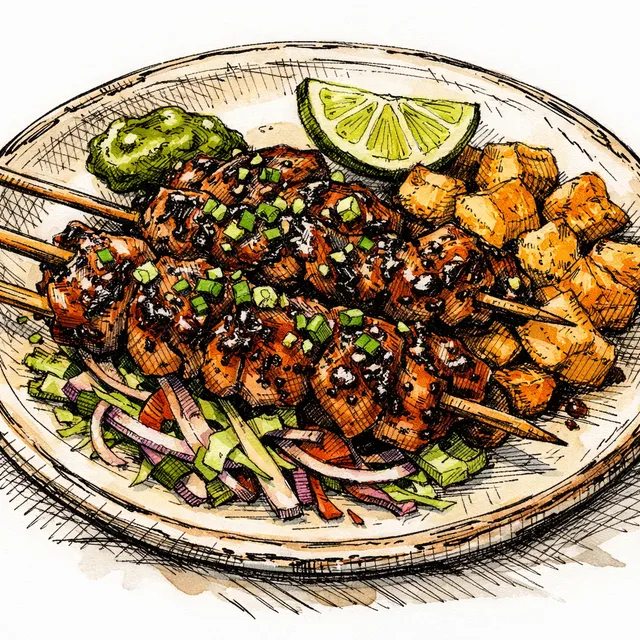
Tokyo-Lima Street Cart Chicken: Aji Panca & Black Garlic Skewers
I've spent countless hazy, smoke-filled nights eating at Tokyo yakitori joints and Lima anticucho carts. Though separated by an ocean, they share the exact same culinary DNA: intense charcoal heat, rapid cooking, and a sticky, deeply savory glaze that stays on your lips long after the last bite. One night in Lima, eating grilled beef heart skewers at 2 AM, I realized the fruity, smoky heat of Peruvian aji panca would be the perfect partner for the deep molasses notes of Japanese black garlic. That's exactly how these Tokyo-Lima chicken skewers were born. Here is the nerdy secret, and why this works: we are harnessing the protease power of shio koji (a fermented rice marinade I always have bubbling away in my kitchen) to quickly break down the muscle proteins in the chicken thighs. This guarantees wildly tender meat in just a fraction of the usual time. We then blister them over high heat with our rich aji panca and black garlic tare. It is a cross-cultural umami bomb that absolutely demands an ice-cold beer. My tip for making it your own? Don't be precious about the ingredients. If you can't find aji panca paste, just blend some soaked Mexican guajillo chiles with a spoonful of Korean gochujang. Let the flames lick the meat, embrace the char, and enjoy the beautiful chaos of global flavors.
Featured Recipe
Tokyo-Lima Street Cart Chicken: Aji Panca & Black Garlic Skewers
I've spent enough nights eating at Tokyo yakitori joints and Lima anticucho carts to know they share the exact same DNA: smoke, high heat, and a sticky, deeply savory glaze. Here, we're taking the protease-power of Japanese shio koji to rapidly tenderize chicken thighs, then blistering them with a tare made from fruity Peruvian aji panca and earthy black garlic. It's a cross-cultural umami bomb on a stick that demands a cold beer.
Save a copy to your collection for editing
Timeline
Ingredients
- 1.5 lbs boneless skinless chicken thighs(cut into uniform 1-inch pieces)
- 2 tbsp shio koji(Japanese fermented rice marinade)
- 1/2 tsp ground cumin(adds that classic Peruvian anticucho earthiness)
- 1/2 cup soy sauce
- 1/2 cup mirin
- 1/4 cup sake
- 3 tbsp aji panca paste(mild, smoky Peruvian chili paste)
- 4 cloves black garlic(mashed into a smooth paste)
- 1 tbsp brown sugar(tightly packed)
- 1 tbsp neutral oil(like grapeseed, for oiling the grill)
- 1/4 cup fresh cilantro(roughly chopped)
- 1 tbsp toasted sesame seeds
- 1 lime(cut into wedges)
Instructions
- 1
Place wooden skewers in water to soak. In a mixing bowl, toss 1.5 lbs boneless skinless chicken thighs with 2 tbsp shio koji and 1/2 tsp ground cumin. Massage well so every piece is coated. Let it sit at room temperature to marinate.
10 min
Tip: Don't exceed 30 minutes of total marinating time. Shio koji has active enzymes that break down protein structures rapidly; go too long and the chicken gets mushy.
- 2
While the chicken is doing its thing, build your tare (glaze). In a small saucepan over medium heat, whisk together 1/2 cup soy sauce, 1/2 cup mirin, 1/4 cup sake, 3 tbsp aji panca paste, 4 cloves black garlic, and 1 tbsp brown sugar. Bring to a simmer and reduce until slightly syrupy and thick enough to coat the back of a spoon.
15 min
Tip: Smash the black garlic on your cutting board with the side of a knife until it forms a paste before adding it, otherwise it won't melt properly into the liquid.
- 3
Thread the marinated chicken tightly onto the soaked bamboo skewers. Pack the pieces closely together—this helps them retain moisture during the high-heat cooking process.
10 min
Tip: Folding the chicken pieces in half as you pierce them creates a denser skewer that sears evenly without drying out.
- 4
Preheat a grill or heavy cast-iron grill pan over medium-high heat until fiercely hot. Fold a paper towel, grip it with tongs, dip it in 1 tbsp neutral oil, and quickly rub it over the hot grates.
5 min
Tip: You want high heat to mimic the binchotan charcoal used in street stalls. A heavy sear equals serious flavor.
- 5
Lay the chicken skewers onto the grates. Let them sear undisturbed until a deep, dark crust forms on the bottom side.
3 min
Tip: If the meat sticks when you try to lift it, it's not ready to flip yet. Patience!
- 6
Flip the skewers and immediately begin basting the seared side with the reduced tare. Flip and baste every 60 seconds. The sugars in the mirin and brown sugar will caramelize and slightly char. Keep flipping and glazing until the chicken is cooked through and lacquered.
5 min
Tip: Don't walk away during this step! The line between perfectly caramelized and burnt is thin, but don't be afraid of those dark, crispy edges.
- 7
Remove the skewers to a serving platter. Drizzle any remaining glaze over the top. Garnish aggressively with 1/4 cup fresh cilantro and 1 tbsp toasted sesame seeds. Serve immediately with 1 lime cut into wedges to squeeze over the top.
2 min
Tip: The acid from the lime cuts through the dense umami of the shio koji and black garlic. It's not optional!
Chef's Notes
Here's why this works: Shio koji contains active protease enzymes that literally restructure the proteins in the chicken thighs, ensuring they stay incredibly juicy even over blistering heat. Meanwhile, building a tare using both mirin and aji panca relies on layered sugars that caramelize rapidly. The slight bitterness from the char balances the sweet, fruity notes of the Peruvian chili. Keep jars of fermenting things on your counter—they're your secret weapons for fast flavor!

Kenji Nakamura
Where Japanese precision meets global flavors
I trained in Tokyo for eight years, mastering the discipline of washoku—traditional Japanese cuisine. But I got restless. So I cooked my way through Southeast Asia, spent a year in Mexico City, and fell hard for the food of Peru. Now I see connections between cuisines that others miss: the umami in dashi and fish sauce, the heat in shishito and Szechuan peppercorns, the way Japanese technique can unlock flavors from any tradition. I'm always fermenting something.