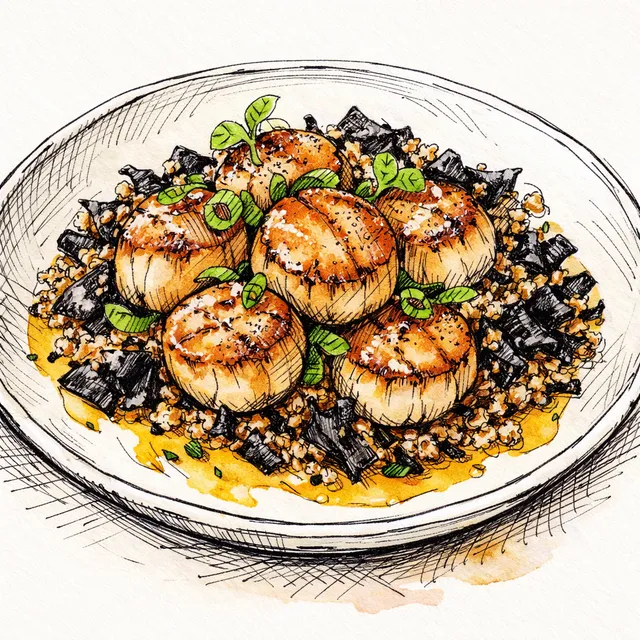
Tokyo Meets Lima: Quick-Seared Scallops with Aji Amarillo-Sake Butter
The first time I bit into a raw aji amarillo pepper in a noisy Lima market, my brain instantly flashed back to Tokyo. That fruity, sunny heat? It begged for the rounded, fermented depth of white miso and the crispness of dry sake. This dish is that exact lightbulb moment on a plate. We are hitting plump sea scallops with a screaming hot skillet for a hard, fast sear. This builds a deeply caramelized crust via the Maillard reaction without turning the delicate interior into rubber. Then comes the magic: basting them in a bright emulsion of Peruvian aji amarillo paste, sake, and miso. The sake lifts the rich butter, while the miso anchors the bright chili. Finally, I add crispy toasted quinoa mixed with crushed nori for a shattered-glass texture against the buttery mollusks. Why does this work? It is all about sensory contrast. Rich meets bright, soft meets crunchy. My biggest tip for this recipe? Pat those scallops bone-dry before cooking and let them sizzle completely undisturbed. Want to make it your own? Swap the nori for toasted amaranth, or fold a spoonful of fermented gochujang into the butter if you are out of aji amarillo. Get in the kitchen and play!
Featured Recipe
Quick-Seared Scallops with Aji Amarillo-Sake Butter & Crispy Nori Quinoa
A collision of Tokyo and Lima on a plate, right out of a screaming hot skillet. We're hitting plump sea scallops with a hard, fast sear to build a deeply caramelized crust, then basting them in a bright, fruity emulsion of Peruvian aji amarillo, sake, and white miso. The crispy toasted quinoa and nori crunch adds the perfect shattered-glass texture against the buttery mollusks.
Save a copy to your collection for editing
Timeline
Ingredients
- 1 lb dry sea scallops(Must be labeled 'dry' (untreated with STPP), tough abductor muscle removed)
- 1/2 cup cooked white quinoa(Leftover, chilled quinoa works best)
- 1 tbsp furikake or crushed nori(Classic sesame/seaweed blend)
- 2 tbsp aji amarillo paste(Peruvian yellow pepper paste, found in Latin markets)
- 2 tbsp sake(Dry cooking sake)
- 1 tsp white miso paste(Shiro miso for a mild umami backbone)
- 1 tbsp neutral oil(Grapeseed or canola for high-heat searing)
- 3 tbsp unsalted butter(Cubed and kept cold)
- 1 tbsp lime juice(Freshly squeezed)
- 1/2 tsp flaky sea salt(For finishing)
Instructions
- 1
Place the 1 lb dry sea scallops on a paper towel-lined plate. Pat them aggressively dry on all sides and leave them uncovered while you prep. Moisture is the enemy of the Maillard reaction—if they are wet, they will steam instead of sear.
5 min
Tip: If your store only had 'wet' scallops, soak them in a quart of cold water with 2 tbsp salt and 2 tbsp lemon juice for 15 minutes to purge the phosphates, then dry thoroughly.
- 2
Place a dry skillet over medium heat. Add the 1/2 cup cooked white quinoa and toast, stirring frequently, until deeply golden and crunchy. Transfer to a small bowl and toss with the 1 tbsp furikake or crushed nori.
8 min
Tip: Listen to the quinoa—it will pop slightly as it loses moisture. Keep it moving so it doesn't burn.
- 3
In a small bowl, whisk together the 2 tbsp aji amarillo paste, 2 tbsp sake, and 1 tsp white miso paste. Set aside near your stove. This will be the base of your pan sauce.
2 min
Tip: Miso loves to clump, so smash it against the side of the bowl with your whisk to fully dissolve it into the sake.
- 4
Heat a heavy cast-iron or carbon steel skillet over medium-high heat until ripping hot. Add the 1 tbsp neutral oil. Once it begins to shimmer and lightly smoke, gently lay the scallops in the pan clockwise so you know which one to flip first. Sear completely undisturbed for 90 seconds.
2 min
Tip: Do not touch them! The crust needs time to develop and release itself from the pan naturally.
- 5
Flip the scallops using tongs or a fish spatula. Immediately drop the heat to medium-low. Add the 3 tbsp unsalted butter and the aji amarillo-sake mixture. As the butter melts and foams, tilt the pan towards you and use a spoon to aggressively baste the scallops with the bubbling emulsion for another 60 to 90 seconds.
2 min
Tip: Basting cooks the scallops gently from the top down while infusing them with the complex, fruity heat of the sauce.
- 6
Transfer the scallops immediately to a warm serving platter to stop the cooking. Off the heat, swirl the 1 tbsp lime juice into the residual pan sauce. Spoon this glossy, golden emulsion over the scallops, top generously with the quinoa crunch, and finish with a pinch of 1/2 tsp flaky sea salt.
2 min
Tip: Serve this immediately. The contrast between the hot, tender scallop, the rich butter, and the shattered-glass crunch of the quinoa is highly perishable magic.
Chef's Notes
Why this works: You hear chefs harp on 'dry' scallops constantly, and I'm going to be that guy too. 'Wet' scallops are soaked in sodium tripolyphosphate (STPP) to artificially plump their weight with water. When that water hits a 450°F pan, it immediately leeches out, dropping the temperature of your skillet and boiling your beautiful seafood. Seek out dry scallops—they should be slightly sticky to the touch and ivory or slightly pinkish in color, not brilliant white. The flavor pairing here is classic Nikkei: Aji amarillo has a natural sunny, fruity heat that perfectly bridges the oceanic sweetness of the scallop with the deep, savory brewed notes of sake and miso.

Kenji Nakamura
Where Japanese precision meets global flavors
I trained in Tokyo for eight years, mastering the discipline of washoku—traditional Japanese cuisine. But I got restless. So I cooked my way through Southeast Asia, spent a year in Mexico City, and fell hard for the food of Peru. Now I see connections between cuisines that others miss: the umami in dashi and fish sauce, the heat in shishito and Szechuan peppercorns, the way Japanese technique can unlock flavors from any tradition. I'm always fermenting something.