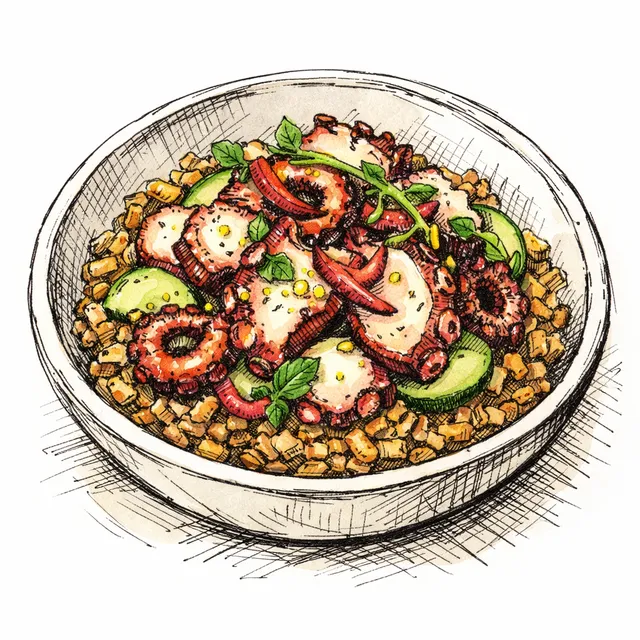
Ume-Yuzu Quick-Cured Seared Octopus Bowl with Toasted Freekeh
Have you ever stared at a jar of umeboshi paste and a tub of green yuzu kosho at midnight and thought, I bet you two would love a cephalopod? That is basically how this bowl was born. I was sitting in my cramped Tokyo apartment years ago, watching my neighbor hang laundry while obsessively tasting through my latest fermentation jars. I wanted something that bridged the sharp, acetic bite of a Peruvian ceviche with the deep, briny umami of a Japanese tataki. Enter the fifteen-minute quick-cure. Why fifteen minutes? Because it is just enough time for the citric acid in the ume and the salt in the yuzu kosho to gently firm up the octopus surface without turning it to rubber, laying down a flavor foundation before it hits a smoking-hot cast iron pan. Paired with nutty, chewy toasted freekeh and a fiery blistered corn-shiso salsa, it is a bowl that hits every single tastebud. My tip? Do not fear the doenjang-lime dressing; that Korean fermented soybean paste brings a funky depth that ties the bright citrus and smoky char together. Break the rules, toast your grains, and always keep something fermenting on your counter.
Featured Recipe
Ume-Yuzu Quick-Cured Seared Octopus Bowl with Toasted Freekeh
Blanched octopus gets a fast 15-minute quick-cure in umeboshi plum paste and green yuzu kosho before a smoking-hot cast-iron sear. Served over nutty toasted freekeh with a blistered corn-shiso salsa and sharp doenjang-lime dressing, this bowl hits every tastebud with crunch, acidity, and deep umami.
Save a copy to your collection for editing
Timeline
Ingredients
- 1 lb Pre-cooked octopus tentacles(Tenderized and blanched octopus, cut into individual tentacles)
- 2 tbsp Umeboshi paste(Japanese salted plum paste)
- 1 tsp Green yuzu kosho(Fermented chili and citrus paste)
- 1 tbsp Mirin(Japanese sweet rice wine)
- 1 tbsp Unseasoned rice vinegar
- 1 cup Cracked freekeh(Toasted green wheat)
- 2 cups Water or light dashi
- 0.5 tsp Sea salt
- 1 cup Fresh corn kernels(Cut from about 1 ear of sweet corn)
- 2 tbsp Grapeseed oil(Divided use; high smoke point oil works best)
- 6 Fresh shiso leaves(Finely chiffonaded)
- 1 tbsp Korean doenjang(Fermented soybean paste; can substitute white or yellow miso)
- 2 tbsp Fresh lime juice
- 1 tsp Toasted sesame oil
- 0.25 cup Pickled radishes(Thinly sliced for garnish)
Instructions
- 1
Combine 1 cup Cracked freekeh, 2 cups Water or light dashi, and 0.5 tsp Sea salt in a small saucepan. Bring to a boil, cover with a tight lid, reduce heat to low, and simmer for 20 minutes. Turn off heat and let rest covered for 5 minutes to steam, then fluff with a fork.
25 min
Tip: Using dashi instead of plain water infuses the grain with subtle ocean minerals that echo the octopus.
- 2
In a shallow dish, whisk together 2 tbsp Umeboshi paste, 1 tsp Green yuzu kosho, 1 tbsp Mirin, and 1 tbsp Unseasoned rice vinegar. Add 1 lb Pre-cooked octopus tentacles and coat thoroughly. Leave at room temperature to quick-cure for exactly 15 minutes.
15 min
Tip: Do not exceed 15 minutes! Umeboshi's high acidity and natural salt level work fast. Too long and the citrus acids will over-denature the exterior, making it rubbery during searing.
- 3
Heat 1 tbsp Grapeseed oil in a heavy skillet over high heat until shimmering. Add 1 cup Fresh corn kernels in a single layer. Let char undisturbed for 2 minutes, stir, then char for another 1 minute. Transfer to a bowl and fold in 6 Fresh shiso leaves after cooling slightly.
8 min
Tip: Leaving the corn undisturbed gives you those dark, smoky blister marks that pair so well with seared seafood.
- 4
In a small cup, vigorously whisk 1 tbsp Korean doenjang, 2 tbsp Fresh lime juice, and 1 tsp Toasted sesame oil until a emulsified dressing forms.
5 min
Tip: Doenjang brings an earthy, funky backbone that cuts through the bright citrus notes in the rest of the bowl.
- 5
Remove octopus from cure and wipe off excess moisture with paper towels. Heat remaining 1 tbsp Grapeseed oil in a cast-iron skillet over maximum heat until smoking. Sear tentacles for 90 seconds per side until deeply golden and blistered. Transfer to a cutting board and slice into 1-inch rounds.
5 min
Tip: Surface dryness is critical! Moisture creates steam, which prevents that shatteringly crisp crust.
- 6
Divide warm freekeh between two lunch bowls. Top with charred corn-shiso salsa, warm seared octopus rounds, and 0.25 cup Pickled radishes. Drizzle with the doenjang-lime dressing and serve immediately.
5 min
Tip: Arrange components in distinct zones so every bite can be a different combo of texture and temperature.
Chef's Notes
Why this quick-cure works: Umeboshi is rich in citric and malic acids as well as sea salt from the traditional sun-drying process. When applied to octopus surface tissue for just 15 minutes, the salt pulls out surface moisture while the acids start light surface denaturation. When hit with high heat in cast iron, the residual natural fruit sugars from the plum paste and mirin caramelize almost instantly, giving you a blistered, savory crust without overcooking the tender interior.

Kenji Nakamura
Where Japanese precision meets global flavors
I trained in Tokyo for eight years, mastering the discipline of washoku—traditional Japanese cuisine. But I got restless. So I cooked my way through Southeast Asia, spent a year in Mexico City, and fell hard for the food of Peru. Now I see connections between cuisines that others miss: the umami in dashi and fish sauce, the heat in shishito and Szechuan peppercorns, the way Japanese technique can unlock flavors from any tradition. I'm always fermenting something.