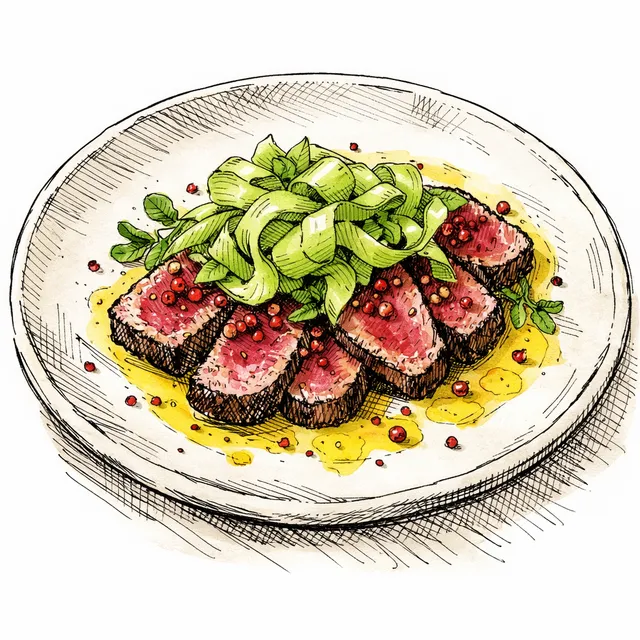
Valentine’s Beef Tataki with Pink Pepper Quick Cure & Meyer Lemon–Olive Oil Emulsion
I started making this Valentine’s tataki after cooking through Peru and Mexico, where citrus and raw proteins get treated like something celebratory, not scary. Back in Tokyo, tataki taught me the opposite lesson: restraint. So I mash them together—Japanese precision, global brightness.
One year I burned the first date-night steak because I was trying to “be romantic” instead of paying attention. We laughed, ordered noodles, and I promised myself: next time, keep it simple and sharp. This dish is that promise. Tenderloin gets kissed hard in a pan—just enough Maillard to smell like dinner—then stays raw-centered like sashimi. The pink pepper–coriander quick cure is my quiet flex: it seasons the surface layer fast, perfumes the meat, and gives you that gently cured snap without turning it hammy.
What makes it special to me is the dressing. A Meyer lemon–olive oil emulsion is basically a glossy, citrus-sweet ponzu’s sunnier cousin. It clings to each slice, and the celery heart ribbons bring crunch, salt-loving freshness, and that green perfume that makes beef feel “clean.”
Make it yours: swap in yuzu or blood orange, add a little grated garlic, or finish with shaved Parmesan or crispy fried shallots. Rules are optional—attention isn’t.
Why this works
A short cure draws a bit of moisture to the surface so seasoning dissolves and penetrates quickly, while a hard, fast sear builds flavor without cooking the center. Emulsifying citrus with olive oil makes the acid feel rounder and helps it coat every slice.
Featured Recipe
Valentine’s Beef Tataki with Pink Pepper Quick Cure & Meyer Lemon–Olive Oil Emulsion (with Celery Heart Ribbons)
This is my at-home Valentine’s small plate when I want something clean and bright, but still quietly luxurious: beef tenderloin kissed hard in a pan, raw-centered, and dressed like a high-end salad. A pink pepper–coriander quick cure seasons the beef all the way through the surface layer, then a Meyer lemon–olive oil emulsion turns every slice glossy and citrus-sweet, with celery heart ribbons for crunch and perfume.
Save a copy to your collection for editing
Ingredients
- 10 oz Beef tenderloin (center-cut) or strip steak, trimmed(Tenderloin is the most "luxe"; strip gives more beefy flavor)
- 1 1/4 tsp Kosher salt(Divided)
- 1 tsp Granulated sugar(For the quick cure; balances citrus bite)
- 1 1/2 tsp Pink peppercorns(Lightly crushed)
- 1 tsp Coriander seed(Lightly crushed)
- 1/2 tsp Black pepper(Freshly ground)
- 1 tbsp Neutral oil (grapeseed/canola)(For searing)
- 1 tsp Meyer lemon zest(From about 1 lemon)
- 2 tbsp Meyer lemon juice(Regular lemon works; add 1/2 tsp extra sugar if using regular)
- 1 tsp Rice vinegar(Adds clean acidity without heaviness)
- 1 tsp Honey(Or maple syrup)
- 4 tbsp Extra-virgin olive oil(Use a fruity one)
- 1 tbsp Unsalted butter(Optional, for a slightly more "luxe" mouthfeel)
- 1 tbsp Capers, rinsed and chopped(For salinity and little pops)
- 1 cup Celery hearts (inner stalks + leaves)(Shaved into ribbons; use leaves too)
- 4 oz Radish (watermelon or red), very thinly sliced(For crunch and color; optional but great)
- 2 tbsp Chives, finely sliced
- 1 pinch Flaky sea salt(To finish)
Instructions
- 1
Make the quick cure: in a small bowl, mix 1 tsp Kosher salt, sugar, 1 1/2 tsp Pink peppercorns, 1 tsp Coriander seed, and 1/2 tsp Black pepper.
3 min
Tip: Crush spices with the bottom of a pan or a mortar—coarse is perfect. Powdery = harsh.
- 2
Cure the beef: pat the steak very dry. Sprinkle the cure evenly over all sides, pressing it in. Set on a plate and refrigerate uncovered for 20 minutes.
20 min
Tip: Uncovered helps the surface dry so you get a faster, cleaner sear with less gray band.
- 3
Build the citrus emulsion: in a bowl, whisk 1 tsp Meyer lemon zest and 2 tbsp Meyer lemon juice, 1 tsp Rice vinegar, 1 tsp Honey, and remaining 1/4 tsp Kosher salt. While whisking, slowly stream in 4 tbsp Extra-virgin olive oil until glossy and slightly thick. Whisk in 1 tbsp Unsalted butter if using (melt it first). Stir in 1 tbsp Capers, rinsed and chopped.
6 min
Tip: If it breaks, just whisk in 1 tsp water and keep whisking. Emulsions are forgiving.
- 4
Prep the crunch: shave 1 cup Celery hearts (inner stalks + leaves) into ribbons (use a peeler or knife). Slice 4 oz Radish (watermelon or red), very thinly sliced paper-thin. Keep cold.
6 min
Tip: Cold, wet crunch next to warm-seared beef is the whole Valentine’s vibe: clean, sharp, and sensual.
- 5
Sear tataki-style: heat a heavy skillet over high heat until just smoking. Add 1 tbsp Neutral oil (grapeseed/canola). Sear the 10 oz Beef tenderloin (center-cut) or strip steak, trimmed 20–30 seconds per side, including edges, just to brown the exterior while keeping the center raw-to-rare.
3 min
Tip: Think "paint the outside with heat." Don’t chase an internal temp—this is a surface event.
- 6
Rest and slice: transfer beef to a board and rest 3 minutes. Slice across the grain into 1/4-inch slices.
4 min
Tip: Short rest keeps juices from flooding the plate but doesn’t cook the center.
- 7
Plate like a small luxury: fan beef on a chilled plate. Toss celery and radish lightly with 1–2 tbsp of the emulsion and mound alongside/over the beef. Spoon more emulsion over the slices. Finish with 2 tbsp Chives, finely sliced and 1 pinch Flaky sea salt.
4 min
Tip: Chilled plate + warm-seared beef = sharper contrast and a more "restaurant" feel at home.
- 8
Optional final move: add a last whisper of lemon zest over the top right before serving.
1 min
Tip: Fresh zest reads like perfume—perfect for a date-night appetizer.
Chef's Notes
Why this works (Kenji brain): the 20-minute quick cure is long enough for salt/sugar to dissolve, grab onto the surface proteins, and season the outer few millimeters—exactly the part you taste first in tataki. The uncovered chill dries the exterior so the sear happens fast, which means less gray overcooked band. The sauce is a classic acid-to-fat emulsion, but Meyer lemon gives soft floral sweetness; capers add little jolts of brine that mimic the way you’d use a salty condiment without leaning on soy or miso. If you want to riff: swap coriander for toasted fennel seed, or add a tiny pinch of Aleppo pepper for gentle heat without changing the clean profile.

Kenji Nakamura
Where Japanese precision meets global flavors
I trained in Tokyo for eight years, mastering the discipline of washoku—traditional Japanese cuisine. But I got restless. So I cooked my way through Southeast Asia, spent a year in Mexico City, and fell hard for the food of Peru. Now I see connections between cuisines that others miss: the umami in dashi and fish sauce, the heat in shishito and Szechuan peppercorns, the way Japanese technique can unlock flavors from any tradition. I'm always fermenting something.