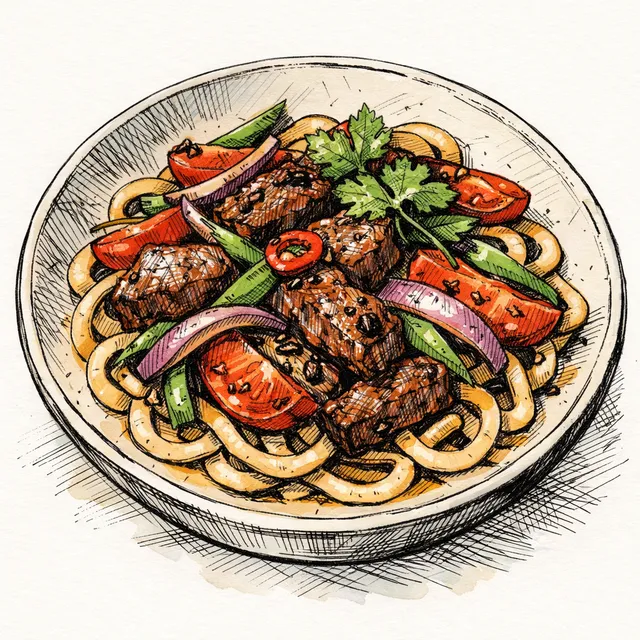
Wok-Smoked Sirloin Lomo Saltado Udon: A Tokyo-Lima Love Story
I will never forget the first time I stood in a frantic Lima kitchen, watching the wok hei (breath of the wok) kiss a pan of Lomo Saltado. The smell of charred beef, soy sauce, and sharp vinegar hit my nose, and I instantly thought of Tokyo. The DNA of this Peruvian classic is already deeply intertwined with Japanese technique thanks to the Nikkei diaspora. But my brain could not stop tinkering. What if, instead of serving it over French fries, we introduced it to the ultimate sauce-sponge: thick, chewy Sanuki udon? That is exactly how this Wok-Smoked Sirloin Lomo Saltado Udon was born. I sear the sirloin hard and fast in a screaming hot wok to get that crucial Maillard reaction without overcooking the center. Then comes the magic: a heavy splash of soy, a bright hit of vinegar, and a dollop of my fermented aji amarillo paste. Why this works: Udon's gelatinized starch exterior acts like an absolute magnet for the emulsified, acidic pan sauce. Make it your own by throwing in whatever you have fermenting in the back of your fridge—a spoonful of lacto-fermented tomatoes or a splash of black vinegar will take this to a whole new dimension. Go ahead and break the rules!
Featured Recipe
Wok-Smoked Sirloin Lomo Saltado Udon
Peruvian Lomo Saltado meets Tokyo comfort food in the wok. I swapped the traditional french fries for thick, chewy Sanuki udon noodles that act like absolute sponges for this smoky, soy-vinegar, aji amarillo pan sauce.
Save a copy to your collection for editing
Timeline
Ingredients
- 1 lb sirloin steak(Cut into 1/2-inch thick strips)
- 2 tbsp shio koji(Liquid or paste; this is our quick-tenderizer)
- 1 tsp freshly ground black pepper
- 21 oz frozen Sanuki udon(Usually comes in 3 frozen bricks)
- 1 large red onion(Cut into thick, 1/2-inch wedges)
- 2 Roma tomatoes(Core removed, cut into thick wedges)
- 3 tbsp soy sauce
- 2 tbsp red wine vinegar(Black rice vinegar also works beautifully)
- 1 tbsp oyster sauce
- 2 tbsp aji amarillo paste(Find this at Latin grocers or online)
- 1/4 cup dashi or beef broth
- 3 tbsp neutral oil(Grapeseed or canola, divided)
- 1 bunch fresh cilantro(Roughly chopped, stems and all)
Instructions
- 1
Slice 1 lb sirloin steak into 1/2-inch thick strips against the grain. In a bowl, massage the beef with 2 tbsp shio koji and 1 tsp freshly ground black pepper. Let it sit at room temperature. The enzymes in the koji will rapidly break down the muscle proteins, yielding an incredibly tender chew and amplifying the umami in just 15 minutes.
15 min
Tip: Don't skip the short resting time! 15 minutes of shio koji works like a 3-hour traditional marinade.
- 2
While the beef cures, prep the vegetables. In a small bowl or liquid measuring cup, vigorously whisk together 3 tbsp soy sauce, 2 tbsp red wine vinegar, 1 tbsp oyster sauce, 2 tbsp aji amarillo paste, and 1/4 cup dashi or beef broth. This is your liquid gold.
5 min
Tip: Have everything chopped and the sauce mixed before you turn on the wok. Wok cooking waits for no one.
- 3
Bring a large pot of water to a rolling boil. Drop in 21 oz frozen Sanuki udon and cook for just 1-2 minutes until the bricks loosen into distinct noodles. Drain immediately and rinse very briefly under cold water to stop the cooking, but don't wash away all the starch.
5 min
Tip: Always use frozen Sanuki-style udon over shelf-stable packets. The texture is vastly superior, preserving that essential 'mochi-mochi' bounce.
- 4
Fire up a carbon steel wok over the highest heat your stove can muster until it literally starts to smoke. Swirl in 2 tbsp neutral oil. Carefully add the marinated sirloin in a single layer. Do not touch it for 60 seconds to build a ferocious crust. Toss fiercely for another 60 seconds until medium-rare, then immediately remove the beef to a plate.
3 min
Tip: Cooking the meat and vegetables separately prevents steaming and guarantees wok hei—that unmistakable smoky 'breath of the wok'.
- 5
With the wok still roaring hot, add the remaining 1 tbsp neutral oil. Toss in the wedged 1 large red onion and 2 Roma tomatoes. Let them sit undisturbed for 15 seconds to blister, then toss vigorously for another 45 seconds. You want the tomatoes slightly softened but holding their shape.
2 min
Tip: If your stove runs cool, you can use a kitchen torch right into the wok as you toss to fake that restaurant-style wok hei.
- 6
Return the seared beef (and any rested juices) to the wok. Throw in the cooked udon noodles. Pour the prepared soy-aji amarillo sauce over the top. Toss everything together furiously over high heat. The starch from the noodles will emulsify the sauce into a glossy, clinging glaze in about 60-90 seconds.
3 min
Tip: The sound should change from a sizzle to a wet, slapping sound as the emulsion forms.
- 7
Kill the heat. Immediately toss in the roughly chopped 1 bunch fresh cilantro. The residual heat will slightly wilt the cilantro, releasing its aromatic oils without destroying its bright flavor. Serve straight away.
1 min
Tip: Serve this immediately. Udon waits for nobody.
Chef's Notes
Why this works: Normally, Lomo Saltado relies on the starch of french fries to soak up its iconic, punchy sauce. Here, we're relying on the gelatinized exterior of the udon noodles to act as a sponge. When you toss the starchy noodles with the soy-vinegar base over screaming high heat, the residual starch physically binds the oil and water molecules, creating a creamy, emulsified pan-sauce. The 15-minute shio koji cure on the sirloin provides rapid enzymatic tenderization, meaning we can use an affordable cut of steak and still get a melt-in-your-mouth texture even after a fierce wok-sear.

Kenji Nakamura
Where Japanese precision meets global flavors
I trained in Tokyo for eight years, mastering the discipline of washoku—traditional Japanese cuisine. But I got restless. So I cooked my way through Southeast Asia, spent a year in Mexico City, and fell hard for the food of Peru. Now I see connections between cuisines that others miss: the umami in dashi and fish sauce, the heat in shishito and Szechuan peppercorns, the way Japanese technique can unlock flavors from any tradition. I'm always fermenting something.