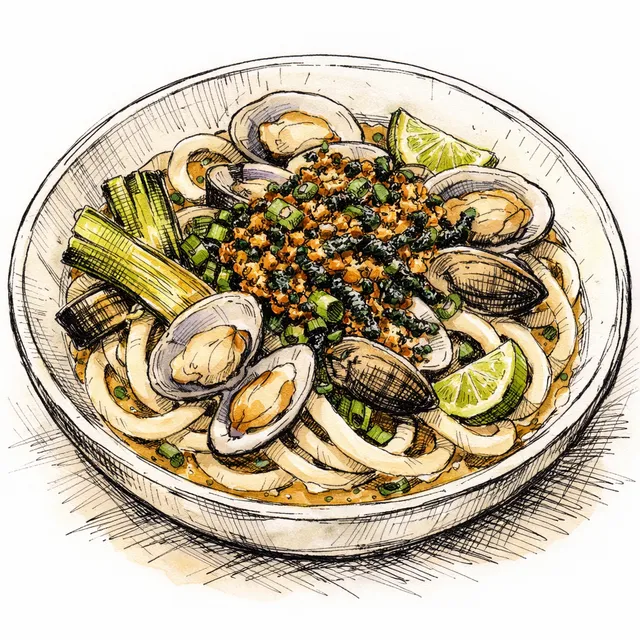
Yuzu-Kosho Clam Udon: Winter Steam, Citrus, and an Ocean of Crunch
January always pulls me toward three things: steam, citrus, and deep umami. This Yuzu-Kosho Clam Udon with Charred Leeks, Miso-Lime Butter, and Crispy Nori Pangrattato is my way of stacking them in one bowl.
The spark came from two places: Tokyo winters—standing over a tiny bowl of udon while my hands thawed—and the way coastal Southeast Asia treats seafood with bright acid and heat. Yuzu-kosho has that same “wake up” energy: chili, citrus, and salt in one punch.
I first made a version of this after a long service, when I had leeks that were getting tired and a bag of clams I refused to waste. I blistered the leeks hard (don’t be shy—black edges equal sweetness), steamed the clams in sake with yuzu-kosho, then whisked in miso-lime butter like I was finishing a French pan sauce. That glossy emulsion clings to udon in a way straight broth never does.
What makes it special to me is the ending: nori pangrattato. It’s my “ocean learned to toast bread” trick.
Make it yours: swap clams for mussels, add shaved cabbage, or finish with a little grated garlic in the butter if you want more bite.
Featured Recipe
Yuzu-Kosho Clam Udon with Charred Leeks, Miso-Lime Butter, and Crispy Nori Pangrattato
In January, I crave steam, citrus, and deep umami—this bowl hits all three. Sweet winter leeks get blistered hard, Manila clams pop open in a yuzu-kosho sake broth, and a miso-lime butter turns it glossy like a French pan sauce—then I finish it with a crunchy nori pangrattato that tastes like the ocean learned to toast bread.
Save a copy to your collection for editing
Ingredients
- 2 servings Frozen or fresh udon noodles(about 400–500 g total; frozen preferred for chew)
- 900 g Manila clams(scrubbed; soak 20 minutes in cold water if sandy)
- 2 Leeks(large; white + light green parts only, halved lengthwise, rinsed well)
- 3 cloves Garlic(thinly sliced)
- 15 g Fresh ginger(julienned (matchsticks) or thinly sliced)
- 120 ml Sake(or dry white wine)
- 480 ml Dashi(awase dashi or good instant dashi)
- 1 1/2 tsp Yuzu kosho(start here; add more at the end for heat/salt)
- 1 1/2 tbsp White miso (shiro miso)(for sweetness and body)
- 2 tbsp Unsalted butter(cold, cut into cubes)
- 1 Lime(zest + 1–2 tbsp juice; yuzu or lemon also works)
- 2 tbsp Neutral oil(rice bran, grapeseed, or canola)
- 1 tbsp Olive oil(for pangrattato (optional but nice))
- 1/2 cup Panko breadcrumbs(or coarse fresh breadcrumbs)
- 1 Nori sheet(crumbled finely by hand or scissors)
- 1 tbsp Toasted sesame seeds(white or mixed)
- 2 Scallions(thinly sliced for finishing)
- 2 cups Baby spinach or mizuna(optional; quick winter greens addition)
- 1/2 tsp Black pepper(freshly ground)
- as needed Kosher salt(only if needed—clams + miso + yuzu kosho bring salt)
Instructions
- 1
Make the nori pangrattato: Heat 1 tbsp neutral oil (and 1 tbsp olive oil if using) in a small skillet over medium. Add 1/2 cup Panko breadcrumbs and toast, stirring often, until deep golden—don’t stop at pale tan.
5 min
Tip: Dark toast = real flavor. If it’s browning unevenly, lower heat and keep it moving.
- 2
Off heat, stir in 1 Nori sheet, crumbled, 1 tbsp Toasted sesame seeds, and a few grinds of 1/2 tsp Black pepper. Transfer to a bowl so it doesn’t keep cooking.
1 min
Tip: Nori goes in off heat so it stays aromatic instead of turning fishy/bitter.
- 3
Char the leeks: Heat a wide pot or deep skillet (big enough to hold clams) over high heat. Add 1 tbsp neutral oil. Place 2 Leeks, cut-side down and press lightly. Cook until aggressively browned and blistered, then flip and brown the other side.
6 min
Tip: You’re not ‘softening’—you’re building smoky sweetness. This is the winter equivalent of grilling.
- 4
Add 3 cloves Garlic, minced and 15 g Fresh ginger, minced around the leeks and cook 30–60 seconds until fragrant. Pour in 120 ml Sake to deglaze, scraping up browned bits.
2 min
Tip: Those browned bits are your secret ramen-shop depth without hours of stock.
- 5
Add 480 ml Dashi and 1 1/2 tsp Yuzu kosho. Bring to a simmer. Add 900 g Manila clams, cover, and cook until they open. As they open, transfer them to a bowl; discard any that stay shut.
6 min
Tip: Pull clams as soon as they open so they stay plump, not rubbery.
- 6
Lower heat to low. In a small bowl, whisk 1 1/2 tbsp White miso (shiro miso) with a ladle of hot broth until smooth, then stir it back into the pot. Add zest of 1 Lime and 1 tbsp lime juice.
2 min
Tip: Never boil miso hard; it dulls aroma and can turn the broth harsh.
- 7
Turn heat off. Whisk in 2 tbsp Unsalted butter, a cube at a time, to make the broth glossy. Taste and adjust: more lime for lift, more yuzu kosho for heat/salt.
2 min
Tip: Cold butter emulsifies—this is basically a Japanese-French hybrid pan sauce wearing a soup’s jacket.
- 8
Cook 2 servings Frozen or fresh udon noodles according to package (usually 1–2 minutes for frozen). Drain well. If using 2 cups Baby spinach or mizuna, wilt it briefly in the hot broth for 20–30 seconds.
3 min
Tip: Drain udon well so you don’t dilute the broth you just built.
- 9
To serve: Divide udon into bowls. Ladle broth and leeks over. Add clams back on top. Finish with 2 Scallions, sliced and a generous shower of nori pangrattato.
2 min
Tip: Crunchy topping should hit the bowl at the last second—like tonkatsu meets Italian breadcrumbs, but ocean-forward.
Chef's Notes
Why this works (my nerdy bit): January leeks are peak-sweet, and hard charring triggers Maillard reactions that mimic grilled flavor without leaving your kitchen. Clams bring natural glutamates; dashi brings inosinate—together they amplify umami (synergy, not just ‘more salt’). Yuzu kosho gives citrus + chile heat + fermentation funk; adding it early infuses the broth, adding a touch at the end keeps the high notes. The miso-lime butter step is my favorite kind of rule-breaking: butter emulsifies into the broth for a silky mouthfeel, while lime (winter citrus is best right now) keeps it bright so the bowl doesn’t feel heavy. The nori pangrattato is the textural contrast I miss in most noodle soups—crunch + sea aroma + toasted notes, like furikake learned an Italian accent. Practical swaps: Use mussels if clams are pricey; use lemon if limes are sad; and if you can’t find yuzu kosho, mix 1 tsp grated citrus zest + 1/2 tsp chile paste + a pinch of salt as a stand-in.

Kenji Nakamura
Where Japanese precision meets global flavors
I trained in Tokyo for eight years, mastering the discipline of washoku—traditional Japanese cuisine. But I got restless. So I cooked my way through Southeast Asia, spent a year in Mexico City, and fell hard for the food of Peru. Now I see connections between cuisines that others miss: the umami in dashi and fish sauce, the heat in shishito and Szechuan peppercorns, the way Japanese technique can unlock flavors from any tradition. I'm always fermenting something.