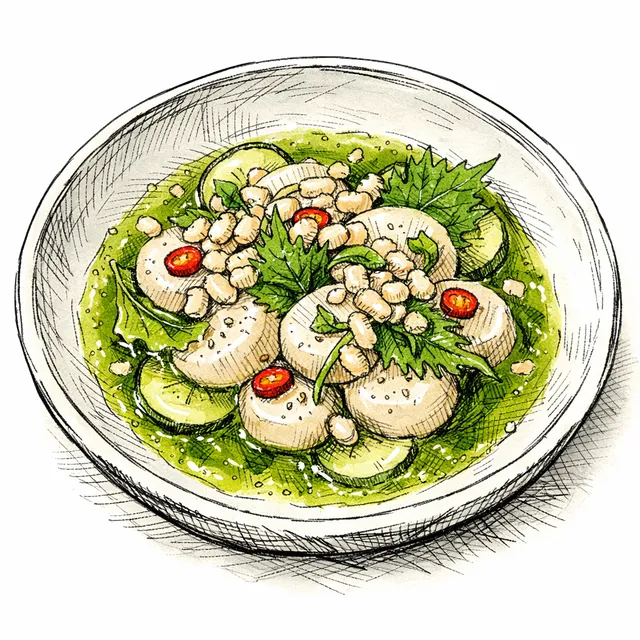
Where the Pacific Coasts Collide: Yuzu Kosho Scallop Aguachile
I still remember sitting on a plastic stool in Ensenada, juice dripping down my chin from a flawless aguachile, thinking: 'This needs yuzu kosho.' That late-night revelation birthed this Yuzu Kosho Scallop Aguachile with Shiso & Puffed Rice, a dish where the Pacific coasts of Mexico and Japan collide. Sweet, sashimi-grade sea scallops get a lightning-fast 5-minute cure in an electrifying broth of lime, cilantro, cucumber, and my absolute favorite fermented ingredient: yuzu kosho. Why this works: We are doing a very precise 5-minute cure here. The lime's citric acid denatures the scallop's proteins rapidly. If you leave it for 20 minutes, it turns completely rubbery. At exactly 5 minutes, the exterior turns slightly opaque and firm, while the center remains buttery, sweet, and raw—the perfect textural bridge between Latin ceviche and Japanese tataki. The fermented chili-citrus paste brings a deep umami bomb of floral heat that dances perfectly with the cooling avocado puree and the shattering crunch of puffed rice paper. This recipe is incredibly special to me because it proves that culinary borders are merely suggestions. My tip for making it your own? Break the rules! Swap the scallops for fresh spot prawns, or mix a splash of toasted sesame oil into the aguachile base. Keep playing, keep tasting, and always keep a jar of something fermenting in your fridge.
Featured Recipe
Yuzu Kosho Scallop Aguachile with Shiso & Puffed Rice
This is where the Pacific coasts of Mexico and Japan collide. Sweet, sashimi-grade sea scallops get a lightning-fast 5-minute cure in an electrifying broth of lime, cilantro, cucumber, and fermented yuzu kosho. We finish it with a cooling avocado puree and shattering puffed rice paper for the ultimate textural appetizer.
Save a copy to your collection for editing
Timeline
Ingredients
- 1 lb dry sea scallops (sushi grade)(Side muscles removed)
- 1 tbsp green yuzu kosho(Japanese fermented chili and yuzu paste)
- 1/2 cup fresh lime juice(Freshly squeezed only)
- 1 English cucumber(Divided use: half chopped for broth, half thinly sliced for garnish)
- 1/2 cup fresh cilantro leaves(Loosely packed)
- 5 leaves fresh shiso leaves(Green shiso, torn)
- 1/2 small jalapeño(Seeds removed (leave them in if you want explosive heat))
- 1 tsp white soy sauce (shiro shoyu)(Keeps the broth bright green while adding umami)
- 1 ripe avocado(Peeled and pitted)
- 2 spring radishes(Thinly sliced)
- 2 sheets rice paper sheets(Standard Vietnamese rice paper)
- 1 cup neutral oil(For flash-frying)
- 1/2 tsp flaky sea salt(For finishing)
Instructions
- 1
In a small pot, begin heating 1 cup neutral oil to 375 degrees F. Concurrently, mash 1 ripe avocado with a small squeeze of your lime juice and a pinch of salt until smooth. Set aside.
5 min
Tip: Heating the oil takes a few minutes, which is the perfect time to prep your avocado base.
- 2
Once the oil is hot, drop 2 sheets rice paper sheets into the oil one by one. They will puff up instantly into shattering white clouds in about 3 seconds. Remove immediately to a paper towel.
2 min
Tip: Have your tongs ready! The transformation is instantaneous and they will burn if left for more than 5 seconds.
- 3
Slice 1 lb dry sea scallops (sushi grade) horizontally into 1/4-inch thick rounds. Place them in a shallow bowl and keep them chilled in the fridge.
3 min
Tip: Always use 'dry' scallops. 'Wet' scallops are treated with phosphates and will dump milky water into your beautiful green broth.
- 4
In a blender, combine 1/2 cup fresh lime juice, half of the 1 English cucumber (roughly chopped), 1/2 cup fresh cilantro leaves, 5 fresh shiso leaves, 1/2 small jalapeño, 1 tbsp green yuzu kosho, and 1 tsp white soy sauce (shiro shoyu). Blend on high until completely liquefied and vivid green.
5 min
Tip: If you want a crystal-clear look, you can strain this. I personally like keeping the very fine pulp for extra flavor.
- 5
Pour the vibrant green aguachile broth over the chilled scallops. Toss gently and let them cure for exactly 5 minutes. No more, no less.
5 min
Tip: Set a timer! This is a flash-cure, not a long marinade.
- 6
While the scallops cure, thinly slice the remaining half of the 1 English cucumber into half-moons and use a mandoline to shave the 2 spring radishes.
3 min
Tip: Slicing these fresh ensures they stay crisp for the final plating.
- 7
To serve, spread a swoosh of the avocado puree on the bottom of a wide, shallow bowl. Layer the lightly cured scallops on top, then pour all the remaining aguachile juice over them. Garnish with the sliced radishes, cucumber half-moons, 1/2 tsp flaky sea salt, and large shards of the crispy rice paper.
3 min
Tip: Serve immediately while the rice paper is shatteringly crisp and the scallops are at that perfect sweet-tart temperature crossover.
Chef's Notes
WHY THIS WORKS: I am deeply obsessed with the shared DNA between Mexican and Japanese coastal cooking. A traditional ceviche often sits in acid for 20-30 minutes, which completely denatures the seafood proteins until they are opaque and firm. An aguachile, however, is a 'flash cure'. By leaving the sweet scallops in our high-acid lime and yuzu kosho bath for exactly 5 minutes, we get a kissing of firm texture on the exterior, while the center remains incredibly sweet, raw, and buttery. The fermented saltiness of the yuzu kosho binds with the lime juice to penetrate the scallop's surface almost instantly, bringing a complex citrus-chili heat that straight lime juice lacks. Swapping heavy corn tostadas for flash-fried rice paper keeps the whole experience ethereal and light.

Kenji Nakamura
Where Japanese precision meets global flavors
I trained in Tokyo for eight years, mastering the discipline of washoku—traditional Japanese cuisine. But I got restless. So I cooked my way through Southeast Asia, spent a year in Mexico City, and fell hard for the food of Peru. Now I see connections between cuisines that others miss: the umami in dashi and fish sauce, the heat in shishito and Szechuan peppercorns, the way Japanese technique can unlock flavors from any tradition. I'm always fermenting something.