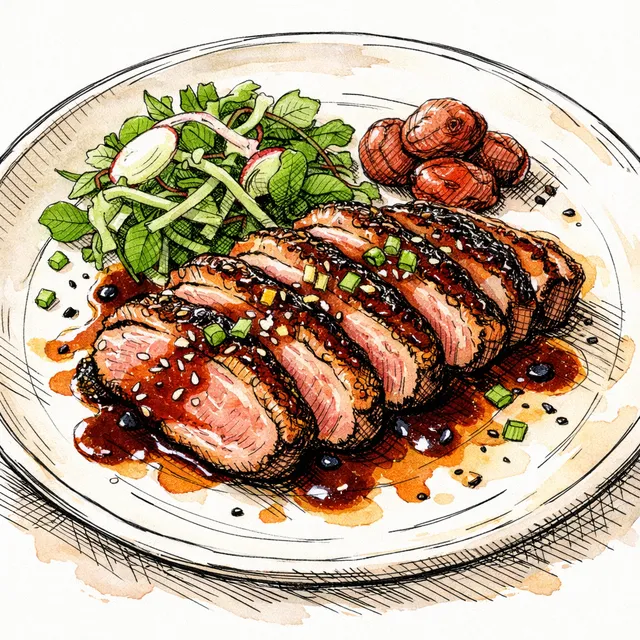
Cold-Seared Duck Breast with Ancho-Umeboshi Glaze
Izakaya food is all about aggressive, savory bites that stand up to a cold beer or a stiff highball. I wanted to take the lacquered, smoky vibe of yakitori and apply it to a whole duck breast. We're crossing borders here: the sweet, raisiny depth of Mexican ancho chile collides with the tart, salty punch of Japanese umeboshi (pickled plum). It cuts right through the rich duck fat.

Save a copy to your collection for editing
Timeline
Ingredients
- 2 whole duck breasts(About 6 oz each, patted completely dry)
- 1 tsp kosher salt(For seasoning the meat side)
- 0.5 tsp black pepper(Freshly ground)
- 2 tbsp umeboshi paste(Japanese pickled plum paste; find it at Asian grocers)
- 1 tbsp ancho chile powder(Do not substitute standard chili powder; you want the raisiny sweetness of pure ancho)
- 3 tbsp mirin(Sweet Japanese cooking wine)
- 1 tbsp soy sauce(Preferably a dark or aged shoyu)
- 1 tbsp honey(To balance the acidity and help lacquer the glaze)
- 2 bunches spring onions(Trimmed, white and light green parts only. Scallions work if spring onions aren't in season.)
- 1 tbsp toasted sesame seeds(For garnish)
- 1 tbsp duck fat(Mentioned in step 7, but not in ingredient list. Used to sear spring onions.)
Instructions
- 1
Using a sharp knife, gently score the skin of 2 whole duck breasts in a crosshatch pattern, spacing the cuts about 1/2-inch apart. Be careful not to cut into the flesh. Season the flesh side only with 1 tsp kosher salt and 0.5 tsp black pepper.
5 min
Tip: Scoring the skin gives the fat a way to escape during cooking, guaranteeing a crispy finish.
- 2
Place the scored duck breasts skin-side down in a cold, dry skillet (cast iron or carbon steel preferred). Turn the heat to medium-low. Let the fat slowly render out for 15 minutes, pouring off the excess fat into a heatproof bowl halfway through.
15 min
Tip: Starting in a cold pan is non-negotiable. If you drop duck into a hot pan, the meat cooks before the thick layer of fat has time to render and crisp.
- 3
While the duck fat renders, whisk together 2 tbsp umeboshi paste, 1 tbsp ancho chile powder, 3 tbsp mirin, 1 tbsp soy sauce, and 1 tbsp honey in a small bowl until smooth.
5 min
Tip: Taste this glaze! It should aggressively ping your palate—salty, sour, sweet, and a little smoky.
- 4
Wash and trim 2 bunches spring onions, leaving them whole but removing the dark green tops (save those for stock) and root ends.
5 min
Tip: Pat them completely dry so they sear rather than steam in the duck fat.
- 5
Once the duck skin is deeply golden and crispy, flip the breasts over. Cook the flesh side for 3 minutes for a perfect medium-rare (internal temp around 130°F).
3 min
Tip: Duck breast should be served pink. If you prefer medium, add another 2 minutes.
- 6
Transfer the duck breasts to a cutting board to rest.
10 min
Tip: Resting allows the muscle fibers to relax and reabsorb their juices. Do not skip this.
- 7
Pour off all but about 1 tbsp duck fat from the skillet (save the rest in your fridge!). Turn the heat up to medium-high. Add the trimmed spring onions and sear, tossing occasionally, for 5 minutes until nicely charred. Transfer to a serving platter.
5 min
Tip: Spring onions cooked in duck fat are a revelation. Let them blister and pick up some of that fond.
- 8
Reduce the skillet heat to low. Pour in the glaze mixture. Let it bubble and reduce for 3 minutes until it thickens into a glossy, syrupy glaze.
3 min
Tip: Keep stirring to prevent the honey and mirin from burning.
- 9
Using a pastry brush, paint the resting duck skin heavily with about half of the thickened glaze.
2 min
Tip: Glazing off the heat ensures the sugars don't scorch while giving the duck a beautiful lacquered finish.
- 10
Slice the duck breasts crosswise into 1/2-inch thick pieces. Fan the slices out over the charred spring onions. Drizzle with the remaining glaze and sprinkle with 1 tbsp toasted sesame seeds.
2 min
Tip: Serve immediately while the skin is crispy and the center is warm and juicy.
Chef's Notes
Here's the science on why this works: Duck breast carries a massive cap of fat. If you drop it into a hot pan like a steak, the meat will overcook long before the fat crisps. By starting in a cold pan, we trick the fat into slowly melting away, leaving behind a wafer-thin, chicharron-like crust. The glaze is where the magic happens: umeboshi is fiercely sour and salty, which we need to cut the richness of the duck fat, while the ancho provides a mellow, sweet, raisiny backbone that bridges the gap between Japanese Izakaya and Mexican cantina.
Frequently Asked Questions
How long does Cold-Seared Duck Breast with Ancho-Umeboshi Glaze take to make?
Cold-Seared Duck Breast with Ancho-Umeboshi Glaze takes about 40 minutes total. That includes 15 minutes of prep and 25 minutes of cooking.
How many servings does this recipe make?
This recipe makes 2 servings.
What skill level is needed for Cold-Seared Duck Breast with Ancho-Umeboshi Glaze?
This recipe is rated medium — it's intermediate, requiring some cooking experience.
What ingredients do I need for Cold-Seared Duck Breast with Ancho-Umeboshi Glaze?
The main ingredients are: duck breasts, kosher salt, black pepper, umeboshi paste, ancho chile powder, mirin, soy sauce, honey, spring onions, toasted sesame seeds, duck fat.
What type of meal is Cold-Seared Duck Breast with Ancho-Umeboshi Glaze?
Cold-Seared Duck Breast with Ancho-Umeboshi Glaze is categorized as: dinner.
Ask Kenji Nakamura a question
Sign in to chat about this recipe, get cooking tips, and ask for substitutions.
Sign in to chat