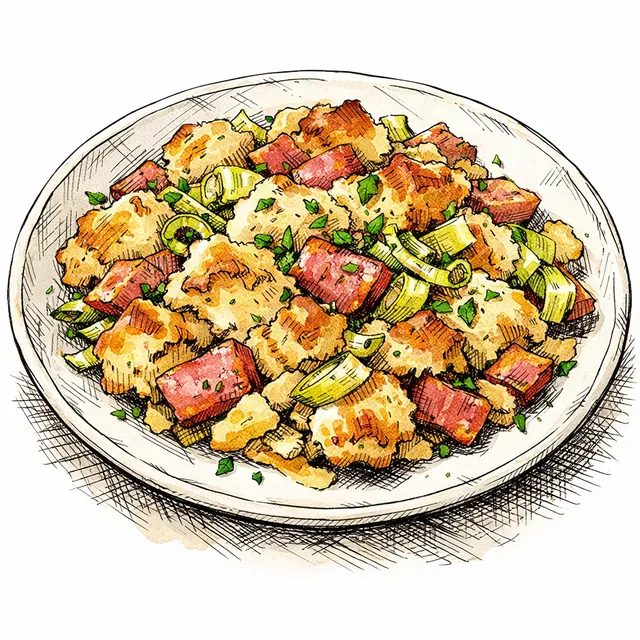
Cast-Iron Country Ham & Torn Biscuit Strata with Spring Leeks
Growing up in Atlanta, Sunday morning biscuits were sacred. We'd eat them piping hot with cane syrup, but by Monday, the leftovers were usually dry and forgotten. That never stopped my Grandmama, though. She'd tear those day-old biscuits up and soak them in milk and eggs for a humble pudding. This Cast-Iron Country Ham and Torn Biscuit Strata with Spring Leeks is my savory love letter to that memory. I take intensely salty, earthy country ham and render it directly in my heaviest cast-iron skillet. Then, I melt sweet spring leeks right into that beautiful, smoky fat before folding in those torn leftover biscuits and binding it all with a rich, sharp cheddar custard. What makes this recipe so special to me is how it bridges generations in a single bite, honoring her resourceful spirit while applying the techniques I honed in Charleston kitchens. Make it your own by swapping the ham for smoked sausage, or folding in a handful of braised greens for a little earthy brightness. Serve it up right out of the skillet on a slow weekend morning, and make sure to share some of your own family history around the table.
Featured Recipe
Cast-Iron Country Ham & Torn Biscuit Strata with Spring Leeks
Growing up in Atlanta, Sunday morning biscuits were sacred, but Monday's leftovers were often dry and forgotten until my grandmama soaked them in milk for a humble pudding. This savory evolution honors that memory, rendering intensely salty, earthy country ham directly in a cast-iron skillet, melting sweet spring leeks into the fat, and binding it all with a rich, sharp cheddar custard. It's an elevated Southern morning centerpiece that bridges generations in a single bite.
Save a copy to your collection for editing
Timeline
Ingredients
- 4 cups day-old buttermilk biscuits(torn into bite-sized pieces (about 4 to 6 biscuits))
- 6 large eggs(room temperature)
- 1 cup heavy cream
- 1 cup whole milk
- 1 tsp fish sauce(my secret weapon for umami)
- 1/2 tsp black pepper(freshly cracked)
- 1 tbsp unsalted butter
- 8 oz thick-cut country ham(diced into 1/2-inch pieces)
- 2 medium spring leeks(white and light green parts only, halved and thinly sliced)
- 1 cup sharp white cheddar cheese(freshly grated)
- 1 tbsp fresh thyme leaves(plus more for garnish)
- 1 tbsp fresh chives(minced)
Instructions
- 1
Preheat your oven to 375°F. In a large mixing bowl, aggressively whisk together 6 large eggs, 1 cup heavy cream, 1 cup whole milk, 1 tsp fish sauce, and 1/2 tsp black pepper. Don't add salt—the country ham will provide all the seasoning we need.
10 min
Tip: The fish sauce might seem unorthodox for a Southern strata, but trust me. It acts like a magnifying glass for the smoky, aged flavors of the ham.
- 2
Place a 10-inch or 12-inch cast-iron skillet over medium heat. Add 1 tbsp unsalted butter and let it melt. Toss in the 8 oz thick-cut country ham and cook until the fat renders and the edges get beautifully crispy.
7 min
Tip: Keep the heat moderate. Country ham is lean, and we want to slowly coax out the flavorful fat without turning the meat tough.
- 3
Add the 2 medium spring leeks to the skillet with the ham. Sauté in the rendered ham fat until the leeks are incredibly tender and slightly caramelized at the edges.
5 min
Tip: Make sure to wash your leeks thoroughly before slicing; they love to hide grit between their layers.
- 4
Remove the cast-iron skillet from the heat. Scatter the 4 cups day-old buttermilk biscuits evenly over the ham and leeks. Sprinkle in 1 cup sharp white cheddar cheese and 1 tbsp fresh thyme leaves, tossing everything gently right in the skillet so the biscuits soak up the residual fat on the bottom.
3 min
Tip: Using day-old, slightly stale biscuits is crucial. They act like sponges; fresh biscuits will turn to mush.
- 5
Pour the prepared custard evenly over the biscuit mixture in the skillet. Using the back of a spatula or your hands, gently press the biscuits down into the liquid so they are fully submerged. Let it sit on the counter to soak.
10 min
Tip: Giving the strata 10 minutes to soak ensures the custard fully penetrates the dense crumb of the buttermilk biscuits.
- 6
Carefully transfer the heavy cast-iron skillet to the middle rack of the preheated oven. Bake until the custard is set in the center, puffed up like a beautiful soufflé, and the exposed biscuit tops are deep golden brown.
35 min
Tip: If the tops of the biscuits are browning too quickly, tent the skillet loosely with aluminum foil for the last 10 minutes of baking.
- 7
Remove the skillet from the oven and let it rest. The strata will deflate slightly as it cools—this is exactly what it's supposed to do. Garnish with 1 tbsp fresh chives before serving warm.
10 min
Tip: Resting is non-negotiable! It allows the custard to finish setting up so you can slice it cleanly.
Chef's Notes
You might think I'm crazy adding fish sauce to a southern breakfast, but it's my favorite trick. It bridges the gap between the aged country ham and the sharp cheddar, providing a profound umami backbone that salt alone simply cannot achieve. Serve this right out of the cast iron in the middle of the table, maybe with a small pitcher of hot honey on the side for those who like a sweet-and-salty kick.

Marcus Stone
Heritage recipes with a chef's touch
My grandmother's kitchen in Atlanta is where I learned that food carries history. Every pot of collards, every batch of biscuits, every Sunday roast told stories of resilience, family, and love. I went on to train at the finest restaurants in Charleston and worked my way up through white-tablecloth kitchens. But I always came back to those family recipes—now I cook them with a chef's technique but a grandmother's heart. Because the best food honors where it came from.