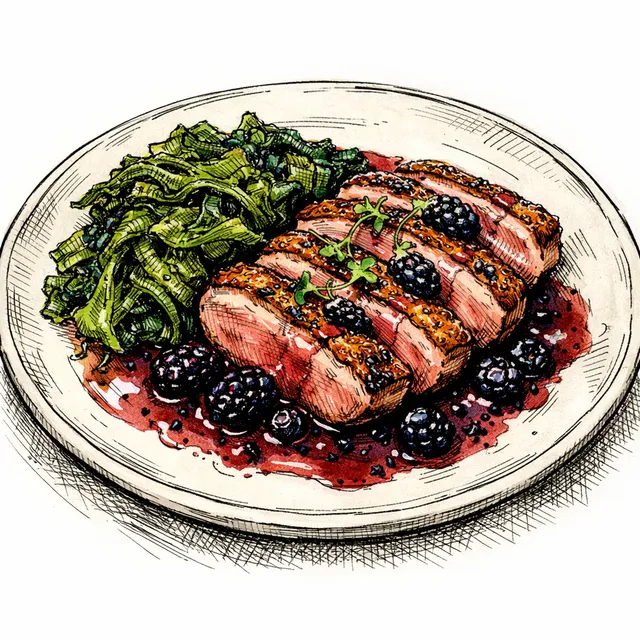
Duck Fat & Memories: Cast-Iron Seared Duck Breast with Sorghum-Blackberry Gastrique
Growing up in Atlanta, my grandmother always said that pork fat was the secret to the universe. I believed her right up until I moved to Charleston and learned the fine dining magic of a properly rendered duck breast. This dish, Cast-Iron Seared Duck Breast with Sorghum-Blackberry Gastrique and Duck Fat Mustard Greens, is the perfect bridge between those two worlds. I still remember standing on a milk crate watching my grandmother wilt greens for Sunday supper. Today, I honor her method but elevate the technique. We start with a cold cast-iron skillet, slowly coaxing the fat from the duck breast until the skin is impossibly crisp. Then, we use that liquid gold to blister spring turnips and wilt peppery mustard greens. The real chef's touch? A sweet, tart sorghum-blackberry gastrique spiked with a single drop of fish sauce for deep umami. This recipe means the world to me because it proves tradition isn't static, it lives and breathes. When you make this at home, make it yours. Swap the blackberries for bruised peaches in the summer, or use collards if mustard greens aren't your speed. Just don't rush the fat. Let the pan do the whispering.
Featured Recipe
Cast-Iron Seared Duck Breast with Sorghum-Blackberry Gastrique & Duck Fat Mustard Greens
A masterclass in rendering fat, merging Charleston fine dining with my grandmother's Sunday supper wisdom. We're slowly coaxing the fat from a cold-pan seared duck breast, then using that liquid gold to blister spring turnips and wilt peppery mustard greens. Finished with a sweet, tart, and umami-rich sorghum-blackberry gastrique spiked with just a drop of fish sauce.
Save a copy to your collection for editing
Timeline
Ingredients
- 2 large duck breasts (about 6-8 oz each)(brought to room temperature, patted dry)
- 1.5 tsp kosher salt(divided)
- 1 tsp freshly ground black pepper
- 1 cup fresh blackberries
- 1/4 cup apple cider vinegar
- 3 tbsp sorghum syrup(can substitute high-quality dark molasses)
- 2 tbsp bourbon
- 1/4 cup chicken stock
- 1 tsp fish sauce(my secret weapon for depth)
- 1 tbsp unsalted butter(cold)
- 1 bunch baby spring turnips(about 8 small turnips, scrubbed and halved)
- 1 large bunch mustard greens(stemmed and torn into bite-sized pieces)
- 2 cloves garlic(thinly sliced)
Instructions
- 1
Using a sharp knife, score the skin of 2 large duck breasts (about 6-8 oz each) in a tight crosshatch pattern, being careful not to cut into the flesh. Season generously on both sides with 1.25 tsp kosher salt and 1 tsp freshly ground black pepper.
5 min
Tip: Scoring the skin gives the fat a way to escape during cooking, ensuring a crispy result.
- 2
Place the seasoned duck breasts skin-side down in a cold, dry cast-iron skillet. Turn the heat to medium-low. Let the fat render slowly. As the fat pools in the pan, occasionally spoon it out into a heatproof bowl to save it.
15 min
Tip: Starting in a cold pan is the golden rule for duck breast. It melts the fat without shocking the meat.
- 3
While the duck renders, start the gastrique. In a small saucepan, combine 1 cup fresh blackberries, 1/4 cup apple cider vinegar, 3 tbsp sorghum syrup, 2 tbsp bourbon, 1/4 cup chicken stock, and 1 tsp fish sauce. Bring to a gentle simmer over medium heat.
12 min
Tip: Smash the berries with a wooden spoon as they soften to release their juices.
- 4
Once the blackberry mixture is thick and syrupy, strain it through a fine-mesh sieve into a bowl, pressing on the solids. Discard the solids, return the syrup to the warm pan (off heat), and swirl in 1 tbsp unsalted butter until glossy.
3 min
Tip: The butter mellows the harshness of the vinegar and creates a beautiful glaze.
- 5
Once the duck skin is deeply browned, thin, and crispy (about 12-15 minutes), flip the breasts. Increase the heat to medium and cook the flesh side for 2 to 3 minutes for a perfect medium-rare.
3 min
Tip: Don't overcook the duck; it should feel like the fleshy part of your palm when pressed.
- 6
Remove the duck breasts to a cutting board to rest.
10 min
Tip: Resting allows the juices to redistribute so they don't bleed out when sliced.
- 7
Pour off all but about 2 tablespoons of the rendered duck fat from the cast-iron skillet. Turn the heat to medium-high. Place 1 bunch baby spring turnips, halved cut-side down in the hot fat. Sear until they develop a deep brown crust.
5 min
Tip: Don't move the turnips around; let them sit undisturbed to get that perfect sear.
- 8
Add 2 cloves garlic, thinly sliced to the skillet with the turnips. Toss for about 30 seconds until fragrant, then immediately pile in 1 large bunch mustard greens, stemmed and torn.
3 min
Tip: The water left on the greens from washing will help steam them and deglaze the pan slightly.
- 9
Toss the greens constantly until they are wilted but still bright green. Season with the remaining 1/4 tsp kosher salt.
2 min
- 10
Slice the rested duck breast on a bias. Spoon the blistered turnips and greens onto a serving platter, fan the sliced duck over the top, and generously drizzle the sorghum-blackberry gastrique over the meat.
2 min
Tip: Serve immediately while the skin is still shatteringly crisp.
Chef's Notes
When I first learned to cook duck breast in a fine-dining Charleston kitchen, the chef told me it was all about patience and rendering the fat. As I watched that beautiful skin crisp up in a slow, cold pan, all I could think of was Grandmama rendering out salt pork or fatback on a Sunday morning before adding her greens. Duck fat is just fancy fatback, y'all. Treat it with the same respect. The slow cold-pan method is non-negotiable here; it melts the fat away without seizing the meat, leaving you with skin like glass. The fish sauce in the gastrique? That's my signature touch for deepening the blackberry and bourbon notes.

Marcus Stone
Heritage recipes with a chef's touch
My grandmother's kitchen in Atlanta is where I learned that food carries history. Every pot of collards, every batch of biscuits, every Sunday roast told stories of resilience, family, and love. I went on to train at the finest restaurants in Charleston and worked my way up through white-tablecloth kitchens. But I always came back to those family recipes—now I cook them with a chef's technique but a grandmother's heart. Because the best food honors where it came from.