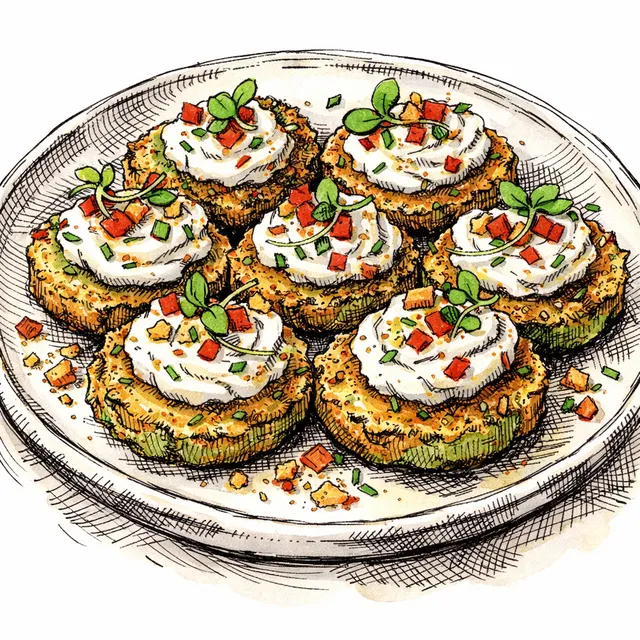
Cast-Iron Green Tomato Bites with Whipped Pimento Chèvre
Growing up in Atlanta, summer didn't officially start until my grandmother hauled out her heavy cast-iron skillet for the first batch of fried green tomatoes. We would eat them right on the porch, scalding our fingers because we just couldn't wait. I love that memory, but when I started cooking in fine-dining kitchens in Charleston, I wanted to capture that porch-sitting magic in a one-handed bite. That is how these Cast-Iron Green Tomato Bites were born. I take tart, bite-sized wedges of green tomato and give them that classic, golden cornmeal crunch my grandmother taught me. But here is where we evolve the tradition: I top them with a whipped pimento chèvre. The tang of the goat cheese cuts beautifully through the rich, shallow-fried crust, and a final drizzle of hot honey wakes the whole flavor profile up. This dish is incredibly special to me because it honors my heritage while wearing a slightly fancier dress. A quick tip for your own kitchen: use true stone-ground cornmeal for the best crunch, and never crowd your skillet. Feel free to swap the hot honey for a dash of your favorite pepper vinegar, and let those little bites sing!
Featured Recipe
Cast-Iron Green Tomato Bites with Whipped Pimento Chèvre
Bite-sized wedges of tart green tomato, shallow-fried to a golden cornmeal crunch and topped with a creamy, elevated take on pimento cheese. Finished with a drizzle of hot honey, this is the ultimate summer porch snack.
Save a copy to your collection for editing
Timeline
Ingredients
- 4 oz goat cheese (chèvre), softened(Brings a tangy lightness to the pimento cheese)
- 2 oz sharp cheddar cheese, finely grated(About 1/2 cup packed)
- 2 tbsp diced pimentos, drained(Pat them dry so they don't water down the cheese)
- 2 tbsp mayonnaise(Duke's is preferred, naturally)
- 2 medium green tomatoes(Firm and completely green, no hints of red)
- 1/2 cup buttermilk(Well-shaken)
- 1 tsp hot sauce(Vinegar-based, like Crystal or Tabasco)
- 1/2 cup yellow cornmeal(Fine or medium grind)
- 1/2 cup all-purpose flour
- 1 tbsp Creole seasoning(Store-bought or homemade)
- 1 cup peanut oil(For shallow frying; canola works too)
- 1 tsp flaky sea salt(For finishing)
- 2 tbsp hot honey(For drizzling)
- 1 tbsp fresh chives, minced(For garnish)
Instructions
- 1
In a medium mixing bowl, vigorously fold together 4 oz goat cheese (chèvre), softened, 2 oz sharp cheddar cheese, finely grated, 2 tbsp diced pimentos, drained, and 2 tbsp mayonnaise until whipped and creamy. Set aside at room temperature.
5 min
Tip: Whipping by hand gives it a beautiful, rustic texture, but you can use a hand mixer if your goat cheese is a bit stubborn.
- 2
Trim the tops and bottoms off 2 medium green tomatoes. Cut them into 1-inch thick wedges or bite-sized half-moons. You want them small enough to be a one-or-two-bite snack.
3 min
Tip: Keeping them a bit thick ensures they retain that signature tart juiciness after frying.
- 3
Set up your breading station. In a shallow bowl, whisk together 1/2 cup buttermilk and 1 tsp hot sauce. In a second shallow bowl, whisk together 1/2 cup yellow cornmeal, 1/2 cup all-purpose flour, and 1 tbsp Creole seasoning.
3 min
Tip: Use one hand for wet ingredients and one for dry to keep your fingers from becoming breaded.
- 4
Pour 1 cup peanut oil into a large cast-iron skillet (the oil should come about 1/4 to 1/2 inch up the sides). Heat over medium-high until the oil reaches 350°F, or until a pinch of cornmeal instantly sizzles.
5 min
Tip: Cast iron is essential here for maintaining an even, roaring heat during shallow frying.
- 5
While the oil heats, toss the tomato wedges in the buttermilk mixture, letting excess drip off. Dredge them thoroughly in the cornmeal mixture, pressing gently so the crust adheres.
4 min
Tip: Letting the breaded tomatoes sit on a wire rack for a few minutes before frying helps the crust lock into place.
- 6
Carefully lower half of the breaded tomatoes into the hot oil. Shallow fry for 2 minutes on the first side until deeply golden brown, then flip and fry for 1 to 2 minutes more.
4 min
Tip: Don't crowd the pan! Frying in batches keeps the oil temperature up and guarantees a shatteringly crisp crust.
- 7
Transfer the first batch to a wire rack set over a baking sheet and immediately sprinkle with half of the 1 tsp flaky sea salt. Repeat the frying process with the remaining breaded tomatoes, salting them as soon as they leave the oil.
4 min
Tip: Always salt fried food the second it comes out of the oil—the heat draws the salt in and bonds it to the crust.
- 8
To assemble, arrange the warm tomato wedges on a platter. Top each bite with a generous dollop of the whipped pimento chèvre. Drizzle evenly with 2 tbsp hot honey and scatter 1 tbsp fresh chives, minced over the top.
4 min
Tip: Serve these immediately while the tomatoes are hot and the cheese just begins to soften against the warmth.
Chef's Notes
Summers on my grandmother's porch in Atlanta meant three things: cicadas buzzing like a saw mill, glasses of sweet tea sweating on wicker tables, and a platter of fried green tomatoes. I wanted to take her classic side dish and turn it into the ultimate communal snack. Slicing them into wedges makes them grab-and-go friendly, while swapping traditional pimento cheese for a whipped chèvre version adds a touch of Charleston elegance. The hot honey? That's just my modern signature to balance out the tang of the green tomato. My grandmother wouldn't have known what to do with chèvre, but I promise you, she'd have eaten a dozen of these before the neighbors even walked up the driveway.

Marcus Stone
Heritage recipes with a chef's touch
My grandmother's kitchen in Atlanta is where I learned that food carries history. Every pot of collards, every batch of biscuits, every Sunday roast told stories of resilience, family, and love. I went on to train at the finest restaurants in Charleston and worked my way up through white-tablecloth kitchens. But I always came back to those family recipes—now I cook them with a chef's technique but a grandmother's heart. Because the best food honors where it came from.