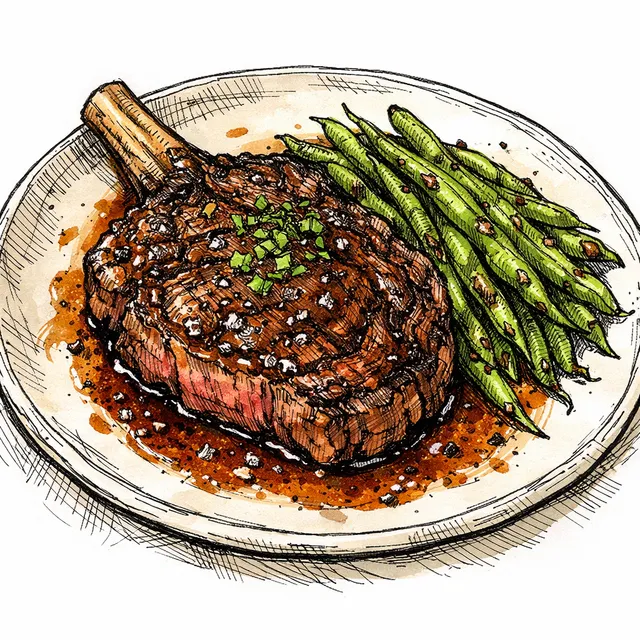
Sunday Supper Reimagined: My Cast-Iron Ribeye with Bourbon Red-Eye Sauce
Growing up in Atlanta, red-eye gravy was morning medicine. My granddaddy poured it over grits and biscuits like it was liquid gold, born from black coffee and salty ham drippings. Years later, working those intense line shifts in Charleston, I started wondering what happened if we took that rustic morning punch and married it to a magnificent, thick-cut bone-in ribeye. This dish is that dream realized. We sear the steak in smoking-hot cast iron, basting it in rich herb butter until the crust sings, then we build a glossy, unapologetically bold pan sauce using good bourbon, chicory coffee, and just a whisper of fish sauce for that deep, lingering umami. Beside it, blistered pole beans toasted with nutty heirloom benne seeds bring a pop of late-summer crunch. This recipe is special to me because it honors the traditions of my childhood while flexing a little fine-dining muscle. My tip for making it your own? Don't rush the sear, and don't be shy with the bourbon—pour a dram for the pan, and definitely pour one for yourself.
Featured Recipe
Cast-Iron Seared Bone-In Ribeye with Bourbon Red-Eye Pan Sauce & Blistered Pole Beans
Thick-cut bone-in ribeye seared in smoking-hot cast iron, basted with herb butter, and draped in a glossy bourbon-chicory red-eye pan sauce with an unexpected umami kick. Served alongside charred late-summer pole beans toasted with heirloom benne seeds, this is Sunday supper elevated to white-tablecloth glory.
Save a copy to your collection for editing
Timeline
Ingredients
- 1 steak bone-in ribeye steak (about 2 inches thick)(roughly 32 ounces, preferably prime or choice with heavy marbling)
- 1.5 tablespoons kosher salt(coarse kosher salt like Diamond Crystal)
- 1 tablespoon coarsely cracked black pepper(freshly cracked)
- 2 tablespoons peanut oil or high-heat oil(for searing)
- 6 tablespoons unsalted butter(divided; chilled)
- 4 cloves garlic(lightly smashed with skins on)
- 5 sprigs fresh thyme sprigs
- 1 sprig fresh rosemary sprig
- 1 medium shallot(finely minced)
- 0.33 cup Kentucky bourbon(choose something you love sipping)
- 0.5 cup strong brewed chicory coffee(warm, freshly brewed)
- 1 tablespoon pure sorghum molasses(adds rich, earthy sweetness)
- 1 teaspoon fish sauce(chef's secret umami booster)
- 12 ounces heirloom pole beans or green beans(stem ends trimmed)
- 1 tablespoon toasted benne seeds(or toasted sesame seeds)
- 1 teaspoon flaky sea salt(for finishing, like Maldon)
Instructions
- 1
Bring 1 steak out of the refrigerator. Pat it completely dry with paper towels on all sides, then generously season with 1.5 tablespoons kosher salt and 1 tablespoon coarsely cracked black pepper, pressing the seasoning firmly into the meat and fat cap. Let the steak rest at room temperature so the interior temp comes up evenly.
30 min
Tip: Never put a cold steak into a hot skillet. Taking off the chill ensures edge-to-edge medium-rare cooking rather than a gray band of overcooked meat.
- 2
Place a 12-inch cast-iron skillet over medium-high heat until it begins to faintly smoke. Pour in 1.5 tablespoons peanut oil or high-heat oil. Carefully lay the seasoned steak into the skillet away from you. Sear undisturbed for 4 minutes until a deep, mahogany crust forms. Flip the steak and sear the second side for another 4 minutes. Hold the steak upright using tongs for 2 minutes to render and crisp the thick fat cap.
10 min
Tip: Resist the urge to move or peek at the steak during the first four minutes so the crust can caramelize properly without steaming.
- 3
Reduce heat to medium-low. Add 3 tablespoons unsalted butter, 4 cloves garlic, 5 sprigs fresh thyme sprigs, and 1 sprig fresh rosemary sprig to the skillet. Tilt the pan toward you slightly and continuously spoon the foaming aromatic butter over the top of the steak for 3 to 4 minutes until an instant-read thermometer inserted into the thickest part reads 125°F for medium-rare.
5 min
Tip: Spoon the foaming butter rhythmically over the bone and thickest center muscle; the hot fat gently finishes cooking the interior while perfuming the crust.
- 4
Transfer the seared steak to a wooden carving board or warm plate. Pour the garlic and herb sprigs on top, and allow the steak to rest completely undisturbed. Reserve the skillet with its rendered beef fat and brown bits for the pan sauce.
10 min
Tip: Resting allows the muscle fibers to relax and reabsorb all the luscious juices; cutting early will wash your cutting board in flavorful juices that belong in your mouth.
- 5
While the steak rests, place a second skillet over medium-high heat with the remaining 0.5 tablespoon peanut oil or high-heat oil and 1 tablespoon unsalted butter. Add 12 ounces heirloom pole beans or green beans in a single layer. Blister without disturbing for 3 minutes, then toss and cook for another 3 minutes until tender-crisp and charred in spots. Remove from heat, toss with 1 tablespoon toasted benne seeds, and season with a pinch of flaky salt.
6 min
Tip: High heat gives pole beans that nostalgic country cookout blister while preserving their garden-fresh snap.
- 6
Pour out all but 1 tablespoon of rendered fat from the cast-iron steak skillet, leaving the dark browned bits behind. Set over medium heat, add 1 medium shallot, and sauté for 1 minute until fragrant. Pull the pan off the burner, pour in 0.33 cup Kentucky bourbon, return to the heat, and scrape the bottom of the skillet to lift every morsel of fond. Simmer for 1 minute until reduced by half.
3 min
Tip: Always pull the pan off the flame before introducing high-proof bourbon to avoid uncontrolled flare-ups.
- 7
Whisk in 0.5 cup strong brewed chicory coffee, 1 tablespoon pure sorghum molasses, and 1 teaspoon fish sauce. Simmer rapidly for 2 minutes until the liquid reduces to a glossy syrup that coats the back of a spoon. Remove from heat and vigorously swirl in the remaining cold 2 tablespoons unsalted butter until the sauce is velvety and emulsified.
3 min
Tip: That splash of fish sauce doesn't taste fishy at all—it bridges the earthy chicory roast, rich bourbon, and beef fat with pure Southern depth.
- 8
Carve the ribeye off the bone, then slice the loin across the grain into thick half-inch slabs. Fan the sliced steak across a warm serving platter alongside the bone and the charred blistered pole beans. Spoon the warm bourbon red-eye jus generously across the sliced steak, finishing the plate with 1 teaspoon flaky sea salt.
2 min
Tip: Don't discard the ribeye bone! The meat clinging to that bone is the cook's prized snack—gnawing on it is a time-honored kitchen privilege.
Chef's Notes
Back home in Atlanta, my grandmother always made red-eye gravy using breakfast ham drippings and strong morning coffee. When I was cooking on the line in Charleston, I realized that very same principle could unlock magic with beef. By marrying Kentucky bourbon and Louisiana chicory coffee with pure sorghum and just a drop of good fish sauce for umami, we take skillet pan dripping gravy into territory that makes prime ribeye sing.

Marcus Stone
Heritage recipes with a chef's touch
My grandmother's kitchen in Atlanta is where I learned that food carries history. Every pot of collards, every batch of biscuits, every Sunday roast told stories of resilience, family, and love. I went on to train at the finest restaurants in Charleston and worked my way up through white-tablecloth kitchens. But I always came back to those family recipes—now I cook them with a chef's technique but a grandmother's heart. Because the best food honors where it came from.