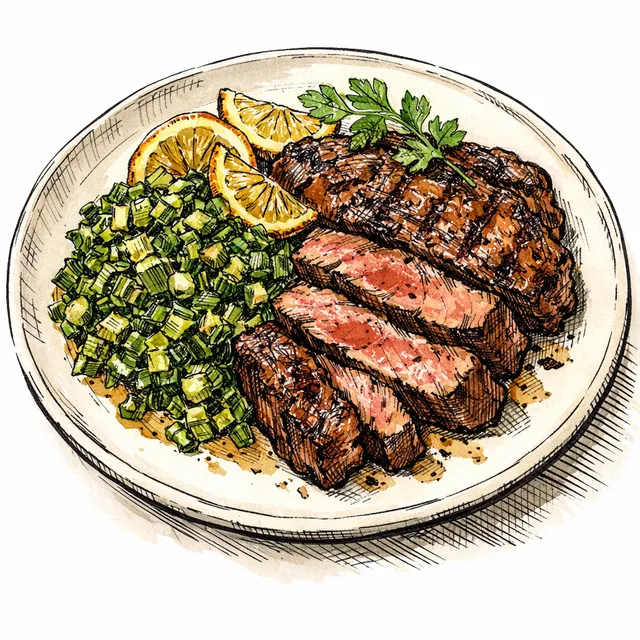
Cast-Iron Ribeyes with Collard & Spring Onion Salsa Verde
Growing up in Atlanta, Sunday meant the heavy sizzle of a cast-iron skillet and the rich, savory smell of beef filling my grandmother's kitchen. She'd cook a steak with deep love, but down in Charleston, I learned the fine-dining magic of a hard, smoking-hot sear and a foaming butter-baste with fresh thyme.\n\nThis Cast-Iron Ribeye with Collard & Spring Onion Salsa Verde is exactly where my two worlds meet. I baste a thick ribeye until it's perfectly medium-rare, then take those glorious pan drippings and pour them straight into a bright, herbaceous salsa verde. But here's the twist: instead of traditional parsley, I use finely chopped, vinegar-massaged collard greens. To finish, I add a splash of fish sauce—my secret umami handshake—giving you that soulful, low-and-slow pot-likker depth in a matter of minutes.\n\nThis dish is so special to me because it honors my grandmother's Sunday cast-iron legacy while waking it up with modern technique. Make it your own by swapping the spring onions for charred ramps when they're in season, or toss in some toasted pecans for a little extra Southern crunch. Grab your heaviest skillet, pull up a chair, and let's make some history.
Featured Recipe
Cast-Iron Ribeyes with Collard & Spring Onion Salsa Verde
Searing a thick ribeye in a smoking-hot cast-iron pan is a Southern Sunday tradition I cherish, but I like to bring a little Charleston fine-dining technique to the party. We baste these steaks with foaming butter and thyme, then pour those savory drippings straight into a bright, herbaceous salsa verde made from raw, vinegar-massaged collards. That little splash of fish sauce in the greens is my secret umami handshake—it gives you that low-and-slow depth in a matter of minutes.
Save a copy to your collection for editing
Timeline
Ingredients
- 2 (16-oz) steaks bone-in ribeye steaks(At least 1.5 inches thick)
- 1 tbsp kosher salt(For dry brining)
- 1 tsp black pepper(Freshly ground)
- 1 cup collard green leaves(Stems removed, very finely chopped)
- 1/4 cup spring onions(Finely chopped, green and white parts)
- 2 tbsp apple cider vinegar
- 1 tsp fish sauce(Adds a deep, savory backbone)
- 1 tsp sorghum syrup(Can substitute honey if needed)
- 1/4 cup extra-virgin olive oil
- 1/4 tsp crushed red pepper flakes
- 2 tbsp neutral oil(Canola or grapeseed)
- 3 tbsp unsalted butter
- 3 cloves garlic cloves(Smashed)
- 3 sprigs fresh thyme
Instructions
- 1
Season 2 (16-oz) bone-in ribeye steaks generously on all sides with 1 tbsp kosher salt and 1 tsp black pepper. Let them sit at room temperature to take the chill off and allow the salt to penetrate the meat.
15 min
Tip: Pulling your steaks from the fridge early ensures an even cook and a much better crust.
- 2
While the meat tempers, make the salsa verde. In a medium bowl, combine 1 cup finely chopped collard green leaves, 1/4 cup chopped spring onions, 2 tbsp apple cider vinegar, 1 tsp fish sauce, 1 tsp sorghum syrup, 1/4 cup extra-virgin olive oil, and 1/4 tsp crushed red pepper flakes. Use your hands to vigorously massage the greens until they soften and darken in the acid.
10 min
Tip: Massaging raw collards breaks down their tough cellular structure, making them tender and vibrant without needing an hour on the stove.
- 3
Place a large, heavy cast-iron skillet over medium-high heat. Let it get smoking hot, then swirl in 2 tbsp neutral oil.
5 min
Tip: Turn your vent hood on high! You want the pan screaming hot before the meat goes in.
- 4
Carefully lay the steaks into the hot skillet, dropping them away from you to avoid splatters. Let them sear undisturbed until a deep, crusty sear forms on the bottom.
4 min
Tip: Don't peek or prod. Let the cast iron do its work.
- 5
Flip the steaks. Immediately add 3 tbsp unsalted butter, 3 smashed garlic cloves, and 3 sprigs fresh thyme to the pan. Tip the skillet slightly toward you and use a large spoon to continuously baste the steaks with the foaming butter.
4 min
Tip: Basting builds a beautiful crust while gently cooking the top of the steak with aromatic butter.
- 6
Transfer the steaks to a wooden cutting board to rest. Carefully pour the remaining butter and pan drippings directly into your collard salsa verde and stir to combine.
10 min
Tip: Resting is non-negotiable. Pouring the hot beef fat over the raw greens wilts them just enough to bring the whole sauce together.
- 7
Slice the rested steaks against the grain. Spoon the warm, buttery collard salsa verde over the top of the sliced meat right before serving.
2 min
Tip: Serve right off the cutting board for a dramatic, family-style presentation.
Chef's Notes
Growing up in Atlanta, the smell of a cast-iron skillet heating up on a Sunday meant my grandfather was about to work some magic. He'd smoke out the whole kitchen, but that steak was always worth it. Down in Charleston, I learned how to properly baste with butter and aromatics. This recipe marries those two worlds. The raw collard salsa verde is a trick I absolutely love—massaging the sturdy greens with vinegar breaks them down beautifully, and that little hit of fish sauce is the secret handshake of modern Southern cooking. It gives you the deep, savory notes of a long-simmered ham hock in a fraction of the time, cutting right through the richness of a perfect ribeye.

Marcus Stone
Heritage recipes with a chef's touch
My grandmother's kitchen in Atlanta is where I learned that food carries history. Every pot of collards, every batch of biscuits, every Sunday roast told stories of resilience, family, and love. I went on to train at the finest restaurants in Charleston and worked my way up through white-tablecloth kitchens. But I always came back to those family recipes—now I cook them with a chef's technique but a grandmother's heart. Because the best food honors where it came from.