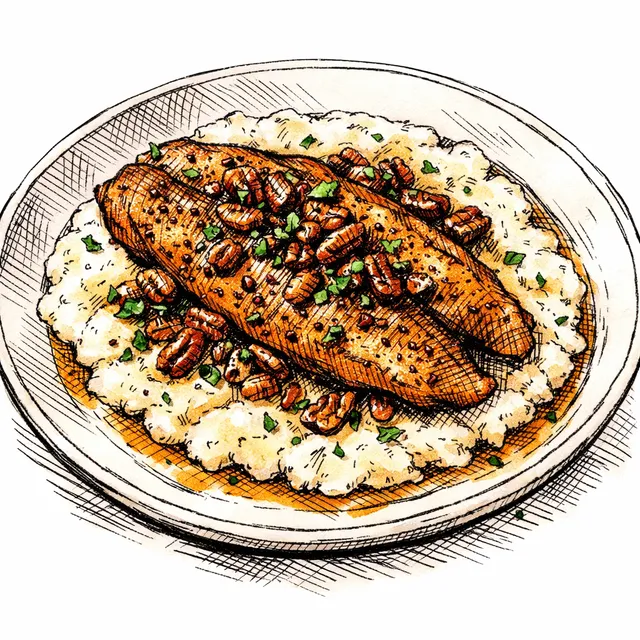
Cast-Iron Seared Catfish with Spiced Pecan Brown Butter & Stone-Ground Grits
Growing up in my grandmother's Atlanta kitchen, Friday nights meant catfish. Years later, training down in Charleston, I fell in love with the refined elegance of Lowcountry seafood and stone-ground grits. This recipe is the sweet spot where those two worlds collide. I still remember the first time I browned butter with toasted pecans and added a dash of fish sauce—a little umami secret my grandmother wouldn't have used, but one I know she would have loved. What makes this dish truly special to me is how it honors our roots while stretching our palates. The key to the grits is patience; never rush a slow simmer, and fold in plenty of sharp white cheddar at the very end. When you sear the catfish, get that cast-iron skillet screaming hot so you get that transcendent, golden crust. Serve it hot, pour a glass of sweet tea, and tell your folks a story while you eat.
Featured Recipe
Cast-Iron Seared Catfish with Spiced Pecan Brown Butter & Stone-Ground Grits
Crisp, golden-crusted catfish fillets seared hard in cast iron and bathed in a nutty, thyme-flecked pecan brown butter with an unexpected splash of fish sauce. Served over velvety, sharp white cheddar stone-ground grits, this dish captures the soul of Lowcountry fine dining grounded in Atlanta supper-table warmth.
Save a copy to your collection for editing
Timeline
Ingredients
- 1 cup coarse stone-ground white grits(preferably Georgia or South Carolina heirloom grits)
- 2 cups low-sodium chicken broth(or water)
- 2 cups whole milk
- 1/4 cup heavy cream
- 1 cup sharp white cheddar cheese(freshly shredded)
- 8 tbsp unsalted butter(1 stick, divided)
- 4 catfish fillets(about 6 oz each, skinless, patted completely dry)
- 2 tbsp all-purpose flour(for a light sear dusting)
- 1 tsp smoked paprika
- 1/2 tsp garlic powder
- 1/4 tsp cayenne pepper
- 2 tsp kosher salt(divided)
- 1 tsp freshly cracked black pepper(divided)
- 2 tbsp neutral cooking oil(such as canola or grapeseed)
- 1/2 cup raw pecans(roughly chopped)
- 1 tbsp fresh thyme leaves(finely chopped)
- 2 tbsp fresh lemon juice(from 1 lemon)
- 1 tsp fish sauce(my secret weapon for savory depth)
- 2 tbsp fresh flat-leaf parsley(finely chopped)
- 2 scallions(thinly sliced, for garnish)
Instructions
- 1
In a heavy-bottomed 3-quart saucepan, bring 2 cups low-sodium chicken broth, 2 cups whole milk, and 1 tsp kosher salt to a gentle boil over medium-high heat. Gradually pour in 1 cup coarse stone-ground white grits in a steady stream while whisking vigorously to avoid clumping.
5 min
Tip: Pouring slowly while whisking prevents grits from forming stubborn lumps right off the bat.
- 2
Reduce the heat to low, cover the saucepan partially with a lid, and cook the grits for 25 minutes, whisking thoroughly every 4 to 5 minutes so the bottom doesn't scorch.
25 min
Tip: True stone-ground grits need time and gentle patience to release their natural starch and soften completely.
- 3
While the grits simmer, prepare the catfish. Pat 4 catfish fillets dry with paper towels. In a small shallow bowl, whisk together 2 tbsp all-purpose flour, 1 tsp smoked paprika, 1/2 tsp garlic powder, 1/4 tsp cayenne pepper, 1/2 tsp kosher salt, and 1/2 tsp freshly cracked black pepper. Sprinkle this seasoning mixture evenly over both sides of the fillets, smoothing it out so there is just an ultra-light, translucent coating.
5 min
Tip: Keep the flour coating whisper-thin; you want an assertive cast-iron sear, not a heavy batter.
- 4
Set a 12-inch cast-iron skillet over medium-high heat until shimmering and faintly smoking. Add 2 tbsp neutral cooking oil and swirl to coat the entire pan. Carefully lay 4 catfish fillets into the pan, laying them away from you. Sear undisturbed for 4 minutes until deeply browned with a crisp crust, then gently flip with a fish spatula and sear the reverse side for 3 to 4 minutes more until the fish just flakes at the thickest part. Transfer the fish to a warm plate and tent lightly with foil.
8 min
Tip: Don't poke or nudge the fillets for the first 3 minutes; letting the crust fully form prevents sticking to the cast iron.
- 5
Reduce the skillet heat to medium-low. Wipe away any excess black speckles with a folded paper towel, leaving the skillet hot. Melt 5 tbsp unsalted butter in the skillet. Once foaming, toss in 1/2 cup raw pecans and cook for about 2 minutes, swirling constantly until the pecans smell toasted and the butter browns into an amber hue with a hazelnut aroma. Immediately stir in 1 tbsp fresh thyme leaves, 2 tbsp fresh lemon juice, and 1 tsp fish sauce, swirling off the heat for 30 seconds as the butter foams vigorously.
4 min
Tip: The fish sauce provides an invisible savory backbone that lifts the sweet richness of the butter and toasted pecans.
- 6
Remove the grits from heat and stir in the remaining 3 tbsp unsalted butter, 1/4 cup heavy cream, 1 cup sharp white cheddar cheese, remaining 1/2 tsp kosher salt, and remaining 1/2 tsp freshly cracked black pepper until melted and glossy. Ladle generous mounds of cheesy grits into wide bowls, nestle a seared catfish fillet onto each, and spoon the warm pecan brown butter pan sauce generously over the top. Garnish with 2 tbsp fresh flat-leaf parsley and 2 scallions before serving.
4 min
Tip: Always fold cheese into grits off the heat to keep the dairy silky rather than separated or grainy.
Chef's Notes
Growing up in Atlanta, catfish meant church fish fries with cornmeal breading and hot sauce. But when I was working the line at a Charleston restaurant on East Bay Street, I discovered meunière pan sauces and realized how beautifully sweet, firm freshwater catfish takes to a screaming-hot cast-iron sear and nutty brown butter. A splash of fish sauce in the pan sauce might sound unconventional for a Southern classic, but that touch of fermented funk magnifies the sweetness of the pecans and cuts straight through the richness of the cheddar grits.

Marcus Stone
Heritage recipes with a chef's touch
My grandmother's kitchen in Atlanta is where I learned that food carries history. Every pot of collards, every batch of biscuits, every Sunday roast told stories of resilience, family, and love. I went on to train at the finest restaurants in Charleston and worked my way up through white-tablecloth kitchens. But I always came back to those family recipes—now I cook them with a chef's technique but a grandmother's heart. Because the best food honors where it came from.