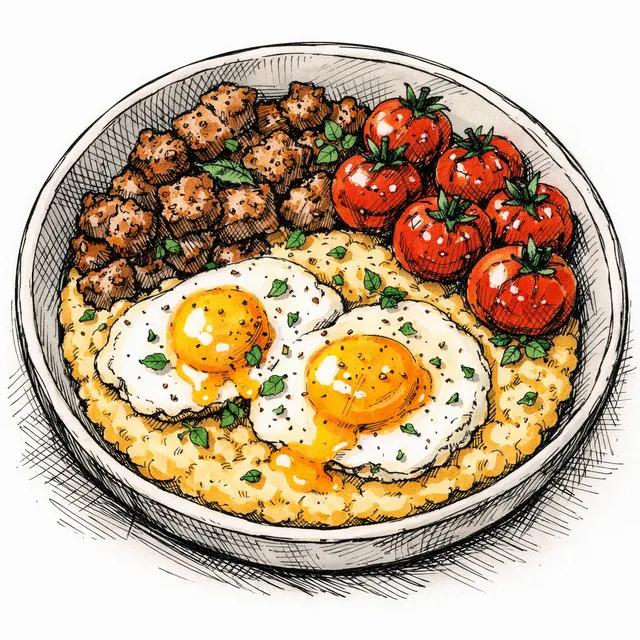
Cast-Iron Skillet Cheddar Grits with Sage Pork Sausage, Blistered Tomatoes & Runny Eggs
My grandmother used to say a good breakfast is like a warm hug on a cold morning. Growing up in Atlanta, Sunday mornings meant the heavy clatter of cast iron and the rich aroma of pork sausage frying up on the stove. This skillet is my love letter to those mornings, blending cherished tradition with a modern, all-in-one approach. I start with slow-simmered, stone-ground yellow grits—never instant—folded generously with sharp white cheddar and butter. Then, I bake them right in a sizzling cast-iron skillet alongside savory sage sausage and sweet blistered tomatoes that pop with every bite. The real magic happens at the end when I cradle farm-fresh eggs directly into the warm grits, letting the yolks create their own rich sauce. What makes this recipe special to me is how it brings everyone around the table, spoon in hand, fighting for the crispy edge pieces. Tip for making it your own: don't be shy with the black pepper, and if you want a little extra depth, a dash of hot pepper vinegar cuts right through the richness of the cheese. Serve it straight from the skillet and watch it disappear.
Featured Recipe
Cast-Iron Skillet Cheddar Grits with Sage Pork Sausage, Blistered Tomatoes & Runny Eggs
Slow-simmered, stone-ground yellow grits folded with sharp white cheddar and butter, baked right in a sizzling cast-iron skillet alongside savory sage sausage and blistered tomatoes. Finished with farm eggs cradled directly into the warm grits for an irresistible, soulful Southern morning skillet.
Save a copy to your collection for editing
Timeline
Ingredients
- 1 cup stone-ground yellow grits(coarse heirloom grits preferred)
- 3 cups low-sodium chicken stock
- 1.5 cups whole milk
- 1.5 tsp kosher salt(divided)
- 8 oz ground sage breakfast sausage(bulk pork sausage)
- 1 cup cherry tomatoes(whole)
- 2 cloves garlic(finely minced)
- 1.5 cups sharp white cheddar cheese(freshly grated)
- 3 tbsp unsalted butter(cubed)
- 0.5 tsp freshly cracked black pepper
- 1 tsp hot sauce(Southern vinegar-based hot sauce)
- 4 large eggs(farm-fresh)
- 2 tbsp fresh chives(finely chopped)
Instructions
- 1
In a heavy-bottomed medium saucepan, combine 3 cups low-sodium chicken stock, 1.5 cups whole milk, and 1 tsp kosher salt over medium-high heat. As soon as tiny bubbles break the surface, slowly pour in 1 cup stone-ground yellow grits in a steady stream while whisking vigorously to avoid clumping.
5 min
Tip: Always whisk while adding coarse stone-ground grits; dumping them all at once guarantees stubborn lumps.
- 2
Reduce the heat to low, cover the saucepan partially with a lid, and let the grits simmer gently for 25 minutes, stirring every 4 to 5 minutes with a wooden spoon across the bottom to ensure nothing sticks or scorches.
25 min
Tip: Stone-ground grits need patience and steam to unlock their deep corn starch and velvety texture.
- 3
Preheat your oven to 400°F (200°C). Set a 10-inch or 12-inch seasoned cast-iron skillet over medium heat. Add 8 oz ground sage breakfast sausage and crumble it with a wooden spoon until browned and crisp around the edges, about 6 minutes. Toss in 1 cup cherry tomatoes and cook untouched for 3 to 4 minutes until the skins char and blister gently.
10 min
Tip: Letting the tomatoes sit without stirring allows the cast iron to give them that blistered, caramelized sweetness.
- 4
Using a slotted spoon, transfer the browned sausage and blistered tomatoes to a plate, leaving the flavorful rendered fat in the hot cast iron. Toss in 2 cloves garlic and sauté for 45 seconds in the residual fat until fragrant, then turn off the skillet burner.
3 min
Tip: Do not wipe the skillet clean; that rendered pork fat forms the crust of our baked grits.
- 5
Uncover the fully tender grits and stir in 3 tbsp unsalted butter, 1.5 cups sharp white cheddar cheese, 0.5 tsp freshly cracked black pepper, the remaining 0.5 tsp kosher salt, and 1 tsp hot sauce until completely melted and silky.
4 min
Tip: A splash of vinegar hot sauce adds balance to the rich milk fats and sharp cheese without masking the corn.
- 6
Pour the hot, creamy cheese grits directly into the warm cast-iron skillet over the garlic drippings. Scatter the cooked sausage and tomatoes over the top. Use the back of a soup spoon to press four gentle hollows into the grits, then carefully crack 4 large eggs, dropping one into each indentation.
3 min
Tip: Making shallow indentations keeps the egg yolks centered and prevents the whites from sliding to the pan edges.
- 7
Slide the skillet into the preheated 400°F oven and bake for 8 to 10 minutes, until the egg whites are just opaque and set while the yolks remain soft and glossy. Remove carefully with oven mitts, sprinkle with 2 tbsp fresh chives, and serve hot right from the skillet.
8 min
Tip: Pull the skillet when the yolks still jiggle gently; the cast iron holds enough residual heat to finish them perfectly at the table.
Chef's Notes
Growing up in Atlanta, my grandmother never bought quick grits—it was strictly coarse stone-ground, simmering on the back eye of the stove while grease popped from breakfast sausage up front. In Charleston kitchens, I learned to bring those elements together into one vessel. Baking the eggs right atop the bubbling, cheese-enriched grits in the pork drippings turns Sunday breakfast into something truly sacred.

Marcus Stone
Heritage recipes with a chef's touch
My grandmother's kitchen in Atlanta is where I learned that food carries history. Every pot of collards, every batch of biscuits, every Sunday roast told stories of resilience, family, and love. I went on to train at the finest restaurants in Charleston and worked my way up through white-tablecloth kitchens. But I always came back to those family recipes—now I cook them with a chef's technique but a grandmother's heart. Because the best food honors where it came from.