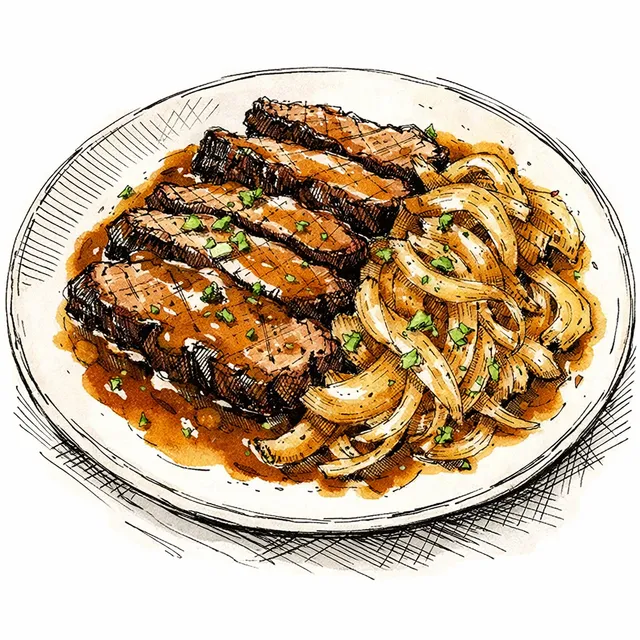
Cast-Iron Skillet-Roasted Beef Brisket with Smothered Vidalias & Bourbon Pan Gravy
Sunday afternoons at my grandmother’s house in Atlanta always smelled like low and slow. I can still picture her leaning over her favorite seasoned skillet, coaxing magic out of simple ingredients. That memory is the heartbeat of my Cast-Iron Skillet-Roasted Beef Brisket with Smothered Vidalias and Bourbon Pan Gravy. When I was training in Charleston, I learned how technique could elevate memory. That is why this brisket sits on a thick bed of melting Vidalia onions, developing a deeply lacquered, peppery bark right in the heavy iron. What makes this recipe truly special to me is the gravy. By finishing the pan drippings with a splash of good bourbon and a stealthy dash of fish sauce—my little umami secret—we unlock an unforgettable depth that honors our roots while pushing the flavor forward. My tip for making it your own? Don't rush the onions. Let them caramelize until they are practically sweet jam before the beef even touches the pan. Serve it with a mess of buttermilk biscuits to sop up every last drop, and tell a story around the table while you eat.
Featured Recipe
Cast-Iron Skillet-Roasted Beef Brisket with Smothered Vidalias & Bourbon Pan Gravy
Slow-roasted directly in heavy cast iron, this brisket develops a deeply lacquered, peppery bark over a bed of melting Vidalia onions. A splash of bourbon and a touch of fish sauce give the rich pan gravy an unforgettable depth that honors traditional Southern Sunday dinners with a chef's refinement.
Save a copy to your collection for editing
Timeline
Ingredients
- 3.5 lbs beef brisket flat (with 1/4-inch fat cap)(trimmed, fat cap lightly scored in a crosshatch pattern)
- 1.5 tbsp kosher salt(divided)
- 1 tbsp coarsely cracked black pepper
- 1.5 tsp smoked paprika
- 1 tsp garlic powder
- 1 tbsp dark brown sugar
- 1 tbsp vegetable oil
- 3 large Vidalia onions(peeled and sliced 1/4-inch thick)
- 6 fresh thyme sprigs
- 6 garlic cloves(smashed)
- 0.33 cup bourbon(use a good sipping bourbon)
- 1.5 cups rich beef stock(low-sodium)
- 1.5 tbsp Worcestershire sauce
- 1 tsp fish sauce(for savory depth)
- 1 tbsp apple cider vinegar
- 2 tbsp unsalted butter(cold, cut into cubes)
Instructions
- 1
Preheat your oven to 300°F (150°C). In a small bowl, stir together 1 tbsp kosher salt, 1 tbsp coarsely cracked black pepper, 1.5 tsp smoked paprika, 1 tsp garlic powder, and 1 tbsp dark brown sugar. Rub the seasoning blend thoroughly over all sides of 3.5 lbs beef brisket flat (with 1/4-inch fat cap), working it into the scored fat cap.
10 min
Tip: Letting the brisket sit on the counter with the rub for 15 minutes before searing helps the salt penetrate the meat evenly.
- 2
Heat 1 tbsp vegetable oil in a 12-inch heavy cast-iron skillet over medium-high heat until shimmering. Carefully lay in the brisket fat-side down and sear undisturbed until a deep, mahogany crust forms, about 6 to 8 minutes. Turn the brisket and sear the lean side for another 4 minutes. Transfer the brisket temporarily to a warm platter.
12 min
Tip: Do not move the brisket while searing the fat cap; let cast iron work its magic to create that essential caramelized crust.
- 3
Reduce skillet heat to medium. Add 3 large Vidalia onions and remaining 0.5 tbsp kosher salt to the rendered beef drippings. Cook, scraping up browned fond with a wooden spoon, until onions soften and lightly brown, about 7 minutes. Add 6 garlic cloves and 6 fresh thyme sprigs, cooking for 1 minute until fragrant.
8 min
Tip: Sweet Vidalia onions release lots of moisture; scraping the bottom of the skillet during this step loosens all the deeply flavorful pan fond.
- 4
Pour in 0.33 cup bourbon, simmering vigorously until reduced by half, about 2 minutes. Stir in 1.5 cups rich beef stock, 1.5 tbsp Worcestershire sauce, 1 tsp fish sauce, and 1 tbsp apple cider vinegar. Bring the pan liquid to a gentle boil.
3 min
Tip: The dash of fish sauce provides foundational glutamates that amplify beefiness without making the gravy taste fishy in the slightest.
- 5
Nestle the brisket back into the skillet, resting fat-side up directly on the smothered onions so the top remains exposed above the braising liquid. Cover the skillet tightly with a double layer of heavy-duty aluminum foil, sealing the edges well. Transfer to the preheated 300°F oven and roast until fork-tender, about 3 hours.
180 min
Tip: A tight seal traps steam inside the heavy cast-iron skillet, gently breaking down collagen without drying out the flat cut.
- 6
Carefully remove the foil. Baste the top of the brisket with a few spoonfuls of the simmering skillet juices. Increase the oven temperature to 400°F (200°C) and roast uncovered for 15 minutes, until the fat cap blisters and glazes into a rich, dark bark.
15 min
Tip: This high-heat finish roasts off excess surface moisture, restoring crispness to the seasoned bark while caramelizing the pan juices.
- 7
Transfer the brisket to a carving board, tent loosely with foil, and let rest for 15 minutes. While the meat rests, place the cast-iron skillet over medium heat on the stovetop. Simmer the pan drippings and smothered onions for 5 minutes until glossy and thickened, then whisk in 2 tbsp unsalted butter until melted into a luscious gravy. Slice brisket across the grain and serve smothered in onions and pan gravy.
15 min
Tip: Always slice brisket against the grain at a slight bias to shorten muscle fibers for maximum tenderness.
Chef's Notes
My grandmother taught me that Sunday brisket wasn't something you rushed—it was the anchor of the week. While pitmasters spend sixteen hours by an offset smoker, home cooks can achieve extraordinary flavor using the heat-retentive prowess of a cast-iron skillet. Searing hard in the skillet before slow-roasting gently braises the meat over sweet Georgia Vidalias, while my Charleston kitchen instincts insisted on a splash of bourbon and fish sauce to push the savory complexity over the top.

Marcus Stone
Heritage recipes with a chef's touch
My grandmother's kitchen in Atlanta is where I learned that food carries history. Every pot of collards, every batch of biscuits, every Sunday roast told stories of resilience, family, and love. I went on to train at the finest restaurants in Charleston and worked my way up through white-tablecloth kitchens. But I always came back to those family recipes—now I cook them with a chef's technique but a grandmother's heart. Because the best food honors where it came from.