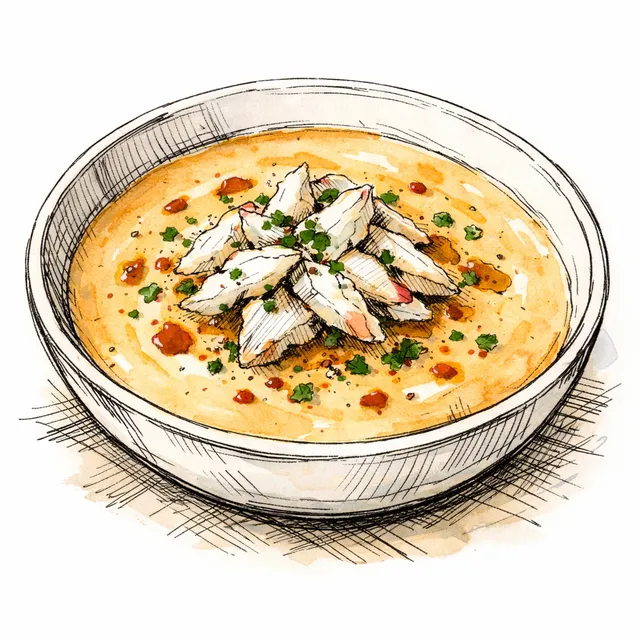
Charleston Silk: Gently Simmered Blue Crab & Sherry Soup
Back when I was working the line in Charleston, I learned a lesson that changed my cooking forever: true Lowcountry elegance is all about restraint. I remember standing in the sweltering kitchen, watching an old-school chef gently coax the sweetness out of local blue crabs. He never rushed the pot. That memory birthed what I call Charleston Silk, my homage to historic She-Crab soup. It relies on a very gentle simmer, barely a whisper of bubbles, to keep that lump blue crab from turning tough. It is special to me because it bridges my time learning fine dining with the deep, soulful roots of Southern coastal food. I finish my version with the traditional dry sherry, but here is my chef's touch: a splash of fish sauce. It sounds untraditional, but it brings out this incredible, deep Atlantic umami that makes the crab taste even more like itself. When you make this at home, do not be afraid to make it your own. Try adding a pinch of smoked paprika or a little fresh chive on top, but whatever you do, respect the crab and keep that heat low. Grab a spoon and let us taste history together.
Featured Recipe
Charleston Silk: Gently Simmered Blue Crab & Sherry Soup
Back when I was working the line in Charleston, I learned that true Lowcountry elegance is all about restraint. This rich, velvety soup pays homage to the historic She-Crab soup of the coast, relying on a very gentle simmer to coax out the delicate sweetness of lump blue crab without turning it tough. I finish it with dry sherry and a splash of fish sauce—my modern nod to the deep umami of the Atlantic.
Save a copy to your collection for editing
Timeline
Ingredients
- 4 tbsp unsalted butter(Divided use)
- 1/2 cup shallots(Finely minced)
- 1/4 cup celery(Finely minced)
- 3 tbsp all-purpose flour
- 1/4 tsp ground mace(Crucial for authentic Lowcountry flavor)
- 1/4 tsp ground white pepper
- 3 cups seafood stock(High quality, warmed)
- 1 lb lump blue crab meat(Picked over carefully for shells)
- 1 cup heavy cream(Room temperature)
- 1 tsp fish sauce(My secret umami booster)
- 1/4 cup dry Amontillado sherry
- 2 hard-boiled egg yolks(Crumbled to mimic crab roe)
- 2 tbsp chives(Finely chopped for garnish)
Instructions
- 1
Melt 4 tbsp unsalted butter in a heavy-bottomed Dutch oven over medium-low heat. Add 1/2 cup finely minced shallots and 1/4 cup finely minced celery. Sweat the aromatics slowly until they are completely translucent and soft but have taken on no color.
5 min
Tip: Patience is key here. You want the vegetables to melt into the butter, creating a sweet, aromatic base.
- 2
Sprinkle in 3 tbsp all-purpose flour, 1/4 tsp ground mace, and 1/4 tsp ground white pepper. Stir constantly with a wooden spoon to create a blond roux. Let it cook just until the raw flour smell dissipates.
2 min
Tip: Mace is the historical backbone of Charleston crab soups—it provides a haunting, nutmeg-like warmth.
- 3
Gradually whisk in 3 cups seafood stock, a half-cup at a time, ensuring the liquid is fully incorporated and smooth before adding more. Increase the heat slightly to bring the mixture to a bare, gentle simmer.
5 min
Tip: Warming your stock beforehand prevents lumps from forming when it meets the roux.
- 4
Reduce the heat to low and maintain a very gentle simmer. Let the soup base cook and thicken slightly while the flavors meld.
15 min
Tip: Look for lazy, occasional bubbles. A hard boil will dull the delicate aromatics.
- 5
While the base simmers, gently pick through 1 lb lump blue crab meat to remove any stray cartilage or shell fragments. Be careful not to break up those beautiful lumps. In a small bowl, crumble 2 hard-boiled egg yolks with a fork.
5 min
Tip: Even the highest quality lump crab hides a few shells. Inspecting it by touch is the best method.
- 6
Whisk 1 cup heavy cream and 1 tsp fish sauce into the simmering base. Keep the heat on low and stir gently until the soup is fully heated through. Do not let it boil.
3 min
Tip: The fish sauce won't make it taste fishy; it acts as an umami multiplier for the natural sweetness of the crab.
- 7
Fold the picked crab meat and 1/4 cup dry Amontillado sherry into the pot. Continue to gently simmer just long enough to warm the crab through completely.
3 min
Tip: Overcooking the crab now will make it stringy. We just want it warmed in our beautiful silk bath.
- 8
Ladle the hot soup into warmed, shallow bowls. Garnish each serving evenly with the crumbled egg yolks and 2 tbsp finely chopped chives.
2 min
Tip: Serving in warmed bowls ensures this delicate soup stays hot while you enjoy it.
Chef's Notes
You'll notice I use crumbled hard-boiled egg yolks here—an old Charleston trick to mimic the richness of female crab roe, which is restricted to harvest today for sustainability. The key to this entire dish is your heat control. Once that cream goes in, respect the crab: keep that heat low, and let it merely whisper into a simmer. Boiling will break the spell.

Marcus Stone
Heritage recipes with a chef's touch
My grandmother's kitchen in Atlanta is where I learned that food carries history. Every pot of collards, every batch of biscuits, every Sunday roast told stories of resilience, family, and love. I went on to train at the finest restaurants in Charleston and worked my way up through white-tablecloth kitchens. But I always came back to those family recipes—now I cook them with a chef's technique but a grandmother's heart. Because the best food honors where it came from.