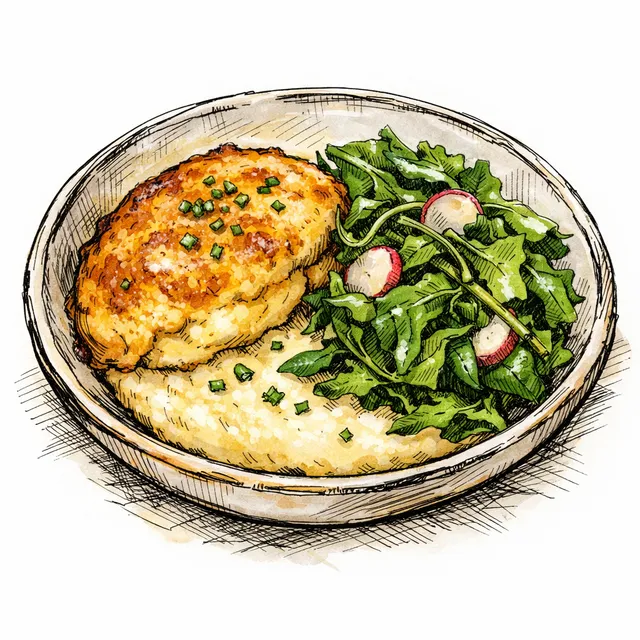
A Breathless Homage: Cheddar Spoonbread & Spring Greens
Growing up in Atlanta, Sunday lunch at my grandmother's house always featured a cast-iron skillet of spoonbread. It was heavy, rich with cornmeal, and absolutely swimming in butter. It was pure perfection. But when I got to Charleston and began playing with French soufflé techniques, I wondered: could I capture the deep, comforting soul of her kitchen in something a little lighter? That is exactly where this Slow-Simmered Grits and Aged Cheddar Spoonbread was born. I start by slow-simmering stone-ground grits until they are impossibly creamy. Then, paying homage to my fine dining training, I gently fold in whipped egg whites, sharp aged cheddar, and wilted spring greens. The result is a cloud-like, savory masterpiece that sits on the plate with an ethereal lightness. This recipe means the absolute world to me because it bridges my past and my present—it is the history of the South lifted up by modern technique. To make it your own, do not be afraid to swap the spring greens for tender mustard greens, or even add a tiny splash of hot sauce to the batter before baking. Food is a living story, so grab a whisk and add your own chapter.
Featured Recipe
Slow-Simmered Grits & Aged Cheddar Spoonbread with Folded Spring Greens
Spoonbread is the unsung hero of Southern lunches, often heavy with cornmeal and dripping with butter. In this elevated homage to my grandmother's kitchen, we slow-simmer stone-ground grits until impossibly creamy, then borrow French soufflé techniques to gently fold in whipped egg whites, sharp aged cheddar, and wilted spring greens. The result is a cloud-like, savory masterpiece that carries the soul of Atlanta but sits on the plate with an ethereal, breathless lightness.
Save a copy to your collection for editing
Timeline
Ingredients
- 1 cup stone-ground yellow grits(Do not use quick or instant grits)
- 2 cups whole milk(Room temperature)
- 2 cups vegetable broth(Low sodium)
- 4 large eggs(Separated into yolks and whites)
- 1.5 cups aged sharp white cheddar(Freshly grated)
- 1/2 cup spring greens(Spinach, arugula, or baby kale, finely chopped)
- 2 tbsp unsalted butter(Divided use)
- 1 tsp kosher salt
- 1/2 tsp freshly cracked black pepper
- 1/4 tsp cayenne pepper
- 1/2 tsp cream of tartar
Instructions
- 1
Preheat your oven to 375 degrees Fahrenheit. Generously grease the inside of a 1.5-quart baking or soufflé dish with 1 tbsp unsalted butter so the spoonbread has a slick surface to climb as it bakes.
5 min
Tip: Brushing the butter in upward strokes on the sides of the dish helps guide the soufflé's rise.
- 2
In a heavy-bottomed saucepan over medium-high heat, combine 2 cups whole milk and 2 cups vegetable broth. Once it reaches a gentle boil, slowly whisk in 1 cup stone-ground yellow grits. Reduce the heat to its absolute lowest setting, cover the pot, and let it slow-simmer. You must treat these grits with patience, stirring every few minutes so they release their starches, for about 30 minutes until deeply tender and thick.
30 min
Tip: Stone-ground grits need low heat and time to fully hydrate without scorching the bottom of the pot.
- 3
While the grits are beginning their simmer, melt the remaining 1 tbsp unsalted butter in a small skillet over medium heat. Add your finely chopped 1/2 cup spring greens and sauté for just a minute or two until barely wilted. Remove from the heat immediately so they keep their vibrant color.
5 min
Tip: Don't overcook the greens here; they will continue to cook in the oven.
- 4
Carefully separate 4 large eggs. Place the yolks in a small bowl. In a large, impeccably clean glass or metal bowl, add the egg whites and 1/2 tsp cream of tartar. Using an electric hand mixer, whip the whites on medium-high speed until stiff, glossy peaks form. This aeration is the secret to elevating our humble grits.
10 min
Tip: Ensure there is not a single drop of yolk in your whites, or they will refuse to whip.
- 5
When the grits are tender and have absorbed the liquid, remove the pot from the heat. Moving quickly, vigorously stir in the egg yolks to temper them into the hot mixture. Then, stir in 1.5 cups aged sharp white cheddar, the wilted spring greens, 1 tsp kosher salt, 1/2 tsp freshly cracked black pepper, and 1/4 tsp cayenne pepper. Mix until the cheese is completely melted and the batter is smooth.
5 min
Tip: The residual heat from the slow-simmered grits will easily melt the aged cheddar.
- 6
Here is where the magic happens. Take one-third of your stiff egg whites and stir them directly into the heavy grits mixture to lighten the base. Then, gently fold in the remaining egg whites in two separate batches. Use a delicate, sweeping figure-eight motion with a rubber spatula, bringing the batter from the bottom of the bowl up over the top. This gentle folding technique is crucial so you don't deflate the air bubbles you just worked so hard to create.
5 min
Tip: Stop folding the moment no white streaks remain. Over-folding leads to a dense spoonbread.
- 7
Gently pour the folded, cloud-like batter into your prepared baking dish. Place it on the middle rack of the oven and bake undisturbed for 35 to 40 minutes. The spoonbread will puff up beautifully, turning deeply golden brown on top while remaining slightly jiggly in the very center.
35 min
Tip: Do not open the oven door during the first 30 minutes of baking, or the sudden rush of cool air might cause the spoonbread to collapse.
- 8
Remove the spoonbread from the oven. It will immediately begin a slow, dramatic descent, which is perfectly natural for a soufflé-style dish. Let it rest for 5 minutes before scooping it out with a large spoon to serve.
5 min
Tip: Serve immediately alongside a crisp spring salad or roasted vegetables.
Chef's Notes
In fine dining, we treat delicate ingredients with reverence. By taking an ingredient as structurally heavy as stone-ground grits and treating it with the care of a French soufflé, we build a bridge between high technique and deeply rooted Southern comfort. Don't be intimidated by the folding process; just keep your wrist loose and let the spatula do the work.

Marcus Stone
Heritage recipes with a chef's touch
My grandmother's kitchen in Atlanta is where I learned that food carries history. Every pot of collards, every batch of biscuits, every Sunday roast told stories of resilience, family, and love. I went on to train at the finest restaurants in Charleston and worked my way up through white-tablecloth kitchens. But I always came back to those family recipes—now I cook them with a chef's technique but a grandmother's heart. Because the best food honors where it came from.