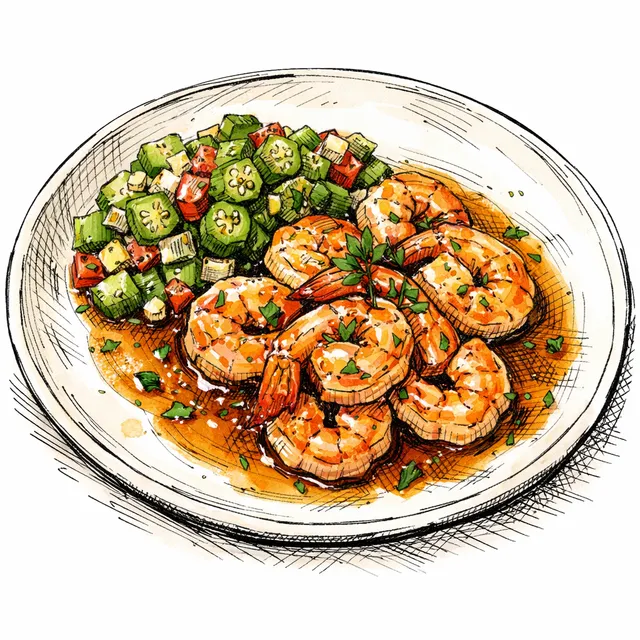
Delicate Sautéed Shrimp with Bourbon-Fish Sauce Butter & Quick Okra Relish
Growing up in Atlanta, our starters were often heavy and deep-fried—and don't get me wrong, my grandmother's fried shrimp still visits me in my dreams. But working the line in fine dining restaurants down in Charleston taught me to treat our coastal catch with absolute restraint. I wanted to create a dish that honors those deep Southern roots but lets the sweet, natural flavor of the shrimp shine through. We're doing a delicate, gentle sauté here, finishing it in a butter pan sauce spiked with a good splash of bourbon, fresh lemon, and my absolute secret weapon: a dash of fish sauce. It might surprise you, but that fish sauce brings a deep, oceanic umami that just makes the whole pan sing. I top it all off with a bright, crunchy quick okra relish to cut through the richness. This recipe is special to me because it perfectly bridges my grandmother's hearty, comforting table and my fine-dining training. It is pure elegance on a plate. To make it your own, try swapping the bourbon for a dry white wine or folding a handful of fresh heirloom cherry tomatoes into the relish. Just remember to pull the shrimp off the heat the second they turn pink—treat them gently, and they will take care of you.
Featured Recipe
Delicate Sautéed Shrimp with Bourbon-Fish Sauce Butter & Quick Okra Relish
A lot of Southern starters lean heavy and deep-fried, but working the line in Charleston taught me to treat our coastal catch with absolute restraint. We’re doing a delicate, gentle sauté here, finishing the sweet shrimp in a butter pan sauce spiked with bourbon, lemon, and my secret weapon—a splash of fish sauce for deep umami. Topped with a bright, crunchy okra relish, this is pure elegance on a plate.
Save a copy to your collection for editing
Timeline
Ingredients
- 1 cup Fresh okra pods (or drained pickled okra)(Thinly sliced into rounds. If using pickled okra, reduce the vinegar in the relish by half.)
- 1 small Shallot(Finely minced)
- 1/4 cup Sweet red bell pepper(Finely diced)
- 3 tbsp Apple cider vinegar(For the quick relish)
- 1 tsp Granulated sugar(Just enough to balance the vinegar)
- 1 lb Jumbo Gulf or Atlantic shrimp(Peeled, deveined, tails left on)
- 4 tbsp Unsalted butter(Divided use)
- 2 cloves Garlic(Shaved paper-thin)
- 2 tbsp Bourbon(A decent sipping bourbon works best)
- 1 tsp Fish sauce(The secret umami bridge; do not skip this!)
- 1 tbsp Fresh lemon juice(Freshly squeezed)
- 1 tbsp Fresh flat-leaf parsley(Finely chopped)
- 4 slices Sourdough bread(Thickly sliced, for mopping up the sauce)
- 1/2 tsp Kosher salt and cracked white pepper(To taste)
- 1 tbsp olive oil(Used for brushing the sourdough slices if butter is not being used; the provided butter is fully utilized in the sauce.)
Instructions
- 1
In a small bowl, combine 1 cup Fresh okra pods (or drained pickled okra), 1 small Shallot, 1/4 cup Sweet red bell pepper, 3 tbsp Apple cider vinegar, 1 tsp Granulated sugar, and a hefty pinch of Kosher salt and cracked white pepper. Toss well and let it sit at room temperature to quick-pickle while you handle the rest.
5 min
Tip: The longer this sits, the better it gets. The vinegar completely tames the okra's natural snap without any sliminess.
- 2
Pat the 1 lb Jumbo Gulf or Atlantic shrimp completely dry with paper towels. A dry shrimp ensures we get a nice, clean flavor without steaming them in the pan. Season gently with 1/2 tsp Kosher salt and cracked white pepper.
3 min
Tip: White pepper brings a slightly fermented, earthy heat that pairs beautifully with the fish sauce later.
- 3
Brush your 4 slices Sourdough bread with 1 tbsp olive oil or melted butter, and place them in a 375°F oven (or a dry cast-iron skillet) to toast until golden brown and crispy.
5 min
Tip: Keep an eye on these. You want them strong enough to drag through a butter sauce without falling apart.
- 4
Melt 2 tbsp Unsalted butter in a large skillet over medium-low heat. We are going for a delicate sauté, not a hard sear. Add the 2 cloves Garlic and cook for 30 seconds until fragrant, then lay the shrimp in the pan. Cook gently for about 1.5 to 2 minutes per side, just until they turn pink and opaque.
4 min
Tip: Keep the heat moderate. You want the butter foaming gently, not browning or smoking. Restraint is the name of the game here.
- 5
Using tongs, quickly transfer the cooked shrimp to a warm plate. Turn the heat up slightly and pour 2 tbsp Bourbon into the skillet to deglaze, scraping up any garlic bits. Let it bubble for 30 seconds to cook off the raw alcohol. Whisk in 1 tsp Fish sauce, 1 tbsp Fresh lemon juice, and the remaining 2 tbsp Unsalted butter until the sauce becomes glossy and emulsified.
3 min
Tip: Take the pan off the heat if the butter starts to break. Swirling cold butter into warm liquid is the chef's trick to a silky sauce.
- 6
Return the shrimp to the pan just to coat them in that beautiful, savory butter sauce. Toss in the 1 tbsp Fresh flat-leaf parsley. Transfer the shrimp and all the pan drippings into a shallow serving bowl. Spoon the bright okra relish directly over the top and serve immediately with the warm sourdough toast.
2 min
Tip: Make sure you get every drop of that pan sauce into the bowl. That's liquid gold.
Chef's Notes
My grandmother could fry a shrimp so perfectly you'd cry, but when I trained in Charleston, I learned the beauty of restraint. The key to this dish is heat control—we aren't hard-searing these shrimp; we are coaxing them to tenderness in warm butter. And please, don't skip the fish sauce. It won't make the dish taste 'fishy.' It just grounds the sweet shrimp and rich butter with a savory, historical depth that honors the coastal South's long legacy of fermented seafood flavors.

Marcus Stone
Heritage recipes with a chef's touch
My grandmother's kitchen in Atlanta is where I learned that food carries history. Every pot of collards, every batch of biscuits, every Sunday roast told stories of resilience, family, and love. I went on to train at the finest restaurants in Charleston and worked my way up through white-tablecloth kitchens. But I always came back to those family recipes—now I cook them with a chef's technique but a grandmother's heart. Because the best food honors where it came from.