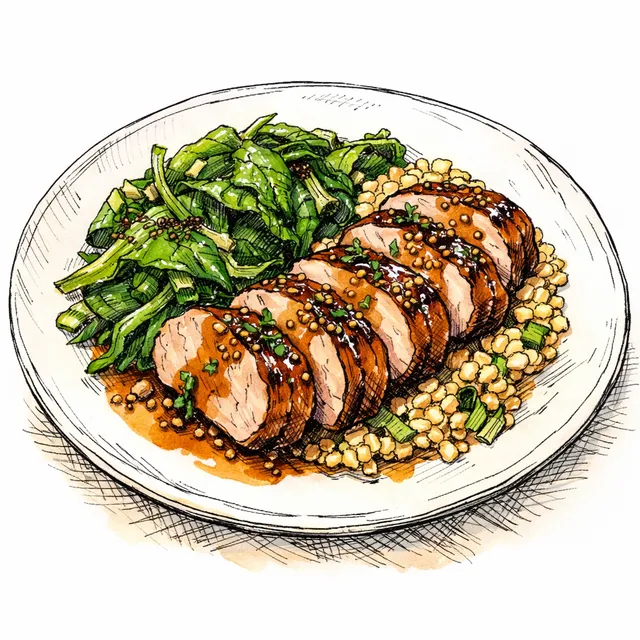
Pan-Roasted Pork Tenderloin with Sorghum-Mustard Glaze: A Sunday Supper Reimagined
Growing up in Atlanta, Sunday supper meant my grandmother's pork roast, cooked low and slow until it completely surrendered. I still dream about her signature pan sauce—a tangy, sticky reduction of sharp mustard, sweet syrup, and apple cider vinegar. While I revere those heritage flavors, I wanted to bring that memory into my own kitchen with a modern chef's touch. Instead of a heavy shoulder, I use a delicate pork tenderloin. I sear it hard in a trusty cast-iron skillet to lock in the juices, then finish it with a glaze of earthy sorghum and mustard. But here is my little secret: I sneak in a splash of fish sauce. That dash of coastal funk amplifies the savory notes without losing the Southern soul. It makes this dish incredibly special to me, bridging my childhood with my fine-dining training in Charleston. To make it your own, toss some fresh spring greens right into the skillet after the pork rests. They will wilt beautifully in the residual pan drippings. Grab a slice of cornbread to sop up the rest, and let the history in this dish speak for itself.
Featured Recipe
Pan-Roasted Pork Tenderloin with Sorghum-Mustard Glaze & Wilted Spring Greens
Growing up in Atlanta, Sunday supper often meant pork roasts that my grandmother cooked until they fully surrendered. While I revere her classic Southern flavor profile of mustard, sweet syrup, and apple cider vinegar, I've brought those memories into my own kitchen with a modern chef's touch. By pan-roasting a delicate pork tenderloin in cast iron and finishing it with a savory sorghum glaze spiked with a touch of fish sauce, we honor the past while keeping the meat incredibly juicy.
Save a copy to your collection for editing
Timeline
Ingredients
- 1 (1.5 lb) pork tenderloin(Silver skin removed, patted very dry)
- 1 tbsp kosher salt(For seasoning the pork)
- 1 tsp cracked black pepper(Freshly ground)
- 2 tbsp grapeseed oil(Or any neutral, high-heat oil for searing)
- 3 tbsp whole grain mustard(Provides a gorgeous rustic texture and sharp tang)
- 2 tbsp sorghum syrup(The deep, earthy sweetness of the South)
- 1 tbsp apple cider vinegar(For necessary acidity)
- 1 tsp fish sauce(My secret umami weapon)
- 1 tbsp unsalted butter(For basting)
- 2 cloves garlic(Smashed)
- 1 sprig fresh rosemary(To perfume the basting butter)
- 1 bunch mustard greens(Stems removed, leaves torn into bite-sized pieces)
- 1/4 cup chicken bone broth(For deglazing the pan)
Instructions
- 1
Preheat your oven to 400F. Pat 1 (1.5 lb) pork tenderloin completely dry with paper towels—moisture is the enemy of a good sear. Season it generously on all sides with 1 tbsp kosher salt and 1 tsp cracked black pepper. Let it sit at room temperature to take the chill off while the oven heats.
5 min
Tip: Tempering the meat ensures it cooks evenly from edge to center.
- 2
In a small mixing bowl, whisk together the Southern trinity of my kitchen: 3 tbsp whole grain mustard, 2 tbsp sorghum syrup, and 1 tbsp apple cider vinegar. Stir in 1 tsp fish sauce to add an invisible backbone of savory depth. Set this glaze aside.
3 min
Tip: Taste the glaze—it should be sharp, sweet, and deeply savory.
- 3
Heat a heavy 12-inch cast-iron skillet over medium-high heat until it begins to smoke slightly. Add 2 tbsp grapeseed oil and let it shimmer. Carefully lay the pork tenderloin into the pan, laying it away from you to prevent splattering. Sear undisturbed for about 2 minutes per side until deeply caramelized and crusty.
6 min
Tip: Don't fuss with the meat; let the cast iron do the heavy lifting to build that crust.
- 4
Reduce the stovetop heat to medium. Toss in 1 tbsp unsalted butter, 2 cloves garlic, smashed, and 1 sprig fresh rosemary. As the butter foams and turns nut-brown, tilt the skillet slightly toward you and use a spoon to continuously baste the pork with the aromatic butter for 1 minute.
2 min
Tip: Basting adds rich flavor and helps cook the meat gently with the hot fat.
- 5
Turn off the burner. Working quickly, use a pastry brush to slather the top and sides of the pork with exactly half of your prepared sorghum glaze. Transfer the entire skillet to the preheated oven. Pan-roast until a meat thermometer inserted into the thickest part reads 140F, which should take about 10 to 12 minutes.
12 min
Tip: Resist the urge to overcook it. Pork tenderloin is lean and best served with a blush of pink in the center.
- 6
While the pork is roasting, wash and thoroughly dry 1 bunch mustard greens. Tear the leaves into rough, bite-sized pieces and discard the tough center stems. Have your remaining glaze and broth staged near the stove.
5 min
Tip: Make sure the greens aren't holding too much water, or they will steam instead of wilt in the final step.
- 7
Carefully remove the hot skillet from the oven (remember that handle is blazing hot!). Transfer the pork tenderloin to a cutting board to rest. Do not wipe out the skillet.
1 min
Tip: Resting allows the juices to redistribute so they don't flood your cutting board when you slice.
- 8
Place the skillet back onto the stovetop over medium heat. Pour in 1/4 cup chicken bone broth, using a wooden spoon to scrape up all the beautiful browned fond from the bottom of the pan. Toss in the torn mustard greens and the remaining half of the sorghum glaze. Cook, tossing frequently, just until the greens are wilted and glossy, about 3 minutes.
3 min
Tip: We want the greens to retain a slight bite, not turn to mush.
- 9
Slice the rested pork tenderloin into thick, half-inch medallions. Arrange them on a platter over a bed of the wilted mustard greens, and spoon the remaining pan juices generously over the top of the meat.
2 min
Tip: Pour any juices that accumulated on the resting board right back over the sliced meat.
Chef's Notes
Don't be afraid of the fish sauce here. My fine dining days in Charleston taught me that a few drops of fermented anchovy can completely transform a Southern pan sauce, adding an umami depth that salt alone just can't reach. It amplifies the meaty flavor of the pork without tasting remotely like seafood. Trust the process, and trust the cast iron!

Marcus Stone
Heritage recipes with a chef's touch
My grandmother's kitchen in Atlanta is where I learned that food carries history. Every pot of collards, every batch of biscuits, every Sunday roast told stories of resilience, family, and love. I went on to train at the finest restaurants in Charleston and worked my way up through white-tablecloth kitchens. But I always came back to those family recipes—now I cook them with a chef's technique but a grandmother's heart. Because the best food honors where it came from.