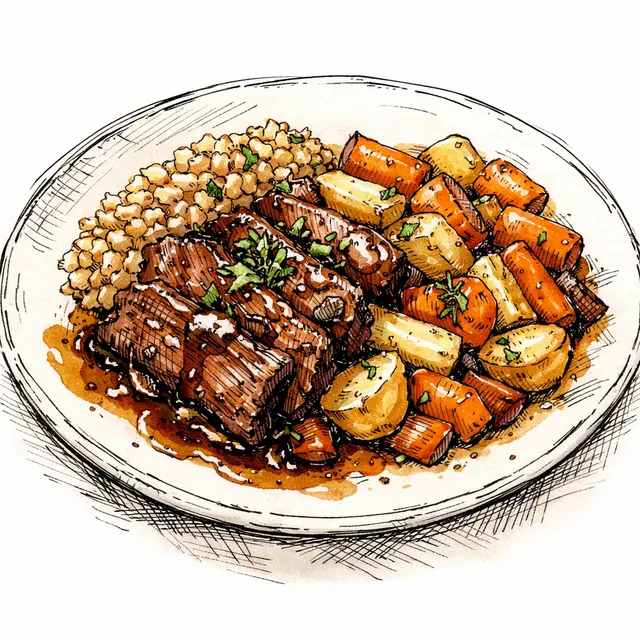
Slow-Braised Sorghum & Dark Ale Beef Brisket with Glazed Autumn Roots
There is a rhythm to Sunday suppers in my grandmother’s Atlanta kitchen that I’ve chased my entire culinary life. I can still see her standing over the stove, coaxing deep, soulful flavors out of the simplest ingredients. This brisket is my love letter to those memories, elevated with a few techniques I picked up along the way in Charleston. The inspiration came from wanting that classic, spoon-tender comfort, but with a complex backbone of flavor. We start with a heavy pour of dark ale and sticky sorghum syrup—that unmistakable Southern sweetness—then I drop in my secret weapon: a splash of fish sauce. Don't let that raise an eyebrow; it brings a savory depth of umami that ties the whole braise together. As the beef melts down, the autumn carrots and parsnips swim in that velvety pan jus, soaking up every drop of history and home. My biggest tip for making this your own? Don't rush the braise. Let it bubble low and slow, and always taste your pot before serving. Gather your people, pull up a chair, and let's eat.
Featured Recipe
Slow-Braised Sorghum & Dark Ale Beef Brisket with Glazed Autumn Roots
Slowly cooked until spoon-tender in a velvety braising liquid of dark ale, rich sorghum syrup, and a secret splash of fish sauce, this Sunday supper brisket is the definition of comfort. Sweet roasted carrots and earthy parsnips soak up every drop of the savory pan jus for a meal that begs for a crowd around the table.
Save a copy to your collection for editing
Timeline
Ingredients
- 3 1/2 lbs beef brisket (flat cut)(trimmed to leave a 1/4-inch fat cap)
- 1 1/2 tbsp kosher salt(divided)
- 1 tbsp coarsely ground black pepper(freshly cracked)
- 2 tbsp neutral cooking oil(or beef tallow)
- 2 large yellow onions(thickly sliced)
- 6 cloves garlic(peeled and lightly smashed)
- 2 tbsp tomato paste
- 12 oz dark ale or porter(1 standard bottle)
- 1/3 cup pure sorghum syrup(or dark cane syrup)
- 3 cups low-sodium beef bone broth
- 1 tbsp fish sauce(Marcus's secret umami boost)
- 2 tbsp apple cider vinegar
- 5 fresh thyme sprigs(tied with kitchen twine)
- 2 bay leaves(fresh or dried)
- 1 lb carrots(peeled and sliced into 2-inch pieces)
- 1 lb parsnips(peeled and sliced into 2-inch pieces)
- 3 tbsp fresh flat-leaf parsley(finely chopped for garnish)
Instructions
- 1
Preheat your oven to 300°F (150°C). Pat 3 1/2 lbs beef brisket thoroughly dry with paper towels. Season generously all over with 1 tbsp kosher salt and 1 tbsp coarsely ground black pepper, pressing the seasoning into the meat.
10 min
Tip: Getting the meat completely dry before searing ensures you develop a deep, mahogany crust rather than steaming the beef.
- 2
Heat 2 tbsp neutral cooking oil in a large heavy-bottomed Dutch oven over medium-high heat until shimmering. Carefully lay in 3 1/2 lbs beef brisket fat-side down and sear without moving for 7 to 8 minutes until deeply browned. Flip and sear the lean side for another 5 to 6 minutes, then transfer the brisket to a platter.
14 min
Tip: Don't rush the sear—that dark fond at the bottom of the pot is the flavor backbone of your entire braise.
- 3
Reduce the heat to medium. Add 2 large yellow onions and the remaining 1/2 tbsp kosher salt to the rendered drippings. Sauté for 6 minutes until soft and caramelized at the edges. Stir in 6 cloves garlic and 2 tbsp tomato paste, cooking for 2 minutes while stirring constantly until the paste turns a deep brick-red.
8 min
Tip: Frying the tomato paste cooks out the raw metallic tang and concentrates its natural sweetness.
- 4
Pour in 12 oz dark ale or porter, scraping up every bit of browned bits from the bottom of the Dutch oven. Bring to a simmer and let it reduce by half, about 4 minutes. Whisk in 1/3 cup pure sorghum syrup, 3 cups low-sodium beef bone broth, 1 tbsp fish sauce, and 2 tbsp apple cider vinegar.
6 min
Tip: The sorghum gives an earthy, malted sweetness that balances the roasty bitterness of the porter, while the fish sauce adds an incredible savory depth without tasting fishy at all.
- 5
Nestle 3 1/2 lbs beef brisket back into the Dutch oven fat-side up along with any accumulated resting juices. Tuck in 5 fresh thyme sprigs and 2 bay leaves. Bring the liquid to a gentle simmer, cover tightly with a heavy lid (or a layer of foil then the lid), and slide into the 300°F oven to braise undisturbed.
130 min
Tip: A tight seal keeps the moisture locked in, ensuring the brisket gently braises without drying out.
- 6
While the beef continues its slow braise, prep the root vegetables: peel and cut 1 lb carrots and 1 lb parsnips into uniform 2-inch chunks.
15 min
Tip: Keeping the root chunks large prevents them from turning to mush during their time in the braising pot.
- 7
Carefully remove the Dutch oven from the oven. Uncover and scatter 1 lb carrots and 1 lb parsnips around the sides of the brisket, pressing them gently into the bubbling braising liquid. Cover tightly and return to the oven for 50 minutes, or until both the brisket and vegetables are completely tender when pierced with a fork.
50 min
Tip: A cake tester or meat fork should slip through the thickest part of the flat with almost zero resistance.
- 8
Transfer the brisket and root vegetables carefully to a warm serving platter and tent loosely with foil to rest. Discard 5 fresh thyme sprigs and 2 bay leaves. Skim any excess rendered fat off the surface of the sauce, then place the Dutch oven over medium heat on the stovetop. Simmer the pan jus for 8 to 10 minutes until glossy and slightly reduced.
12 min
Tip: Letting the brisket rest for at least 15 minutes before carving keeps every precious drop of juice inside the meat.
- 9
Slice the rested brisket against the grain into 1/4-inch thick slices. Arrange the meat surrounded by the tender glazed carrots and parsnips, ladle warm sorghum-ale jus over everything, and scatter with 3 tbsp fresh flat-leaf parsley before serving.
5 min
Tip: Always look closely at the direction of the grain before slicing; cutting perpendicular to the grain ensures every mouthful is melt-in-your-mouth tender.
Chef's Notes
Down in Atlanta, Sunday supper was an unhurried affair. My grandmother taught me that you can't rush connective tissue—you've got to give tough cuts the patience and respect they deserve. In Charleston, I learned how dark beer and a touch of fish sauce can transform a traditional braising pot into pure restaurant-level magic. Sorghum syrup is my Southern heirloom secret here: it brings a rustic, bittersweet depth that brown sugar just can't duplicate. Serve this with a warm skillet of buttermilk cornbread to sop up that unforgettable jus.

Marcus Stone
Heritage recipes with a chef's touch
My grandmother's kitchen in Atlanta is where I learned that food carries history. Every pot of collards, every batch of biscuits, every Sunday roast told stories of resilience, family, and love. I went on to train at the finest restaurants in Charleston and worked my way up through white-tablecloth kitchens. But I always came back to those family recipes—now I cook them with a chef's technique but a grandmother's heart. Because the best food honors where it came from.