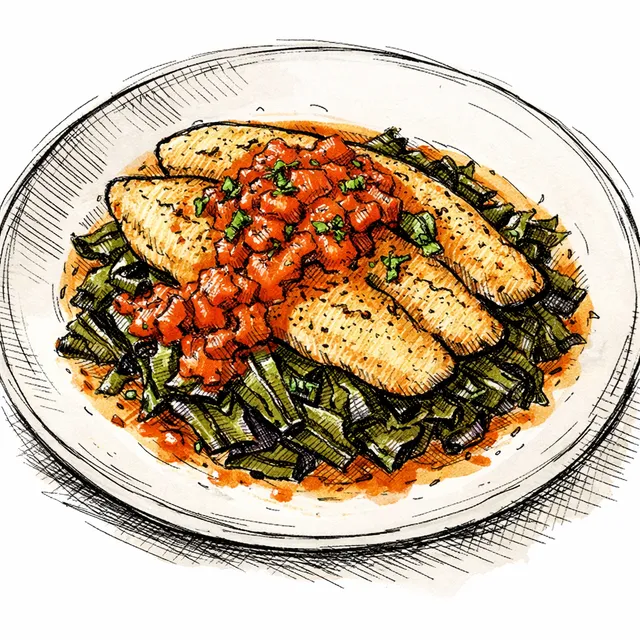
Slow-Roasted Heritage Catfish with Fish-Sauce-Braised Collards and Roasted Tomato Gravy
Growing up in my grandmother's Atlanta kitchen, catfish and collards were a sacred Sunday ritual. Back then, the fish was always fried crisp and the greens simmered for hours with smoked pork. I still love that classic plate more than words can say, but working the line in Charleston taught me how to look at tradition through a slightly different lens. That is where the inspiration for this dish was born. One afternoon, testing ways to treat catfish with the same delicate care as a fine piece of salmon, I tried slow-roasting it at a gentle three hundred degrees. The result blew my mind—it rendered the fish impossibly tender, silky, and rich without losing a single drop of moisture. To honor my roots while playing with depth of flavor, I braised my collards with a secret weapon: a splash of umami-rich fish sauce that elevates the greens to something legendary, paired with a sweet roasted Vidalia-tomato gravy. Making it your own is all about the balance. If you cannot find Vidalias, any sweet onion will sing. This dish is Southern comfort at its absolute finest, carrying every bit of my history right to your table.
Featured Recipe
Slow-Roasted Heritage Catfish Fillets with Fish-Sauce-Braised Collards & Roasted Tomato Gravy
Slow-roasting catfish low and slow at 300°F renders it impossibly tender, silky, and rich without losing a drop of moisture. Paired with collard greens elevated by my signature splash of fish sauce and a sweet roasted Vidalia-tomato gravy, this dish is Southern comfort at its finest.
Save a copy to your collection for editing
Timeline
Ingredients
- 4 Catfish fillets(about 6 oz each, pat dry)
- 1.5 lbs Collard greens(stems removed, leaves chopped into 2-inch ribbons)
- 1 Smoked turkey leg(about 8 oz, for rich depth in the pot likker)
- 1 large Yellow onion(finely diced)
- 1 medium Vidalia sweet onion(halved and thinly sliced)
- 1 lb Plum tomatoes(halved lengthwise)
- 6 cloves Garlic(minced)
- 1.5 tbsp Fish sauce(my secret ingredient for ultimate pot likker umami)
- 4 cups Low-sodium chicken broth
- 2 tbsp Apple cider vinegar
- 4 tbsp Unsalted butter(melted and divided)
- 3 tbsp Olive oil(divided)
- 1.5 tbsp Cajun or Creole seasoning blend
- 1 tsp Smoked paprika
- 0.5 tsp Red pepper flakes
- 1.5 tsp Kosher salt(divided)
- 0.5 tsp Freshly cracked black pepper
- 1 tbsp olive oil(for sautéing onion and garlic)
- 1 tbsp olive oil(for tossing tomatoes and onions)
- 0.5 tsp kosher salt(for tomatoes and onions)
- 0.5 tsp kosher salt(for the gravy)
- 2 cloves garlic(for the gravy)
- 1 tbsp olive oil(for rubbing catfish fillets)
- 2 tbsp unsalted butter(for rubbing catfish fillets)
Instructions
- 1
In a heavy Dutch oven, heat 1 tbsp olive oil over medium heat. Add 1 large yellow onion, finely diced and 4 cloves garlic, minced. Sauté for 5 minutes until soft and translucent.
5 min
Tip: Don't rush the onions; letting them sweeten sets the base for a rich pot likker.
- 2
Add 1.5 lbs collard greens, 1 smoked turkey leg, 4 cups low-sodium chicken broth, 2 tbsp apple cider vinegar, 1.5 tbsp fish sauce, 0.5 tsp red pepper flakes, and 0.5 tsp kosher salt to the Dutch oven. Bring to a boil, then reduce heat to low, cover tightly, and simmer for 40 minutes until greens are tender.
40 min
Tip: That splash of fish sauce enhances the natural glutamate in the collards and turkey without making it taste fishy at all.
- 3
Preheat your oven to 300°F. On a rimmed baking sheet, toss 1 lb plum tomatoes, halved, 1 medium Vidalia sweet onion, sliced, 1 tbsp olive oil, 1 tsp smoked paprika, 0.5 tsp kosher salt, and 0.5 tsp freshly cracked black pepper. Arrange tomatoes cut-side up.
10 min
Tip: Slow roasting at 300°F concentrates the natural sugars in both the tomatoes and Vidalia onions.
- 4
Place the baking sheet with tomatoes and onions in the preheated 300°F oven and roast for 25 minutes.
25 min
Tip: Keep an eye on the onions near the edges so they caramelize without scorching.
- 5
Pat 4 catfish fillets dry with paper towels. Rub each fillet with 1 tbsp olive oil, 2 tbsp unsalted butter, melted, and 1.5 tbsp Cajun or Creole seasoning blend. Place fillets on a parchment-lined baking dish.
5 min
Tip: Patting the fish dry allows the butter and spiced rub to adhere properly.
- 6
Place the catfish in the 300°F oven alongside the roasting tomatoes. Slow-roast for 18 to 20 minutes, until the catfish flakes gently with a fork and reaches an internal temperature of 145°F.
20 min
Tip: Slow roasting catfish preserves moisture far better than high-heat baking, yielding a velvety, succulent texture.
- 7
Transfer roasted tomatoes and onions into a skillet or blender. Add remaining 2 tbsp unsalted butter, 2 cloves garlic, minced, and 0.5 tsp kosher salt. Pulse or mash coarsely into a warm gravy.
5 min
Tip: Keep it a bit rustic; small chunks of roasted tomato give great texture on top of the fish.
- 8
Remove smoked turkey leg from collards, shred any tender meat, and stir back into greens. Divide braised collards onto four plates, lay a slow-roasted catfish fillet over each bed of greens, and spoon warm roasted tomato gravy over the fish. Serve immediately.
5 min
Tip: Make sure to spoon a bit of that gold-standard pot likker over the whole dish!
Chef's Notes
Growing up in Atlanta, catfish was almost always dipped in cornmeal and quick-fried in a searing iron skillet. But when I was training in Charleston, I discovered how magical slow-roasting fish low and slow can be. At 300°F, catfish doesn't dry out—it becomes buttery, sweet, and deeply infused with warm spices. Pairing it with collards enriched with a quick splash of fish sauce (my favorite secret weapon) brings out a level of savory depth that honors heritage while giving it a refined touch.

Marcus Stone
Heritage recipes with a chef's touch
My grandmother's kitchen in Atlanta is where I learned that food carries history. Every pot of collards, every batch of biscuits, every Sunday roast told stories of resilience, family, and love. I went on to train at the finest restaurants in Charleston and worked my way up through white-tablecloth kitchens. But I always came back to those family recipes—now I cook them with a chef's technique but a grandmother's heart. Because the best food honors where it came from.