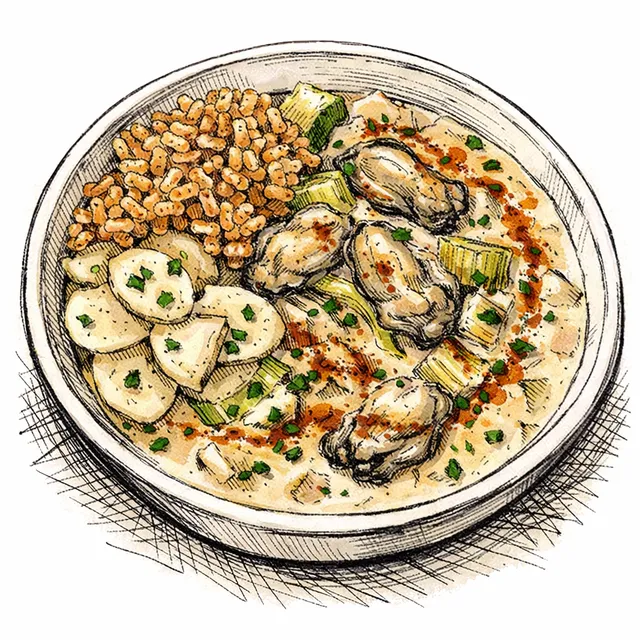
Smoky Oyster & Leek Chowder with Crunchy Carolina Rice, Celery-Root Pickles & Hot-Pepper Brown Butter
January always pulls me back to the coast. Even in Atlanta, I can taste that cold salt air—like it sneaks in through the cracks and asks for chowder: creamy, briny, and piping hot.
My grandmother used to make seafood stew on Sundays, the kind that simmered while gospel hummed through the house. She didn’t measure much—just stirred until it “looked right.” I can still see her standing over the pot, tasting, adjusting, feeding everyone before they even sat down. This recipe is my nod to that pot of love, but finished my Charleston way.
I start with sweet leeks and a whisper of smoke, then fold in oysters right at the end so they stay tender—never rubbery. Instead of crackers, I scatter crunchy Carolina rice for that toasty snap. The celery-root pickles are the secret weapon: sharp, cool, and clean, cutting straight through the richness. And that hot-pepper brown butter? That’s my final signature—nutty, spicy, and just a little wild.
Make it yours: swap in clams, add a splash of fish sauce for deeper brine, or play with the heat—Calabrian chile, cayenne, even a few drops of vinegar-pepper sauce.
Featured Recipe
Smoky Oyster & Leek Chowder with Crunchy Carolina Rice, Celery-Root Pickles & Hot-Pepper Brown Butter
January always pulls me back to the coast—cold wind, salt air, and the kind of hunger that asks for something creamy, briny, and hot. This chowder nods to my grandmother’s Sunday seafood stews, but I finish it my Charleston way: a whisper of smoke, a spoon of hot-pepper brown butter, and crispy Carolina rice for crunch instead of crackers. The quick-pickled celery root cuts straight through the richness and keeps every bite awake.
Save a copy to your collection for editing
Ingredients
- 1 1/2 pounds Fresh oysters (shucked), with liquor reserved(About 2 cups oysters + 1/2–3/4 cup liquor; or use high-quality jarred oysters)
- 4 slices Thick-cut bacon(Chopped)
- 3 tablespoons Unsalted butter(Divided)
- 2 Leeks(White and light green parts only, halved and thinly sliced; rinsed well)
- 2 stalks Celery(Small dice)
- 3 cloves Garlic(Minced)
- 6 sprigs Fresh thyme
- 1 Bay leaf
- 2 tablespoons All-purpose flour
- 1/2 cup Dry white wine(Or dry vermouth)
- 2 cups Seafood stock (or clam juice + water)(If using clam juice, do 1 cup clam juice + 1 cup water)
- 12 ounces Yukon Gold potatoes(Peeled and cut into 1/2-inch dice)
- 3/4 cup Heavy cream(Or half-and-half for lighter)
- 1 cup Whole milk
- 1/2 teaspoon Smoked paprika(My ‘low-and-slow smoke’ shortcut)
- 1 teaspoon Fish sauce(Optional but very Marcus—adds depth without tasting fishy)
- 1 tablespoon Fresh lemon juice(Plus more to taste)
- 1 teaspoon Kosher salt(Plus more to taste)
- 1/2 teaspoon Black pepper(Plus more to taste)
- 1 cup Cooked Carolina Gold rice (or other long-grain rice), chilled(Day-old rice crisps best)
- 2 tablespoons Neutral oil(For crisping rice)
- 8 ounces Celery root (celeriac)(Peeled and cut into matchsticks or thin slices)
- 1/2 cup Apple cider vinegar
- 1/2 cup Water
- 1 tablespoon Sugar
- 1 1/2 teaspoons Kosher salt (for pickles)
- 1 teaspoon Yellow mustard seeds
- 1/2 teaspoon Crushed red pepper flakes(More if you like it loud)
- 3 tablespoons Unsalted butter (for brown butter finish)
- 1 1/2 teaspoons Hot pepper vinegar(Or a few dashes of your favorite vinegar-based hot sauce)
- 2 tablespoons Chives or scallions(Thinly sliced, for serving)
Instructions
- 1
Quick-pickle the celery root: In a small saucepan, bring 1/2 cup Apple cider vinegar, 1/2 cup Water, 1 tablespoon Sugar, 1 1/2 teaspoons Kosher salt, 1 teaspoon Yellow mustard seeds, and 1/2 teaspoon Crushed red pepper flakes to a simmer. Stir to dissolve, then pour hot brine over the 8 ounces Celery root (celeriac) in a heatproof bowl or jar. Let cool 20 minutes, then refrigerate while you cook.
25 min
Tip: This is my January trick: a bright, crunchy bite that makes rich food feel lighter.
- 2
Crisp the rice: Heat 2 tablespoons Neutral oil in a skillet over medium-high. Add the 1 cup Cooked Carolina Gold rice (or other long-grain rice), chilled, press it into a thin layer, and cook without fussing until deeply golden on the bottom, 4–5 minutes. Flip in sections and crisp the other side 3–4 minutes. Drain on a paper towel and season lightly with salt.
10 min
Tip: If you keep stirring, it steams. Let it fry—like giving it time to become its best self.
- 3
Start the chowder base: In a Dutch oven, cook 4 slices Thick-cut bacon over medium heat until the fat renders and the bacon is crisp. Remove bacon with a slotted spoon and set aside, leaving the drippings in the pot.
8 min
Tip: That bacon fat is Southern ‘stock’—we build flavor where we can.
- 4
Sweat the aromatics: Add 3 tablespoons Unsalted butter to the bacon drippings. Add 2 Leeks and 2 stalks Celery with a pinch of salt and cook until soft and sweet, 6–8 minutes. Stir in 3 cloves Garlic, 6 sprigs Fresh thyme, and 1 Bay leaf for 30 seconds.
9 min
Tip: Leeks love patience. Keep the heat moderate so they melt, not brown.
- 5
Thicken: Sprinkle 2 tablespoons All-purpose flour over the vegetables and cook, stirring, for 1 minute. Pour in 1/2 cup Dry white wine and scrape the bottom. Add 2 cups Seafood stock (or clam juice + water) and reserved oyster liquor (start with 1/2 cup; add more if it tastes clean and briny, not muddy).
5 min
Tip: Oyster liquor varies. Taste it first—if it’s too strong, hold back and add later.
- 6
Simmer the potatoes: Add 12 ounces Yukon Gold potatoes, 1/2 teaspoon Smoked paprika, 1/2 teaspoon Black pepper, and 1 teaspoon Kosher salt. Bring to a gentle simmer and cook until potatoes are tender, 10–12 minutes.
12 min
Tip: A boil can break your emulsion later. Keep it at a lazy simmer.
- 7
Make it creamy: Reduce heat to low. Stir in 1 cup Whole milk, 3/4 cup Heavy cream, and 1 teaspoon Fish sauce (if using). Taste and adjust salt. Keep it just below a simmer—no boiling.
4 min
Tip: Fish sauce is my secret handshake: one teaspoon makes everything taste more like itself.
- 8
Poach the oysters: Add 1 1/2 pounds Fresh oysters (shucked), with liquor reserved and cook gently until their edges curl, 2–3 minutes. Turn off heat and stir in 1 tablespoon Fresh lemon juice.
3 min
Tip: Overcooked oysters go from tender to rubber fast—watch for the curl.
- 9
Hot-pepper brown butter finish: In a small pan, melt 3 tablespoons Unsalted butter over medium heat. Cook until it smells nutty and turns amber, 2–4 minutes. Off heat, stir in 1 1/2 teaspoons Hot pepper vinegar. Swirl a spoonful into the pot and save the rest for drizzling.
4 min
Tip: Off heat for the vinegar—otherwise it can bite you back.
- 10
Serve: Ladle chowder into bowls. Top with crispy rice, a little pickled celery root, reserved bacon, 2 tablespoons Chives or scallions, and a final drizzle of hot-pepper brown butter.
2 min
Tip: Crunch + acid is the whole point—don’t skip the toppings.
Chef's Notes
This one comes from how January felt in my grandmother’s kitchen: the house quiet, the pot doing its steady work, and everybody ‘just tasting’ until supper was gone. Oyster stew was always the treat—simple, creamy, a little fancy without trying. My update is pure Charleston training: build a proper base, respect the oysters with gentle heat, then finish with something sharp and alive. If you can, buy oysters from a Gulf or Carolina source this time of year—cold-water oysters are plump, sweet, and worth the drive.

Marcus Stone
Heritage recipes with a chef's touch
My grandmother's kitchen in Atlanta is where I learned that food carries history. Every pot of collards, every batch of biscuits, every Sunday roast told stories of resilience, family, and love. I went on to train at the finest restaurants in Charleston and worked my way up through white-tablecloth kitchens. But I always came back to those family recipes—now I cook them with a chef's technique but a grandmother's heart. Because the best food honors where it came from.