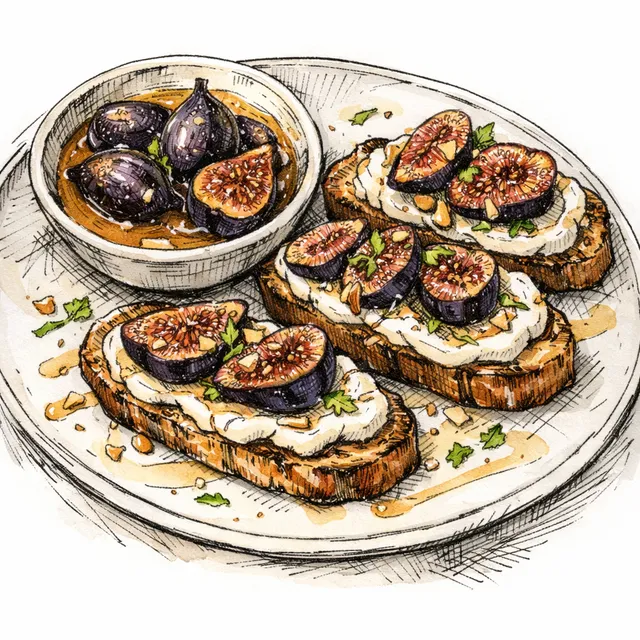
Chablis & Honey-Poached Mission Figs with Whipped Fromage Blanc Tartines
Picture a sunlit Parisian morning crashing right into the Santa Monica farmers market. That is the exact vibe of these tartines. I was chatting with Mateo, who grows the most incredible Black Mission figs, and he handed me a basket so warm from the California sun I knew they had to meet some French technique immediately. Back in Paris, we would have heavy cream and endless ceremony. Here? We are keeping it breezy. I gently poach those sweet figs in a crisp Chablis, wild honey, and a splash of bright Meyer lemon until they are glossy and begging to be eaten. Then, we slather thick toasted levain with whipped fromage blanc—light, tangy, and impossibly creamy. My biggest tip? Do not rush the poaching liquid reduction; let it get syrupy so you can drizzle every last drop over the top. Pair this with a chilled glass of natural orange wine on your patio, and tell me you are not in heaven. Cooking should always feel this effortless, darlings.
Featured Recipe
Chablis & Honey-Poached Mission Figs with Whipped Fromage Blanc Tartines
A sunlit Parisian morning meets the Santa Monica farmers market in this effortless bistro breakfast. Ripe Black Mission figs are gently poached in crisp white wine, wildflower honey, and Meyer lemon until tender and glossy, then piled high over cloud-like whipped fromage blanc and golden, butter-toasted levain.
Save a copy to your collection for editing
Timeline
Ingredients
- 1 lb fresh Black Mission figs(about 12 to 14 firm-ripe figs, stems trimmed)
- 0.5 cup dry white wine(crisp Chablis or California Sauvignon Blanc)
- 0.25 cup water
- 0.33 cup wildflower honey(divided; 1/4 cup for poaching, remainder for fromage blanc)
- 1 Meyer lemon(peeled in wide strips, then juiced to yield 2 tbsp juice)
- 4 sprigs fresh lemon thyme(plus extra tiny leaves for garnish)
- 1 fresh California bay leaf(or standard dried bay leaf)
- 0.25 tsp whole black peppercorns(lightly crushed)
- 1 cup fromage blanc(or whole-milk ricotta blended until smooth)
- 0.25 cup crème fraîche
- 0.5 tsp orange blossom water
- 0.5 tsp flaky sea salt(divided, such as Maldon)
- 4 slices crusty country levain bread(cut thick, about 3/4-inch)
- 2 tbsp unsalted European-style butter(high fat content, like Normandy cultured butter)
- 3 tbsp toasted hazelnuts(roughly cracked)
- few fresh thyme leaves(Mentioned in step 7, but not listed.)
Instructions
- 1
Using a sharp paring knife, gently score a tiny 'X' on the blossom base of 1 lb fresh Black Mission figs so they drink up the aromatics without bursting. Using a vegetable peeler, take wide ribbons of zest from 1 Meyer lemon, then halve and squeeze to collect 2 tbsp fresh Meyer lemon juice.
4 min
Tip: Scoring the base keeps the fig skins intact while letting that fragrant poaching liquor penetrate right to the jammy core.
- 2
In a shallow 10-inch skillet or saucier, combine 0.5 cup dry white wine, 0.25 cup water, 0.25 cup wildflower honey, 2 tbsp fresh Meyer lemon juice, the wide lemon peels, 4 sprigs fresh lemon thyme, 1 fresh California bay leaf, and 0.25 tsp whole black peppercorns. Bring to a gentle simmer over medium heat for 3 minutes until fragrant and the honey has fully dissolved.
3 min
Tip: Keep the heat moderate; you want to awaken the herbs and citrus oils before introducing the delicate fruit.
- 3
Turn heat down to low so the surface is merely quivering with tiny, lazy bubbles—true poaching temperature, around 165°F. Stand 1 lb fresh Black Mission figs upright in the skillet. Spoon the warm aromatic broth over their shoulders continuously, poaching gently for 8 minutes until the fruit is warm, plump, and yielding to the touch. Carefully transfer the figs with a slotted spoon to a shallow dish.
8 min
Tip: Never let this boil, or the skins will slip right off. Gentle poaching preserves their gorgeous teardrop shape.
- 4
While the figs bathe, place 1 cup fromage blanc, 0.25 cup crème fraîche, the remaining 1.33 tbsp wildflower honey, 0.5 tsp orange blossom water, and 0.25 tsp flaky sea salt into a bowl. Whisk vigorously for 2 minutes until glossy, airy, and billowy. Set aside at cool room temperature.
4 min
Tip: The combination of tangy fromage blanc and velvety crème fraîche keeps the tartines bright rather than cloying.
- 5
Fish out the bay leaf, lemon peel, and thyme sprigs from the poaching pan. Increase heat to medium-high and simmer the remaining liquid for 5 minutes, swirling occasionally, until reduced by half into a glossy, jewel-toned, slow-bubbling fig syrup.
5 min
Tip: Watch closely near the end so the honey sugars do not scorch; it should coat the back of a spoon lightly.
- 6
Simultaneously, heat a large cast-iron skillet over medium heat and melt 2 tbsp unsalted European-style butter. Add 4 slices crusty country levain bread and toast for 2 to 3 minutes per side until golden-brown, buttery, and crackling crisp on the edges while remaining tender in the center.
5 min
Tip: A good cultured butter provides that irresistible bistro crunch that anchors the floral fruit.
- 7
Place a warm slice of toasted levain onto each plate. Generously billow the whipped fromage blanc across the toast. Halve or quarter the warm poached figs and arrange them over the dairy. Spoon the warm reduced honey-wine syrup over the figs, then scatter with 3 tbsp toasted hazelnuts, fresh thyme leaves, and the remaining 0.25 tsp flaky sea salt. Serve straight away.
3 min
Tip: Serve immediately while the contrast between warm, buttery toast, cool tart cheese, and warm poached fruit is at its peak.
Chef's Notes
Poaching fruit is one of those classic French bistro rituals that feels decadent yet takes almost no effort. Black Mission figs love the floral acidity of California citrus and a dry Chablis or Sauvignon Blanc. If you cannot track down fromage blanc at your local creamery, whole-milk ricotta whipped in a food processor with a squeeze of fresh lemon and crème fraîche makes a glorious, silky stand-in. Pair with a hot café au lait or a chilled glass of pét-nat.

Marguerite Lavigne
French soul, California sun
I grew up in a small village outside Lyon, where my grandmother taught me that the best meals come from respecting your ingredients. After training at Le Cordon Bleu and spending years in Parisian kitchens, I moved to San Francisco and fell in love with California's farmers markets and wine country. Now I cook the food I wish my grandmother could taste—French technique with California abundance, where a perfect roast chicken might come with Meyer lemon and wild fennel instead of tarragon.